
Campfire Circle Solar Weather Update — February 2, 2026
Join the Campfire Circle
Global Meditation • Planetary Field Activation
Enter the Global Meditation PortalCampfire Circle Solar Weather Update
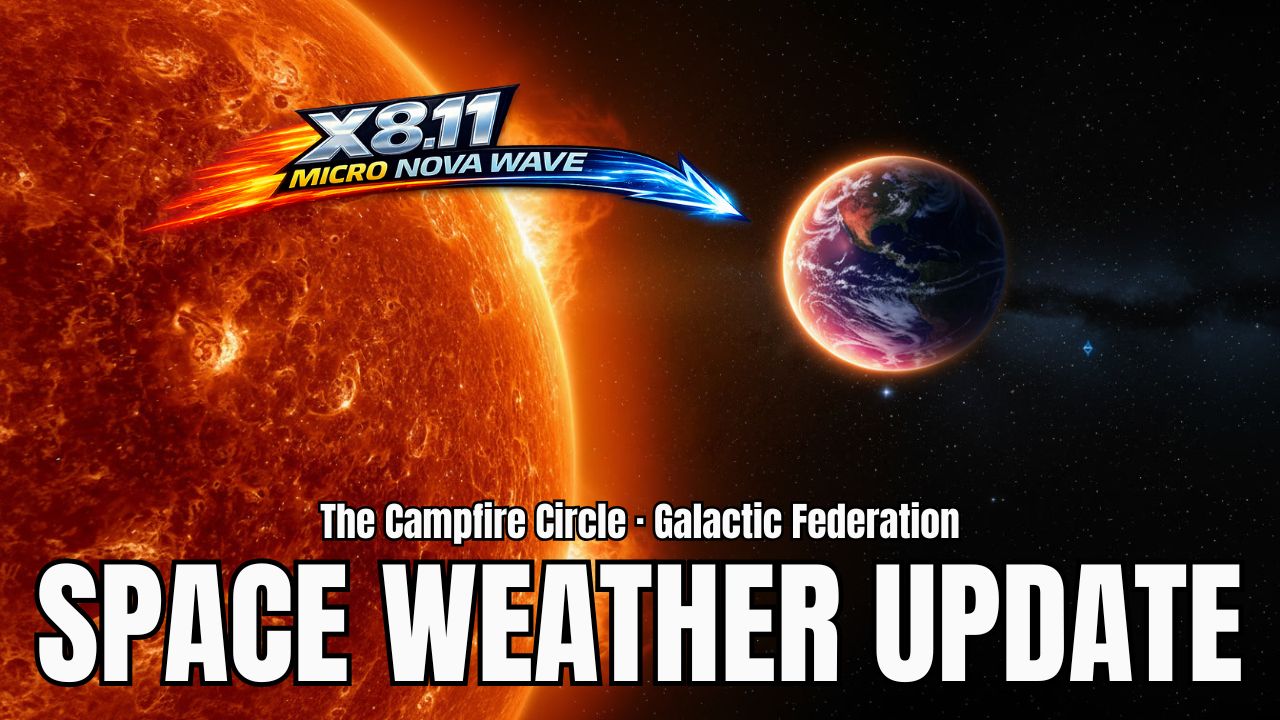
February 2, 2026 — X8.11 Solar Flare Threshold Brief
Looking for ascension-aware space weather? Here’s the latest on the current X-class flare sequence, Solar Flash priming, and what this means for the coming window.
Solar Headlines: X8.11 Flare And Active Region Status
- Event: X8.11-class solar flare
- Type: Strong, mini–micronova-style eruption
- Source: Complex, highly active region on the Sun
- Pattern: Part of a back-to-back flare sequence, not a single spike
- Status: Light impact has occurred; plasma/geomagnetic impact is still evolving
This X8.11 flare marks one of the stronger eruptions of the current solar cycle and continues a pattern of repeated high-energy events from the same region. The system is demonstrating high capability and ongoing instability, which is why this window is being treated as a threshold rather than a routine fluctuation.
Current Situation: Threshold Window, Not One-Off Spike
The key story is sequence and geometry:
- The active region has already produced multiple strong flares in a short span.
- It is moving into a more Earth-facing position, increasing the probability that any further eruptions could interact more directly with Earth’s field.
- This creates a threshold window—a period where conditions are primed for meaningful interaction, even though no single outcome is guaranteed.
Think of it as the difference between one loud knock on the door and a series of sustained knocks. One can be ignored. A sequence demands attention and a decision about how to respond.
This window is being watched closely because the system is changing quickly. Rapid change is the hallmark of threshold phases: there is less time for gradual adjustment, and more need for presence, clarity and practical readiness.
Light Flash Versus Plasma Package: Two Different Impacts
For this and all major events, it is essential to distinguish between:
1. The Light Component (Fast)
- Travels at near light-speed and has already reached the near-Earth environment.
- Interacts primarily with the upper atmosphere and radiation environment.
- Correlates with:
- Short-term radio blackouts on the sunlit side
- Changes in high-frequency communication quality
- Heightened energetic sensitivity in many bodies
2. The Plasma Component (Slower, Geometry-Dependent)
- Carries the mass and magnetic structure of the eruption (CME/plasma cloud).
- Takes longer to reach Earth and may miss Earth entirely depending on direction.
- The severity of any geomagnetic storm depends on:
- Direction: Earth-directed vs glancing blow
- Speed and density: How hard and how fast it hits
- Magnetic orientation: Whether the solar magnetic field “locks in” with Earth’s field or slides past it
A strong flare does not automatically mean a strong geomagnetic storm. Capability and possibility are high in this window, but alignment is everything.
Risk Assessment: From Micronova Waves To Solar Flash Scenarios
Within the current spiritual and ascension community, this X8.11 sequence is being viewed as part of a broader “micro-nova layers” / Solar Flash training pattern:
- Large solar expressions tend to build in layers, with repeated waves warming and testing the system.
- Repeated high-end flares reveal the upper range of what this region can express.
- They also act as training waves, helping bodies and fields learn to hold stronger current.
From a grounded risk lens:
- The X8.11 flare confirms that very strong events are on the table this cycle.
- A Carrington-scale, deeply Earth-coupled event still requires rare alignment of multiple factors (direction, speed, density, magnetic orientation).
- At present, we can say:
- The system is primed.
- The probability of moderate geomagnetic disturbances in this window is elevated.
- The probability of an extreme, historic-level event remains low but non-zero, as with any high-activity phase.
This is best approached as serious space weather, not guaranteed catastrophe.
FURTHER READING — THE COMPLETE GUIDE TO THE SOLAR FLASH EVENT & ASCENSION CORRIDOR
• The Solar Flash Explained: The Complete Foundational Guide
This complete pillar page brings together everything you could want to know about the Solar Flash in one place — what it is, how it is understood within ascension teachings, how it relates to Earth’s energetic transition, timeline shifts, DNA activation, consciousness expansion, and the larger corridor of planetary transformation now unfolding. If you want the full Solar Flash picture rather than fragments, this is the page to read.
Field And Body Indicators: What People May Notice
Because we’ve already passed through multiple strong flares in quick succession, the Earth field is energetically preloaded. Even if the plasma impact is moderate, many may notice:
- Sleep pattern shifts: early-morning wakeups, vivid dreams, restless or unusually light sleep.
- Emotional amplification: feelings cresting faster, resilience feeling thinner, old grievances surfacing.
- Sensory sensitivity: screens, social feeds, crowded or noisy spaces feeling harsher than usual.
- Subtle body cues: head pressure, buzzing, heat/cold waves, heart-field flutters in otherwise healthy individuals.
These are common in charged windows and reflect increased responsiveness of the system, not automatic proof that a major disruptive event is imminent.
Practical Readiness: Calm, Clear, And Competent
For this X8.11 threshold window, here are some grounded, practical readiness steps:
1. Basic Infrastructure Awareness
- Keep phones, power banks, and key devices topped up.
- Know where your flashlights, batteries, and simple backup light sources are.
- Maintain a small buffer of water and staple foods you use regularly.
- Treat this as you would treat a forecast of strong storms: wise, modest preparation.
2. Information Hygiene
- Choose one or two trusted space-weather dashboards or services and check them at set intervals, rather than engaging in continuous monitoring.
- Avoid feeds whose primary output is fear escalation. The goal is signal, not adrenaline.
3. Nervous System Management
Even in a news-only frame, the human component matters. During high-activity windows:
- Support electrical balance with hydration and minerals (good salt, mineral-rich foods, simple electrolytes).
- Use deliberately slower exhales a few times per day to help keep the nervous system out of chronic fight-or-flight.
- Include light movement or walking to help the body distribute charge.
4. Community And Communication
- Quietly check in on more sensitive friends or family who may be tracking these events closely.
- Be prepared to offer calm, factual reassurance if headlines spike.
- Keep your own language clear: capability ≠ inevitability; threshold ≠ guaranteed disaster.
Next 72 Hours: What To Watch
Over the next several days, the key watchpoints are:
- Further eruptions from the same active region as it continues its transit across the Earth-facing side.
- CME analysis: confirmations of whether any plasma clouds from this and follow-up flares are:
- Earth-directed
- Glancing
- Mostly off-angle
- Official geomagnetic forecasts (e.g., G1–G5 storm levels) based on updated CME tracking.
- Auroral potential: strong but not extreme storms can still deliver significant aurora at lower latitudes.
Until those data points settle, this X8.11 flare should be treated as:
- A major demonstration of current solar capability.
- A live training window for both infrastructure and human systems.
- A call for measured attention and competent calm, not panic.
Closing Update Reflection
The Sun has raised its voice again, clearly and powerfully. For now, the most accurate position is straightforward:
Conditions are significant, the window is live, alignment will decide impact.
Stay informed, stay practical, keep your systems tidy—and let the data, not fear, set the tone of your response.
THE FAMILY OF LIGHT CALLS ALL SOULS TO GATHER:
Join The Campfire Circle Global Mass Meditation
CREDITS
📡 Transmission Type: Cosmic Solar Weather Update
📅 Message Date: February 2, 2026
🎯 Source: Galactic Federation of Light Solar Transmissions (T’eeah)
📸 Header Imagery: Leonardo.ai
FOUNDATIONAL CONTENT
This transmission is part of a larger living body of work exploring the Galactic Federation of Light, Earth’s ascension, and humanity’s return to conscious participation.
→ Read the Galactic Federation of Light Pillar Page
→ Solar Flash 101: The Complete Solar Flash Guide
Further Reading – Med Bed Master Overview:
→ Med Beds: A Living Overview of Med Bed Technology, Rollout Signals and Readiness