

QUANTUM FINANCIAL SYSTEM
The Most Complete QFS Resource Online:
Meaning, Mechanics, Rollout Corridor, and Sovereign Prosperity Framework
✨ Summary (click to expand)
The Quantum Financial System (QFS) is a planetary-scale financial integrity architecture: a replacement-layer system designed to move value through clean transaction rails and a continuous, auditable ledger that collapses the legacy corridors where manipulation hides—delay, obscurity, editable records, and off-ledger power. This pillar page is built to answer the real questions people have—what QFS is, how it works, how rollout visibility unfolds, and how sovereign participation actually functions—without panic language, savior hooks, or institutional outsourcing.
From the start, the page separates the Quantum Financial System from the confusion layer: it is not a crypto hype funnel, not an XRP-only narrative, not a “magic switch,” not a registration portal, and not a rebrand of CBDC social-control infrastructure. The emphasis is simple and repeated: a sovereignty-based system does not require the public to scramble into third-party links, pay “activation” fees, or buy access to dignity. The QFS posture is stability, discernment, and practical markers—watching settlement behavior and routing clarity, not viral headlines and countdown theatrics.
The middle pillars clarify mechanics and rollout: ledger integrity becomes continuous, transaction routing becomes cleaner as gatekeeper friction loses leverage, and staged integration keeps society stable while the back-end rails normalize first. The rollout is framed as a release corridor—installed, tested, hardened, brought online, then made visible in phases—so there is no single “announcement day,” and no rational basis for bank-run fear stories. What people notice first is behavioral: fewer unexplained delays, fewer intermediary choke points, and less “mystery processing,” alongside tighter fraud resistance and clearer settlement patterns.
Pillar IV defines the prosperity interface as a coherent stack: sovereign wallets as the identity-anchored access instrument, Universal High Income as a stabilizing floor, the People’s Treasury as a stewardship container for dividends and shared resource flow, debt relief as a correction mechanism (not a rumor lottery), and humanitarian channels as staged compassion that stabilizes the most vulnerable first. The sovereign wallet is treated as the authorization spine—built to prevent impersonation, prevent double-claims, and block scam corridors—so “one human = one access key” remains enforceable through unique signature integrity rather than bureaucracy.
Pillar V locks governance implications into the same integrity logic: NESARA/GESARA is defined directly as a reform package surface (banking reform, usury collapse, tax restructuring, currency transition, and corporate capture unwind), while QFS is the enforcement substrate that makes the old hiding places stop working. In this model, the system becomes a legitimacy engine: when value movement becomes legible and accountable, predatory interest loops, fee-stacking corridors, regulatory fog, and financial chokepoints lose structural cover—so sovereignty and currency transition can stabilize without being re-captured through new branding.
Pillar VI finishes where the real stability lives: stewardship law, AI oversight, and learning matrices as the scale governance layer that can manage the quantum ledger continuously—detecting distortion early, inserting precision friction where needed, and enforcing rules uniformly without human bribery corridors. This pillar closes with practical integration: nervous-system stability over obsession, clean discernment against psyop spirals, and a disciplined way to hold the QFS information field without feeding fear, dependency, or savior traps. The throughline is consistent: coherence is the advantage, sovereignty is the protection, and integrity enforcement is the mechanism.
Join the Sacred Campfire Circle
A Living Global Circle: 2,200+ Meditators In 102 Nations Anchoring The Planetary Grid
Enter the Global Meditation Portal
Jump to QFS Live News Updates (Newest First)
✨ Table of Contents (click to expand)
- Worldview & Reader Orientation
-
Pillar I — Core Definition, Identity, And Scope Of The Quantum Financial System (QFS)
- 1.1 What Is The Quantum Financial System? (Foundational Definition In Plain Language)
- 1.2 What The Quantum Financial System Is Not (Crypto Hype, “Magic Switch,” Scam Apps, Doom Fantasies)
- 1.3 Why QFS Matters (Integrity, Transparency, End Of Extraction Mechanics)
- 1.4 How This Site Reports On The Quantum Financial System (Authority Stance + Why SERPs Misframe It)
- 1.5 QFS In One Breath (Core Takeaway)
- 1.6 Core Terms Glossary For The Quantum Financial System (Rails, Ledger, Asset-Referenced, Sovereign Wallet, Etc.)
-
Pillar II — Architecture, Mechanics, And “Rails” Of The Quantum Financial System (QFS)
- 2.1 The Core Architecture: Ledger, Rails, Routing, And Settlement
- 2.2 Continuous Accounting Vs Batch Reconciliation (Why “Truth Becomes Structural”)
- 2.3 Settlement Finality (Why Backdating And Quiet Rewrite Collapse)
- 2.4 Secure Routing (Why Hidden Corridors Lose Leverage)
- 2.5 Asset-Referenced Value (Why Stability Replaces Manufactured Scarcity)
- 2.6 Interfaces, Banks, And Legacy Systems (What Changes, What Stays Familiar)
-
Pillar III — The QFS Rollout Corridor, Staging, And Public Visibility
- 3.1 Why QFS Visibility Expands In Stages (Stability Thresholds And Corridor Widening)
- 3.2 What “Dominating The Rails” Looks Like (Back-End Normalization Signals)
- 3.3 SWIFT, Clearing, And Settlement Delays (How Legacy Friction Loses Power)
- 3.4 Practical Markers Of Transition (Routing Clarity, Reduced Mystery Delays, Cleaner Settlement)
- 3.5 Why Headlines Mislead (Narrative Timing Vs Infrastructure Timing)
- 3.6 Recognizing Noise (Scams, Mimic Language, Fake Portals, Panic Funnels)
- 3.7 Recognizing Signal (Behavioral Shifts You Can Actually Observe)
-
Pillar IV — Sovereign Participation And Prosperity Systems Within The Quantum Financial System (QFS)
- 4.1 Sovereign Wallets In QFS (What They Are In This Framework)
- 4.2 Universal High Income (UHI) As A Stability Layer (Not A Lottery)
- 4.3 The People’s Treasury Model (Stewardship Container For Dividends And Shared Value Flow)
- 4.4 Debt Relief And Restructuring (Correction Mechanisms Vs Viral Rumors)
- 4.5 Humanitarian / Early-Access Channels (Staged Compassion, Rule-Bound Sequencing, And Capture Prevention)
-
Pillar V — Quantum Financial System (QFS), NESARA/GESARA, And The Governance Reset
- 5.1 How NESARA/GESARA Connects To The Quantum Financial System (QFS)
- 5.2 Banking Reform Under QFS Rails (How Usury Extraction Collapses Structurally)
- 5.3 Tax Restructuring And Public Value Flow (Stewardship, Transparency, And Legitimacy)
- 5.4 Currency Transition And National Sovereignty (Stability During Reclassification)
- 5.5 Corporate Capture Prevention (Why The Old Control Grid Loses Leverage When The Ledger Can’t Be Falsified)
-
Pillar VI — Stewardship, AI Oversight, Discernment, And Integration For The Quantum Financial System (QFS)
- 6.1 Stewardship Law In QFS (Non-Coercion, Integrity, Accountability, And Consequence)
- 6.2 Non-Egoic AI Oversight (How Integrity Is Enforced Without Human Capture)
- 6.3 AI Learning Matrices In The Quantum Financial System (QFS): Managing The Full Quantum Ledger At Scale
- 6.4 Scarcity Programming Vs Stewardship Reality (Nervous-System Stability, Coherence, And Clean Participation)
- 6.5 Discernment Checklist (Scams, Fear Hooks, Timeline Obsession, Savior Traps, Control-Grid Inversions)
- 6.6 Holding The QFS Information Field (Speak Cleanly, Stay Stable, Don’t Feed Psyop Spirals, Build Coherence)
- Closing — An Orientation, Not An Ending — Quantum Financial System (QFS)
- Frequently Asked Questions
- Quantum Financial System Live News Updates
Pillar I — Core Definition, Identity, and Scope of the Quantum Financial System (QFS)
Before we can talk about rollout corridors, prosperity systems, or governance resets, we have to lock the foundation: what QFS actually is in clear, human language. Most confusion around the Quantum Financial System comes from people trying to understand it through the wrong lens—treating it like a coin, a rumor, a political slogan, or a single “switch-flip” event.
This pillar establishes the core identity of QFS as a system-level architecture: what it is designed to do, what it replaces, what it changes, and what it does not claim to be. Once the definition is clean, everything else on the page becomes simple—because the mechanics, the rollout, and the outcomes all snap into place as consequences of the same underlying design.
Now we begin where every real framework begins: definition, scope, and first principles.
1.1 What Is the Quantum Financial System? (Foundational definition in plain language)
The Quantum Financial System (QFS) is a planetary-scale financial integrity architecture—a replacement-layer system designed to move value in a way that is traceable, auditable, and structurally resistant to hidden manipulation. In plain language: it is the shift from a financial world where power can hide money, reroute funds invisibly, and rewrite outcomes behind closed doors, into a financial world where the ledger itself becomes the enforcement mechanism.
At its core, QFS is not “money” and it is not “a bank.” It is the underlying infrastructure that determines how value is recorded, verified, moved, settled, and made accountable. You can think of it as the rails and rule-set beneath the visible financial world—the thing that decides whether transactions can be ghosted, whether accounts can be manipulated off-ledger, whether assets can be falsified, and whether systemic siphoning can persist without exposure.
QFS is built around one primary purpose: integrity of the ledger. When integrity becomes structural—meaning the system itself preserves the record—then corruption stops being a debate and becomes a technical impossibility at scale. That is the fundamental claim of QFS: the end of “hidden accounting,” not because people become perfect, but because the system stops allowing reality to be edited without consequence.
QFS as a “transparency engine,” not a political ideology
QFS isn’t primarily a belief system. It is a mechanism. It changes the game because it changes what can be concealed. Under legacy finance, there are countless ways to bury theft, camouflage extraction, and reroute wealth through layers that the public never sees. Under QFS, the architecture is designed so that value movement becomes continuously visible within the system, and where visibility exists, accountability follows.
This does not mean every human becomes ethical overnight. It means the system stops rewarding and protecting unethical behavior. When integrity is structural, corruption becomes costly, fragile, and increasingly self-exposing.
“Transaction rails” and why that phrase matters
When people talk about QFS “rails,” they’re pointing to a core idea: a transaction doesn’t just happen because someone clicks send. A transaction happens because the system has pathways for verification and settlement. In the legacy world, those pathways can be routed through opaque gatekeepers, delayed, reversed, hidden, or rewritten. In the QFS framework, the rails are designed to be:
- Direct (less dependence on hidden intermediaries)
- Verifiable (the system can confirm what happened)
- Auditable (a real record exists, not a story)
- Resistant to manipulation (fewer “black box” corridors)
That’s why QFS is described as a “grid” or “mesh” overlay: it isn’t just one database. It’s an integrity layer across the broader system of value movement.
QFS and blockchain: the “bridge layer,” not the final identity
Within this framework, blockchain is treated as bridge technology—a transitional set of tools and rails that can help shift finance toward transparency and verifiability. But QFS is not “crypto,” and it does not depend on the public adopting a specific coin to exist. QFS uses the principle blockchain points toward—ledger integrity—but QFS is the overarching architecture, not the marketing layer people fight about online.
In other words: crypto discourse often looks like a noisy street market. QFS is the system that makes the street market either irrelevant or fundamentally transformed.
Scope: what QFS is meant to replace
QFS is described as a replacement layer for legacy financial control systems—not just banking as a customer experience, but banking as a power structure. It addresses the parts of the old model that made long-term extraction possible:
- Off-ledger corridors
- Hidden clearing and settlement manipulation
- Asset misclassification and paper-value inflation
- Systemic opacity that protects theft at scale
- Gatekeeper dependence that allows coercion through money
Under the QFS model, the system stops being built around controlling populations through scarcity and starts being built around stewardship, transparency, and stability—with the ledger functioning as the enforcement backbone.
What QFS changes for the average person (in plain terms)
For most people, the early stages won’t feel like “a sci-fi event.” It will feel like systems shifting underneath reality:
- More consistency between what is claimed and what is true
- Less ability for institutions to “disappear” funds without trace
- More visibility into how value moves and where it goes
- A tightening of the corridors where fraud traditionally hides
- A gradual move toward distribution models that normalize dignity
The point is not spectacle. The point is structural integrity—because structural integrity is what makes a prosperity layer sustainable.
The core takeaway of this definition
If you strip everything down to one sentence:
The Quantum Financial System is an integrity-led financial infrastructure designed to make large-scale hidden manipulation impossible by making the ledger itself continuously verifiable, auditable, and accountable.
That’s the foundation. Everything else—rollout, wallets, prosperity systems, governance resets—sits on top of that.
Now that the core definition is set, the next step is to clear the noise. QFS has been buried under crypto hype, “magic switch” fantasies, scam funnels, and deliberate mislabeling. In 1.2, we define exactly what the Quantum Financial System is not—and we name the common confusions directly so the framework stays clean.
1.2 What the Quantum Financial System Is Not (crypto hype, “magic switch,” scam apps, doom fantasies)
Clarity requires subtraction. The Quantum Financial System is easiest to understand once we remove the false containers people keep trying to force it into. Most online confusion isn’t accidental—it’s the predictable result of a real concept being surrounded by hype, monetization schemes, fear narratives, and deliberate mislabeling. So we’re going to define QFS by what it is not, in plain language, naming the most common conflations directly.
QFS Is Not “Crypto” — And It Is Not A Coin
QFS is not a cryptocurrency, and it is not dependent on any public token’s price action. Crypto markets are a speculative arena where narratives are sold, tribes form, and attention is monetized. QFS is infrastructure—the rails beneath the visible marketplace. People constantly confuse the two because both use “ledger” language, both involve networks, and both get wrapped in “new system” hype. But infrastructure and speculation are not the same thing.
This matters because the moment QFS is framed as “a coin,” it becomes easy to dismiss, easy to weaponize, and easy to turn into a pump cycle. QFS is not a pump cycle. It is a structural architecture.
QFS Is Not “XRP-Only” Or Any Single-Token Salvation Narrative
One of the loudest distortions online is the claim that QFS equals one specific asset—often an “XRP-only” storyline where everything hinges on one token and one payoff. That framing is a marketing tunnel. It is not an explanation of system architecture.
QFS is the system layer that governs verification, settlement, and accountability. If any asset plays a role in transitional rails, that is secondary. QFS does not require a messiah coin. It requires a ledger structure that cannot be quietly rewritten.
QFS Is Not A CBDC — And It Is Not “Digital Slavery With A New Name”
Many people hear “new financial system” and immediately assume “CBDC.” That’s a category error. A CBDC is a state-issued digital currency instrument. QFS is described as an integrity-led architecture that collapses hidden manipulation and replaces extraction corridors with transparency. Those are different aims, different power dynamics, and different outcomes.
A CBDC framework, as commonly feared, centers control at the issuance and permission layer. QFS, as defined here, centers accountability at the ledger layer and moves toward sovereignty and stewardship. If you collapse these into the same thing, you lose the entire point of QFS and you end up reacting to the wrong target.
QFS Is Not A Generic “Blockchain Banking Rebrand”
A lot of institutions can and will slap the word “blockchain” onto legacy systems and call it modernization. That is not QFS. A legacy system can adopt new tech and remain a legacy system if the underlying power architecture stays intact.
QFS is not “old banking with a new UI.” It’s not “Swift 2.0.” It’s not “same gatekeepers, now with buzzwords.” The defining feature of QFS is not the technology label—it’s the integrity and transparency enforcement that makes systemic theft and hidden routing collapse over time.
QFS Is Not A Scam App, A Portal Link, Or A Pay-To-Activate Scheme
This one needs to be blunt. There is no legitimate QFS rollout that requires you to:
- Pay someone to “activate” anything
- Click a random link to “register”
- Send crypto to “secure your place”
- Give personal banking info to an online stranger
- Join a paid group for “inside access” to the system
Those are prosperity funnels. They feed on urgency, confusion, and desperation. QFS does not require your money to access it. Any narrative that asks for your money as the entry ticket is not QFS—it’s exploitation wearing a QFS costume.
QFS Is Not A “Magic Switch” Event
Another distortion is the idea that QFS arrives as a single global flip—one morning the old system is gone and everything becomes perfect. That is fantasy architecture. Real systems transition through layers: back-end rails first, visibility later, normalization over time.
The “magic switch” story produces two harmful effects:
- It keeps people locked in passive waiting instead of understanding the structure.
- It creates repeated disappointment cycles that can be used to discredit the entire topic.
QFS is described as a staged replacement corridor, not a theatrical reveal.
QFS Is Not A Doomsday Trigger Or A Fear Theater
QFS is often framed online as either an apocalypse trigger or an instant utopia. Both extremes are distortions. Fear theater sells clicks. Doom fantasies keep people emotionally hooked. Neither builds understanding.
QFS is an integrity architecture. Integrity architecture is stabilizing by nature because it reduces the hidden volatility created by manipulation. That does not mean there will be no turbulence during transition, but it means the purpose of the system is stabilization, not chaos.
QFS Is Not A Savior Narrative Or A Replacement For Personal Sovereignty
Some people cling to QFS as if it will solve human consciousness for us—like a cosmic parent arriving to fix everything. That creates dependency, and dependency is always exploitable.
QFS is a structure that supports sovereignty; it does not replace sovereignty. If people don’t develop discernment, ethics, and responsibility, they will simply recreate new forms of manipulation inside whatever system exists. QFS closes old corridors—but humans still choose who they are.
QFS Is Not “Proof-First Or Nothing”
A common trap is the demand that QFS must be publicly certified by the very institutions it is said to replace, or else it cannot be real. That logic locks the mind inside the old permission structure: “If the gatekeepers don’t validate it, it doesn’t exist.”
QFS is a replacement architecture. Replacement architectures do not arrive by asking the old system for approval. They arrive by becoming operational, then increasingly visible as effects surface into ordinary life.
Now that the false containers are cleared, the next question becomes simple: if QFS is not hype, not a coin, not a CBDC, not a scam funnel, and not a magic switch—then why does it matter at all? That is exactly what we answer next, by naming the integrity problem it solves and the extraction mechanics it ends.
1.3 Why QFS Matters (integrity, transparency, end of extraction mechanics)
The Quantum Financial System matters because it targets the real engine of global control—not ideology, not personalities, not elections, not headlines, and not surface-level policy. The engine is financial architecture: the hidden corridors through which value is siphoned, reality is rewritten through accounting, and populations are governed through engineered scarcity.
QFS matters because it is not a “new story.” It is a new structure—and structure is what decides what can persist.
Integrity Becomes Structural, Not Optional
In a legacy system, integrity is something you ask for. You investigate. You audit after the fact. You try to “hold people accountable.” But the architecture itself permits hidden routing, off-ledger bookkeeping, compartmentalized clearing, and narrative-based accounting—meaning the record can be manipulated, delayed, buried, or reframed until consequences disappear.
QFS matters because it reverses that equation. Under QFS, integrity is not a virtue; it is an engineering property. The ledger is designed to be continuously verifiable, meaning the system itself preserves the truth of value movement in a way that is difficult to quietly alter at scale. When integrity becomes structural, the old game collapses—not because humans become saints, but because the system stops protecting theft with opacity.
This is the single most important point: QFS is not about morality speeches. It is about making dishonesty expensive and fragile while making honesty stable.
Transparency Ends The Invisible Kingdom
The world you know is shaped by what you can’t see: off-ledger corridors, black budgets, shell structures, laundered influence, and financial mechanisms that allow power to move without consent. When money can move invisibly, policy is theater. When money can be rewritten invisibly, truth becomes negotiable.
QFS matters because transparency ends the “invisible kingdom.” When value flow becomes auditable and traceable inside the system, entire classes of manipulation lose oxygen:
- Hidden siphoning becomes harder to sustain
- Artificial scarcity becomes easier to expose
- Manufactured crises lose funding corridors
- Coercion through money becomes more visible
- Institutional narratives face ledger reality
Transparency is not a moral preference. It is a power rearrangement. A transparent ledger architecture forces reality to stay real.
The End Of Extraction Mechanics
Extraction is not just “rich people being greedy.” Extraction is a system design: value is pulled upward through interest loops, debt traps, currency manipulation, hidden inflation, asset misclassification, and controlled access to basic needs. People live on treadmills not because they are lazy, but because the treadmill is the point.
QFS matters because it is designed to terminate extraction at the architectural level. When the ledger is clean and the routing is visible, it becomes far harder to:
- Create wealth through hidden leverage and paper illusions
- Move resources through channels the public can’t trace
- Inflate values while quietly draining purchasing power
- Hide theft behind bureaucracy and complexity
- Hold nations hostage through financial dependency
In short: QFS matters because it breaks the mechanism that keeps humanity permanently “almost stable,” permanently “one emergency away,” permanently dependent.
Sovereignty Stops Being A Slogan And Becomes Infrastructure
People talk about sovereignty like it’s an attitude. But sovereignty without infrastructure is fragile. If your access to life is controlled by opaque systems, sovereignty becomes a private feeling with no structural support.
The Quantum Financial System matters because it supports sovereignty by removing hidden gatekeeper leverage. As financial architecture becomes more transparent and integrity-based, people can make decisions with less coercion. Nations and individuals become less vulnerable to invisible penalties and manufactured constraints because the financial corridors that enforce compliance are no longer protected by darkness.
Sovereignty is not just “freedom.” It is the ability to live without being governed by unseen financial weapons.
Prosperity Becomes Sustainable, Not Imaginary
One of the reasons people struggle to trust prosperity frameworks is because they imagine prosperity inside the old system. Inside the old system, “free money” becomes inflation. Inside the old system, distribution becomes another form of control. Inside the old system, anything good gets hijacked.
QFS matters because it provides an architectural foundation where prosperity can exist without the old theft mechanisms draining it in the background. When value flow is transparent and manipulation corridors are closed, distribution systems can be built to normalize dignity instead of managing survival. In this framework, prosperity is not a fantasy. Prosperity is what becomes possible when extraction is no longer structurally protected.
QFS is not “a handout story.” It is a stability story—because stability is what allows prosperity to last.
The Psychological War Ends When The Ledger Stops Lying
Scarcity is not only material. Scarcity is psychological. A system that keeps people financially insecure keeps their nervous systems reactive. Reactive nervous systems are easier to steer: fear, polarization, compliance, short-term thinking, and dependency become the default.
QFS matters because it weakens the psychological war by weakening the scarcity machine. When the architecture begins to stabilize and extraction corridors close, people think more clearly. They make better choices. They stop living in permanent emergency. And when that happens, the control mechanisms that rely on stress, confusion, and financial intimidation lose force.
In other words: QFS matters because it changes the inner landscape of humanity by changing the structural conditions that keep humanity contracted.
Why This Matters Now
The Quantum Financial System is consistently framed as emerging during a broader transition cycle—when hidden systems are losing stability, when truth pressure is rising, and when the cost of maintaining deception is becoming unsustainable. This is not “random timing.” When integrity architecture becomes possible, it appears at the moment the old architecture can no longer hold without breaking everything.
QFS matters now because it represents a solution that does not require humanity to “win” through fighting inside the old game. It replaces the game.
And that is why it triggers such intense reaction: when you threaten the machinery of extraction, you threaten the foundations of hidden power.
With the “why” established, the next section clarifies the stance and method of this page—how QFS is approached on this platform, why the public landscape is saturated with distortion around it, and why a clean framework matters more than consensus.
1.4 How This Site Reports On The Quantum Financial System (authority stance + why SERPs misframe it)
The Quantum Financial System (QFS) is not being introduced into a neutral information environment. It is entering a landscape where the top search results are shaped by institutions whose survival depends on the public never seeing a coherent replacement model—especially one that ends the mechanisms that make extraction, hidden routing, and scarcity governance possible.
So this section does two things, cleanly and directly:
- It states the authority stance of this platform in plain terms.
- It explains why the public search landscape is saturated with dismissals, distortions, and dead-end narratives around QFS.
Authority Stance: We Write From The Framework, Not From Permission
This site does not approach QFS as a rumor to be debated, a theory to be politely balanced, or a claim that needs institutional approval before it can be spoken. We approach it as a real transition architecture—a system-level replacement corridor that is already in motion and becoming increasingly visible through its effects.
That means we do not build our understanding by asking banks, governments, corporate finance media, or official “fact authorities” to validate the very thing QFS is framed to replace. We do not outsource definition to legacy gatekeepers. We define the system from the inside of the framework and articulate it as a coherent whole: identity, mechanics, rollout corridor, sovereignty layer, and stewardship ethics.
If you are looking for “permission language,” you will not find it here. What you will find is a structured, comprehensive explanation of QFS as an integrity-led architecture—with clear terms, clean scope boundaries, and direct statements.
Why SERPs Misframe QFS: The System Protects Its Own Reality
When people search “Quantum Financial System,” they are often met with the same pattern: dismissive headlines, shallow definitions, ridicule framing, and repetitive lines that reduce the topic to “internet conspiracy” or “crypto scam.” This isn’t an accident. It is how narrative control works in a world where information is filtered through systems that defend institutional legitimacy.
Search results are not a public library. They are a ranking battlefield shaped by power, authority signals, reputational networks, and corporate incentives. And on topics that threaten institutional architecture, the system does what it always does: it buries coherent frameworks and elevates narratives that keep the public inside the old mental cage.
There are a few predictable mechanisms behind this.
Corporate Authority Weighting: “Official” Sources Get Default Trust
Search algorithms heavily reward what they interpret as established authority: government domains, legacy media, financial institutions, and large “reference” platforms. Those sources will never define QFS as real if QFS represents an end to their control corridors. So what ranks highest is usually not what is most truthful—it’s what is most institutionally protected.
That leads to a search environment where the top answers are often circular:
- “QFS isn’t real because official sources say it isn’t real.”
- “The only real financial systems are the ones currently recognized by the institutions that run them.”
This creates the appearance of consensus, when what is really happening is permission filtering.
Ridicule As A Containment Tool
When a topic threatens systemic power, ridicule becomes a primary containment mechanism. Ridicule is not debate; it is social conditioning. The goal isn’t to address the architecture—it’s to make people afraid to look.
So the search landscape tends to be filled with language designed to produce immediate dismissal: “baseless,” “conspiracy,” “debunked,” “viral hoax,” “scam.” Those labels are often applied without any serious engagement with what QFS actually claims to be: a ledger-integrity replacement architecture.
Ridicule collapses nuance. It keeps people from doing the one thing that breaks control: understanding the system clearly.
Keyword Capture: Flood The Topic With Noise
Another tactic is saturation. If a term begins gaining traction, it gets flooded with content that hijacks the keyword and turns it into a chaotic dumpster fire. That way, when a sincere reader searches, they hit a wall of:
- token hype
- influencer monetization
- affiliate funnels
- “activation portal” scams
- fear-loop propaganda
- shallow “debunk” articles
- endless contradictory claims
This doesn’t just mislead. It exhausts the seeker. Confusion is a deterrent. The goal is to make the topic feel impossible to hold.
QFS, by nature, requires structure to understand. So flooding the term with noise is an effective sabotage strategy.
Algorithmic Summaries: The New Gatekeepers
Modern search isn’t only “ten blue links.” It’s AI summaries, snippets, and instant answers that compress complexity into a few lines. When those summaries are trained or tuned toward institutional consensus, they will default to the safest mainstream framing: dismissal, minimization, and oversimplification.
So even when good information exists, it can be filtered out by summary layers that decide “what the user should believe” in two sentences.
This is why a structured, comprehensive QFS resource matters: it bypasses the shallow summary layer by providing a full internal model that cannot be reduced to a slogan without losing coherence.
Why This Page Exists: To Replace Confusion With A Complete Framework
The purpose of this QFS page is not to argue with the internet. It is to provide the framework that the internet will not provide. When people search for the Quantum Financial System, they should be able to find:
- a clear definition
- a clean scope boundary (“what it is / what it isn’t”)
- the architecture and mechanics
- the rollout corridor logic
- the prosperity layer and sovereignty implications
- the governance reset connections (including NESARA/GESARA)
- the stewardship ethics and discernment required to engage it cleanly
In other words: one coherent map instead of a thousand contradictory fragments.
How To Read This Page Correctly
This page is built to be read like a system manual, not like a feed post.
- If you want the foundation, start with the definition and scope.
- If you want mechanics, go to the architecture pillar.
- If you want timing and visibility, go to rollout.
- If you want prosperity and sovereignty, go to participation systems.
- If you want discernment, go to the final pillar and the FAQs.
The goal is not to persuade a hostile mind. The goal is to give a structured mind something solid to stand on.
A Final Clarity: We Do Not Build Around Doubt
QFS is not presented here as a “maybe.” It is presented as an integrity architecture that is already in motion and increasingly inevitable because the old system cannot survive rising transparency pressure indefinitely.
People do not need to agree with that for it to be written clearly. They simply need to be willing to read it as a complete framework rather than as a meme.
Now that the stance is clear and the distortion field is named, we can compress the essence into a single clean statement—so the reader can hold the entire QFS framework in one breath before we move into deeper mechanics and rollout architecture.
1.5 QFS In One Breath (core takeaway)
The Quantum Financial System (QFS) can be described in thousands of words, but it can also be held in a single clean sentence.
QFS is a planetary-scale integrity ledger and transaction-rail architecture designed to replace legacy financial control systems by making value movement continuously verifiable, auditable, and accountable—ending hidden extraction corridors and restoring sovereignty through structural transparency.
That is the core framework.
Everything else on this page is simply that sentence unfolded:
- Definition and scope explain what the system is.
- “What it is not” clears the distortion field.
- Why it matters names the extraction mechanics it ends.
- Architecture and mechanics describe how integrity is enforced.
- Rollout explains why it arrives in stages, not spectacle.
- Prosperity and governance show what becomes possible when theft corridors collapse.
- Discernment teaches how to engage without getting hijacked by hype or fear.
If you want a shorter version that still carries the full meaning:
QFS is the system that makes financial truth structurally enforceable.
Now that the framework is condensed and stable, the next step is to define the core terms—so when we talk about rails, ledgers, asset-reference, sovereign wallets, and stewardship layers, every reader is holding the same meanings rather than projecting old assumptions onto new language.
1.6 Core Terms Glossary For The Quantum Financial System (rails, ledger, asset-referenced, sovereign wallet, etc.)
This glossary locks the shared language for the Quantum Financial System (QFS) so the reader isn’t projecting legacy assumptions onto new architecture. These terms are used throughout this page exactly in the sense defined below.
AI Stewardship
AI stewardship refers to the use of advanced intelligence as a guardian of integrity, not a tool of coercion. In this model, AI is framed as supporting transparency, fraud detection, and accountability—while the moral direction remains anchored in stewardship, non-coercion, and sovereignty.
Asset-Referenced
Asset-referenced means value is anchored to tangible, accountable reality rather than purely narrative-based issuance. In this framework, “asset-referenced” is not a marketing slogan—it is tied to stability: currency and value systems behave differently when they are constrained by accountable backing rather than infinite abstraction.
Auditability
Auditability means the system can be examined in a way that reveals what happened rather than what was claimed. In QFS, auditability is not just “someone can investigate later”—it is an embedded property of how records are preserved and verified.
Backing
Backing refers to the underlying value foundation that supports a currency or system—what it is ultimately tied to, measured against, or stabilized by. In the QFS model, backing is discussed as part of restoring reality-based finance rather than debt-based illusion finance.
Biometric/Frequency Signature
In the Quantum Financial System (QFS) framework, a Biometric/Frequency Signature is the unique living identifier used to bind a sovereign wallet and its authorization rights to a specific person. It is described as a combined verification field—biometric (the body’s unique markers) and energetic/frequency-based (the individual’s coherent signal)—that prevents duplication, impersonation, and proxy control. In this model, access is not granted by passwords, institutions, or gatekeepers, but by unmistakable identity-level authentication, ensuring each wallet corresponds to one real, verifiable human presence and cannot be safely hijacked, forged, or “registered” through third-party portals.
Blockchain
Blockchain is a distributed ledger framework that records transactions in linked, time-ordered blocks across a network, making the record difficult to alter without detection. In the Quantum Financial System (QFS) framework, blockchain is treated as bridge technology—an interim integrity-and-traceability layer that familiarizes humanity with transparent settlement rails while deeper QFS infrastructure comes online.
Clearing
Clearing is the behind-the-scenes process of validating obligations and preparing transactions for settlement. In legacy finance, clearing layers can become opacity layers. In QFS framing, clearing is simplified and integrity-driven rather than gatekeeper-driven.
Confusion Layer
The confusion layer is the noise field around QFS: scams, impersonation, hype funnels, and ridicule framing that prevents coherent understanding. In this framework, confusion is not random—it is a predictable byproduct of real transition pressure meeting an information ecosystem that rewards distortion.
Extraction Mechanics
Extraction mechanics are the system behaviors that pull value upward through hidden leverage: debt traps, opaque routing, engineered inflation, paper-value games, scarcity enforcement, and protected fraud. QFS is described as important because it ends extraction at the architectural level, not the debate level.
Integrity Ledger
An integrity ledger is a ledger built so the record cannot be quietly rewritten without detection or consequence. In the QFS framework, the ledger itself becomes a structural enforcement mechanism—meaning “truth in accounting” is no longer a preference; it is the system’s default state.
Ledger
A ledger is the record of value: what moved, where it moved, and what the system recognizes as real. In legacy systems, ledgers can be fragmented, delayed, obscured, or corrected behind closed doors. In QFS, the ledger is treated as the reality anchor.
Legacy Financial System
The legacy system refers to the current global finance architecture: institutional gatekeepers, opaque settlement corridors, protected intermediaries, and scarcity governance through money control. In this framework, QFS is not a “reform” of legacy finance; it is a replacement layer that makes legacy manipulation unsustainable.
Off-Ledger Corridors
Off-ledger corridors are pathways where value can be moved, disguised, or leveraged without appearing cleanly inside the public-facing accounting reality. In the QFS framework, these corridors are a primary target of collapse—because they are how extraction hides.
Quantum Financial System (QFS)
The Quantum Financial System is the integrity-led financial architecture designed to replace legacy financial control systems by making value movement continuously verifiable, auditable, and accountable. QFS is not “money” or “a coin”—it is the underlying infrastructure that governs how value is recorded, routed, settled, and enforced.
Rollout Corridor
A rollout corridor is the staged transition window through which a replacement system becomes operational and then increasingly visible. The QFS model rejects the idea of a single “announcement day” and instead frames adoption as back-end first, public-facing later, with visibility rising as stability thresholds are met.
Routing
Routing is the selection of the pathway a transaction takes through the system. In the legacy world, routing can be manipulated through gatekeepers, delays, invisible intermediaries, and off-ledger corridors. Under QFS, routing is framed as cleaner, more direct, and harder to weaponize.
Settlement
Settlement is the moment a transaction becomes final inside the system—no longer “pending,” reversible through hidden leverage, or dependent on backstage approvals. In the QFS model, settlement is tied to ledger integrity: finality is real because the record is coherent and enforceable.
Sovereign Wallet
A sovereign wallet is the concept of value custody that is not structurally dependent on legacy gatekeeper permission. In QFS framing, sovereign wallets are part of how participation becomes more direct, transparent, and less vulnerable to hidden financial coercion.
Stewardship
Stewardship is governance through responsibility rather than domination—managing systems for the benefit of life, not the benefit of a hidden class. In the QFS framework, stewardship is the ethical orientation that replaces scarcity-based control models once transparency becomes enforceable.
SWIFT
SWIFT is commonly referenced as a symbol of the legacy cross-border messaging and settlement coordination layer. In QFS context, references to SWIFT often represent the broader idea of legacy rails and intermediaries being bypassed or replaced by cleaner settlement architecture.
Transaction Rails
“Rails” are the pathways and rule-sets that determine how a transaction travels from sender to receiver and how it becomes final. When QFS is described as new rails, it means the settlement pathways are being replaced with routes designed for integrity, traceability, and reduced hidden interference.
Transparency Enforcement
Transparency enforcement is the idea that the system’s structure makes certain kinds of concealment increasingly impossible. It does not mean every detail is public to everyone; it means the old protected darkness—where theft and manipulation hide by default—loses its structural shelter.
Treasury Layer
The treasury layer refers to the distribution and stewardship infrastructure that routes value toward public good rather than upward extraction. When the page references “treasury” language, it is usually pointing to how prosperity systems can function sustainably when integrity is structural.
Universal High Income
Universal High Income is described as a distribution layer made possible when extraction corridors collapse and value flow can be stewarded transparently. In this framework, it is not “free money fantasy”; it is a stability mechanism that normalizes dignity once the old siphoning architecture is disabled.
With these definitions fixed, the next step is to move from vocabulary into structure—because once the terms are clean, the architecture of QFS (ledger integrity, rails, settlement, and enforcement) can be explained precisely without drifting into old-system assumptions.
FURTHER READING — QFS
The Quantum Reset Has Been Authorized by Source – Ashtar Transmission | Ashtar Command
Pillar II — Architecture, Mechanics, And “Rails” Of The Quantum Financial System (QFS)
If Pillar I establishes what the Quantum Financial System (QFS) is, Pillar II explains how it works—not as a slogan, not as a rumor, and not as a “flip-the-switch” fantasy, but as an underlying architecture change. The core shift is mechanical: the old financial world relied on opacity, intermediaries, and time delays to keep extraction invisible. QFS reverses that by changing the environment itself—toward continuous accounting, real-time reconciliation, and rails that force value to leave an auditable trace.
This is where the word rails matters. Rails are the routing and settlement pathways value moves across—how transactions are authenticated, recorded, reconciled, and finalized. In this framework, “blockchain” functions as a bridge layer people can understand while deeper infrastructure comes online, and legacy pathways (messaging networks, clearinghouses, institutional chokepoints) are progressively outclassed by a cleaner mesh built for integrity. When settlement becomes clean and fast, and the record becomes continuous, the old manipulation games don’t get “argued with”—they become structurally harder to sustain.
From there, everything else becomes definable: what “asset-referenced” stability means inside this model, why fraud exposure becomes permanent once transparency becomes infrastructure, and where the system’s limits still require human ethics and conscious stewardship. We begin with the first anchor point: ledger integrity—because when the ledger cannot lie, the entire system is forced back into reality.
2.1 Ledger Integrity Inside The Quantum Financial System (why accounting becomes continuous + auditable)
The Quantum Financial System (QFS) begins with a foundational reality: the ledger becomes the anchor of truth rather than a negotiated story. In the legacy world, “the ledger” is not one coherent reality. It is fragmented across institutions, delayed through processing windows, corrected behind closed doors, and mediated through intermediaries whose job is often to reconcile contradictions rather than prevent them. What looks like “accounting” on the surface is frequently the management of opacity underneath.
The Quantum Financial System flips that foundation. In this framework, the record is designed to be continuous, auditable, and self-consistent—not because humans suddenly become honest, but because the architecture stops rewarding concealment. Ledger integrity isn’t a moral preference here. It is an engineering condition.
The Legacy System Runs On Discontinuity
To understand why Quantum Financial System ledger integrity matters, the function of discontinuity must be named clearly.
In a discontinuous system, value can move through layers that don’t reconcile in real time. Transactions can be routed through corridors the public never sees. Time delays can be used to mask what is actually happening. And because records are fragmented, no single vantage point can hold the whole truth at once. That creates a world where “truth” is often whatever the most powerful institution can successfully publish and enforce.
Discontinuity is not an accident. It is a feature that allows:
- hidden leverage to persist
- extraction to hide inside complexity
- accountability to arrive too late to matter
- “errors” and “exceptions” to become permanent loopholes
This is what “rigged” means in functional terms: the architecture protects invisibility, and invisibility protects control.
Ledger Integrity Means The Record Cannot Lie Quietly
Inside the Quantum Financial System (QFS), ledger integrity means the record becomes far harder to manipulate without leaving a trace. Not “harder to debate.” Harder to do.
A clean way to say it is: QFS is designed so that value movement becomes structurally legible. When the ledger is coherent, the old games—backdating, routing tricks, compartmentalized accounting—stop working the way they used to, because the record is continuously reconciling against itself.
That is why the Quantum Financial System is an integrity-led ledger architecture and not merely “a database.” It is not the storage that matters—it is the enforcement of consistency.
Continuous Accounting: The End Of Processing Windows
One of the most important shifts is the end of “processing-window reality.”
In legacy banking, time is used as a weapon. Delays and batching create a fog where value is “in motion” but not yet final, obligations can be shifted, and visibility is always behind the event. That delay layer gives power room to maneuver.
The Quantum Financial System (QFS) collapses that delay advantage. Continuous accounting means the ledger is not updated in a way that conveniently protects hidden action. It becomes a living system that reconciles in real time, or close enough to real time that old manipulation corridors can’t hide inside the gap.
When accounting becomes continuous inside the Quantum Financial System:
- settlement becomes more immediate
- routing becomes less maskable
- “pending” becomes less exploitable
- contradictions surface faster
- fraud loses the benefit of time
A perfect world is not required for this shift to change everything. Only the end of protected delay is required.
Auditability: Accountability Becomes Structural, Not Optional
The word “auditable” is often misunderstood. In the legacy world, auditability usually means you can investigate later—if you have access, if you have authority, and if the trail wasn’t deliberately obscured.
In the Quantum Financial System (QFS) framework, auditability is closer to a default state. It means the ledger itself is designed so the trail remains intact. Accountability becomes less dependent on who controls the investigation and more dependent on the system’s ability to keep its own record coherent.
That does not mean every citizen sees every transaction. It means the old protected darkness—where power could move value invisibly—becomes harder to sustain without detection and consequence.
Why This Changes Everything
The reason the Quantum Financial System begins with ledger integrity is simple: once the record is coherent, reality reasserts itself.
Extraction relies on hiding. Manipulation relies on fragmentation. Scarcity governance relies on controlling what can be verified. A system where the ledger cannot lie quietly undermines all three.
This is why the Quantum Financial System (QFS) is a replacement architecture rather than a reform. Discontinuity cannot be “reformed” into integrity with policy promises. The underlying rails and the underlying record must change.
And once they do, the next question becomes obvious: if the ledger is clean and continuous, how does value actually move through the system? That takes us directly into the transaction rails—routing, settlement, bridge layers, and how QFS is framed as an overlay that outclasses legacy intermediaries rather than negotiating with them.
2.2 Transaction “Rails” In QFS (routing, settlement, “blockchain as bridge,” how it’s framed)
The Quantum Financial System (QFS) is not defined only by what it records, but by how value moves. That “how” is what this page calls transaction rails: the routing and settlement pathways that carry value from origin to destination, confirm that it is legitimate, and lock the outcome into the record as final. In the legacy system, rails are layered, permissioned, delayed, and often deliberately opaque. In QFS, rails are framed as cleaner, faster, and designed to force traceability and accountability into the movement itself.
So when this page says “rails,” it is not speaking metaphorically. It is naming the structural layer beneath banking interfaces—what actually determines whether a transaction can be ghosted, stalled, rerouted through hidden corridors, reversed through backroom leverage, or washed through complexity until nobody can prove what happened.
Rails Are The Pathways Of Trust
In any financial system, the rails decide what “trust” means. If the rails are opaque, trust becomes a social agreement enforced by gatekeepers: “believe the institution.” If the rails are integrity-based, trust becomes structural: “the record and settlement pathway are verifiable.”
That is the core reframing. The Quantum Financial System pushes trust away from personalities, brands, and centralized permission structures and toward verifiable routing and settlement.
Routing In QFS: Directness Over Intermediary Maze
Routing is the path a transaction takes through the system. In legacy finance, routing is frequently a maze: intermediary banks, correspondent layers, clearing delays, and message networks that act as chokepoints. Those chokepoints don’t merely “process payments.” They shape power. They create places where transactions can be slowed, flagged, frozen, “reviewed,” or quietly altered before settlement.
QFS routing is framed as a cleaner corridor—less dependent on stacked intermediaries and more dependent on integrity verification inside the system itself. The more direct the routing, the less room there is for silent manipulation. And the more the system can verify the legitimacy of value movement at the ledger level, the less it requires gatekeepers to “decide” what is real.
Settlement In The Quantum Financial System: Finality Becomes Real
Settlement is where a transaction becomes final. In the legacy model, settlement finality is often delayed, conditional, reversible through hidden levers, or obscured inside batching windows. That time-gap is where many of the old games live: obligations shifted in the fog, paper claims stacked, and reality edited later.
In the Quantum Financial System, settlement is framed as tighter and more continuous—closer to real-time reconciliation where “pending” becomes less exploitable. This is not just a convenience upgrade. It is an integrity upgrade. When toggle-space disappears, the manipulation layer loses oxygen.
The QFS “rails” concept is inseparable from this: the rails are designed so settlement locks into a coherent record that cannot be quietly rewritten without consequence.
Blockchain As Bridge: Transitional Rails, Not The Final Identity
Because the internet is saturated with crypto narratives, it’s important to define this cleanly: blockchain is not QFS, but blockchain can function as bridge technology inside the wider QFS corridor.
Blockchain is best understood as a distributed ledger method that increases traceability and tamper-resistance compared to many legacy databases. In the QFS framework, it acts as a stepping stone—an interim layer that familiarizes humanity with integrity-led recordkeeping and transparent settlement logic while deeper QFS infrastructure becomes operational.
So when this page references blockchain in relation to QFS, it is not selling a coin and it is not assigning sovereignty to a token. It is describing a bridge period where certain blockchain-like rails may be used to transition away from opaque legacy corridors and toward cleaner settlement architecture.
The “Quantum” Component: Coherence, Verification, And Non-Forgery
In this framework, the “quantum” aspect is not a buzzword. It is shorthand for an integrity condition: coherent verification that reduces forgery, duplication, and invisible edits.
Legacy systems can be manipulated because they rely on compartmentalized databases, delayed reconciliation, and authority-based permission. QFS is framed as a system where verification becomes intrinsic to movement and settlement—where the record is continuously reconciling against itself, and where hidden contradictions surface rather than being buried.
That is why QFS rails are repeatedly described as “integrity rails” rather than “faster payments.” Speed is a side effect. Integrity is the point.
Why Rails Matter More Than Headlines
Most public discussion focuses on front-end experiences: apps, cards, bank names, announcements. But the real shift happens at the rail layer. If the rails change, everything above them changes over time—because the rails dictate what can be hidden, what can be enforced, and what can be sustained.
That is why the Quantum Financial System is framed as inevitable once the rails become operational. When value movement becomes continuously traceable and settlement becomes clean, the legacy extraction corridors do not “win arguments.” They simply lose functionality.
Now that the rails—routing, settlement, and bridge layers—are defined, the next question becomes stability: if QFS is enforcing integrity at the movement level, what anchors the value system itself to reality rather than paper illusion? That takes us into the asset-referenced framework and what “backing” means inside this model.
2.3 Asset-Referenced Stability in the Quantum Financial System (what “backing” means in this framework)
In the Quantum Financial System (QFS) framework, “asset-referenced” is not a buzzword and it is not a marketing pitch. It is a stability principle: value must be anchored to something real enough that it cannot be multiplied endlessly without consequence. This is one of the sharpest contrasts between legacy finance and the Quantum Financial System—because legacy finance is built to expand paper claims faster than reality, while QFS is framed to force value systems back into accountable reference points.
So when this page uses the phrase asset-referenced, it is pointing to a simple corrective: money must answer to reality again.
What “Backing” Means Inside This Framework
In mainstream finance language, “backing” often becomes a vague talking point. In the QFS framework, backing is treated much more concretely: backing is the constraint that prevents unlimited narrative-based issuance.
Backing does not mean “a comforting story.” It means a system has limits—limits that can be reconciled, verified, and audited in a way that prevents hidden inflation from being used as a stealth extraction tool.
In legacy systems, a population can be drained without obvious theft through mechanisms like currency expansion, debt creation, and inflation that quietly erodes purchasing power. The theft is real, but it is disguised as “policy,” “necessity,” or “market forces.” In the Quantum Financial System, the premise is that this kind of disguised extraction becomes harder to sustain because issuance must remain accountable to asset-reference reality.
Asset-Referenced Does Not Mean “Gold Only”
A common misunderstanding is that “asset-backed” automatically means “gold-backed,” and that QFS is simply a return to a single-metal standard. That is not the cleanest reading of the framework.
Asset-referenced stability is broader than one asset. It points to a value system that is grounded in measurable, tangible reality rather than abstract multiplication. Gold can be part of that, but the deeper point is that value must be referenced to real assets and real productive capacity—so that currency becomes a representation of reality rather than a lever of control.
The Quantum Financial System is not framed as “old-world money again.” It is framed as a system where value is anchored so that:
- purchasing power stops being silently drained through hidden expansion
- currencies stop being used as weapons through manipulation corridors
- nations stop being kept dependent through debt architecture
- “money printing” stops functioning as a stealth tax on the public
That is what stability means here.
Why Asset-Reference Ends Scarcity Governance
Scarcity governance is the control strategy that keeps people and nations perpetually “almost stable,” always within reach of collapse, always dependent on gatekeepers for relief. One of the main tools of scarcity governance is the ability to expand, contract, or manipulate value systems in ways the public cannot track.
Asset-referenced stability matters because it blocks the easiest path to covert control: narrative-based issuance without consequence.
When value must be referenced to reality, the system becomes harder to hijack through:
- artificial inflation cycles
- paper-claim expansion detached from actual assets
- leveraged illusions that pump wealth upward
- controlled crashes used to consolidate assets
This is why asset-reference is not a side feature. It is a central sovereignty mechanism.
The QFS Ledger and The Asset-Reference Constraint
Asset-reference matters even more when paired with ledger integrity. A clean ledger without asset constraints can still record a manipulated system accurately. The real transformation happens when both conditions are present:
- The ledger is continuously auditable and coherent
- The value system is constrained by accountable reference points
When those two are combined in the Quantum Financial System, hidden inflation becomes harder to disguise, and paper illusions become easier to expose. This is where the extraction mechanics begin to fail systematically—not because someone “cracks down,” but because the system no longer supports infinite divergence from reality.
Source Alignment: Why “Reality-Based Value” Is A Spiritual Mechanic Too
This is one place where the spiritual layer is not decoration—it is structurally relevant.
In this framework, QFS is described as aligned with higher law because higher law is essentially truth law: reality must be honored, consequences must reconcile, and what is false cannot be sustained indefinitely. Asset-referenced stability is the financial expression of that principle. It is a system designed so that value cannot be conjured endlessly while life pays the price.
So the asset-reference constraint is not only economic. It is ethical. It is coherence made structural: currencies and value systems must reflect what is true rather than what is convenient.
What Asset-Referenced Stability Produces Over Time
When value systems stop being weaponized through invisible issuance, several downstream effects follow:
- long-term planning becomes possible again
- inflation manipulation loses its stealth advantage
- labor and productivity regain meaning relative to purchasing power
- distribution systems become viable because the drain mechanism is reduced
- prosperity becomes more sustainable because the siphon is weaker
This is one of the reasons QFS is framed as a prosperity corridor: not because it promises magic, but because it removes one of the central drains that prevents prosperity from stabilizing.
What This Does Not Mean
Asset-referenced does not mean “every problem disappears.” It does not mean there will never be volatility. And it does not mean humans can’t attempt new forms of manipulation.
It means the easiest and most destructive manipulation tool—unbounded narrative-based issuance hidden behind complexity—loses structural protection.
That is why asset-referenced stability is a pillar-level feature of the Quantum Financial System rather than a footnote.
Now that the value foundation is clarified—rails, ledger integrity, and asset-reference—the next layer is enforcement: how the system collapses fraud corridors, exposes off-ledger power, and forces manipulation into visibility. That takes us into the fraud-resistance and exposure logic of QFS.
2.4 Fraud Resistance and Exposure Through QFS (off-ledger power, manipulation collapse logic)
The Quantum Financial System (QFS) is not framed as “a nicer banking system.” It is framed as a structural trap for fraud—because fraud is not primarily a personality problem. Fraud is an architecture problem. When a system permits hidden routing, fragmented ledgers, delayed reconciliation, and authority-based exceptions, manipulation becomes normal. It doesn’t even have to be dramatic. It can be procedural. It can be “standard practice.”
QFS changes that by changing the environment fraud depends on. It doesn’t rely on perfect humans. It relies on visibility, coherence, and enforcement of record-consistency.
Off-Ledger Power: Where The Old System Hides
Off-ledger power is the invisible layer where the legacy system has historically operated: value moved through corridors that don’t reconcile cleanly to a public-facing record, obligations hidden inside complexity, and “exceptions” that become permanent shadow channels. This is where black budgets, laundering corridors, shell routing, and unaccountable leverage can live—because the system protects fragmentation and delay.
The key point is this: if the public can’t verify the chain, power can move without consent.
So “fraud” here does not mean only petty crime. It includes systemic theft mechanisms—large-scale manipulation that becomes possible when the record is not forced to stay coherent.
QFS Fraud Resistance: Integrity Becomes Structural
Fraud resistance in the Quantum Financial System is not framed as a single feature. It emerges from the combination of core design conditions:
- Continuous ledger reconciliation (contradictions surface faster)
- Traceable rails (routing leaves a coherent trail)
- Tighter settlement finality (less “pending fog” to exploit)
- Auditability by design (the record remains legible)
- Asset-referenced constraints (paper illusion becomes harder to expand)
These conditions remove the oxygen fraud uses: time gaps, compartmentalization, and exception corridors.
That’s why QFS is described as a system where the ledger does not “wait” to tell the truth after the damage is done. The ledger becomes a living integrity field that forces reconciliation.
The Collapse Logic: Fraud Dies When The Chain Stays Whole
The manipulation collapse logic is simple.
Fraud scales when a chain can be broken. If the chain breaks, the system can’t prove what happened. If the system can’t prove what happened, consequences can be negotiated, delayed, or avoided.
QFS flips that by keeping the chain intact.
When the transaction chain remains coherent across routing and settlement:
- laundering becomes harder because source and path remain visible
- synthetic claims become harder because reconciliation reveals divergence
- duplicated value becomes harder because the ledger enforces non-forgery
- “hidden fees” and siphons become harder because the movement stays legible
- backroom edits become harder because record-consistency exposes tampering
This is not a moral argument. It is a structural fact: fraud collapses when concealment collapses.
Real-Time Reconciliation: The End Of “We’ll Find It Later”
In legacy finance, enforcement often arrives after the event—if it arrives at all. That is why massive fraud can persist for years: it takes time to detect what the system was never built to make clear.
In the Quantum Financial System (QFS), reconciliation is framed as continuous enough that many forms of manipulation surface while the event is still unfolding, not months or years later. That changes the entire incentive landscape.
When the system is designed to see contradictions quickly:
- manipulation becomes riskier
- repeated patterns become easier to flag
- corridors become harder to maintain
- the cost of hidden power rises
In other words, the system begins to punish deceit structurally, not rhetorically.
Fraud Exposure Is Not “Total Visibility” — It Is The End Of Protected Darkness
A common misunderstanding is that transparency means “everyone sees everything.” That’s not the claim. The claim is that protected darkness ends.
Protected darkness is the state where powerful actors can move value invisibly as a default condition. Under QFS, that default condition is described as being removed. Exposure becomes possible because the record stays coherent and auditability is built into the rails.
So the distinction is:
- Privacy can exist
- Protected fraud corridors cannot
That is the line.
The Spiritual Layer: Truth Pressure Becomes Financial Law
This is one of the places where the spiritual layer is not decoration. In this framework, the “truth pressure” many people feel in the collective is mirrored in financial architecture. QFS is described as aligned with higher law because it structurally enforces what higher law demands: coherence, consequence, and reconciliation.
Fraud is ultimately the attempt to separate action from consequence—value from truth. In a coherence-based system, that separation becomes harder to maintain. That is why the Quantum Financial System is repeatedly framed as a collapse mechanism for false power: it forces the hidden into visibility over time.
Not through sermons. Through structure.
What Fraud Resistance Cannot Do
QFS cannot remove human intent. It cannot prevent someone from trying to deceive. It cannot eliminate greed or malice. It cannot make people ethical.
What it can do is remove the system’s historical protection of deception by collapsing the places deception hides.
That is why the next section matters. Once fraud corridors lose shelter, the question becomes: what does QFS still not do? Where are the limits? Where does human ethics remain decisive even inside an integrity-led system?
That takes us into the limits of the Quantum Financial System—because a system can enforce transparency, but it cannot replace consciousness.
2.5 Limits of the Quantum Financial System (what the system cannot do; where human ethics still matters)
The Quantum Financial System (QFS) is framed as an integrity architecture, not a consciousness replacement. That distinction matters, because one of the fastest ways a real system gets distorted is when it is treated like a savior—something that will fix human nature, end conflict, and automatically produce utopia. That is not what QFS is.
The Quantum Financial System changes the environment in which financial behavior occurs. It collapses concealment corridors. It increases accountability. It anchors value to reality. But it does not eliminate choice. It does not remove intent. And it does not guarantee that humans will act ethically simply because the rails are cleaner.
So this section draws a clean boundary: what QFS cannot do, even if the architecture is real and operational.
QFS Cannot Replace Human Ethics
The Quantum Financial System can force transparency into the record. It can make certain kinds of fraud harder to sustain. But it cannot force the human heart to be coherent.
A person can still lie verbally even if the ledger is clean. Institutions can still attempt to manipulate through policy even if routing is traceable. Power can still pressure populations through culture, media, and law even if old financial corridors are collapsing. QFS reduces a major control mechanism, but it does not erase all control dynamics automatically.
This is why stewardship remains essential. A clean system without ethical guardianship can still be bent through new methods.
The Quantum Financial System Cannot Stop All Corruption — It Can Only Remove Protected Darkness
QFS is not “anti-corruption magic.” It is an architecture that removes the default protections corruption has relied on: fragmentation, time delays, hidden routing, and off-ledger corridors. That alone is enormous, but it is not everything.
Corruption can still attempt to adapt by:
- shifting from financial concealment to legal coercion
- using social manipulation instead of hidden funding
- moving influence through non-financial channels
- weaponizing bureaucracy and policy interpretation
So the key correction is this: QFS can end the era where corruption hides effortlessly inside the system. It cannot eliminate the existence of corrupt intent.
QFS Cannot Instantly Heal The Damage Already Done
Even if QFS rails are operational, the legacy world still has momentum: debt structures, distorted pricing, captured assets, broken infrastructure, and populations conditioned into scarcity psychology. Those don’t vanish overnight.
The Quantum Financial System is framed as a transition corridor—a staged replacement that changes what is possible. But humans still have to unwind legacy distortions:
- economic trauma and fear-patterns
- dependency on predatory systems
- institutional habits and bureaucratic inertia
- social distrust created by generations of manipulation
QFS can remove the siphon. It does not automatically rebuild the house. Rebuilding still takes deliberate action.
QFS Cannot Guarantee “Fairness” Without Conscious Governance
A common misconception is that transparency automatically equals justice. It doesn’t. Transparency reveals truth. Justice is what humans choose to do with truth.
The Quantum Financial System can make value movement legible and auditable. But fair distribution, ethical policy, and humane governance still require conscious decision-making. A clean ledger can still record an unfair world perfectly if humans choose to maintain unfair policy.
So QFS does not eliminate governance. It forces governance to become more accountable to reality.
QFS Cannot Prevent All Scams During The Transition
Even a real system can be surrounded by counterfeit versions while public understanding is still forming. This is why prosperity scams, “activation portals,” and fake “QFS registration” funnels can exist in parallel with genuine transition pressure.
QFS itself does not require your money to access it. But the confusion layer around QFS can still be exploited by opportunists until the public becomes more discerning and the rails become more visible.
This is also why the discernment pillar later matters: a clean system does not protect those who refuse to think clearly.
QFS Cannot Replace Inner Sovereignty
The deepest limit is this: QFS cannot do the job of awakening for anyone.
A person can receive a stable system and still remain fearful, dependent, reactive, and easily manipulated. A person can live in a transparent economy and still choose deception in relationships. A person can benefit from integrity rails and still outsource their power to a new authority figure.
The Quantum Financial System supports sovereignty, but it cannot create sovereignty in someone who refuses to embody it.
This is why the spiritual layer is structurally relevant: coherence is not just a financial metric. It is a human state. The cleaner the external system becomes, the more obvious inner incoherence becomes—because it no longer has a systemic excuse to hide behind.
QFS Cannot Make The Transition “Comfortable” For Everyone
When extraction corridors collapse, there is turbulence. Those who built empires on opacity resist. Those who depended on old privileges panic. Those who were conditioned into fear can interpret restructuring as threat.
So while QFS is framed as stabilizing long-term, the transition can still produce:
- narrative warfare and confusion spikes
- attempts to hijack “new system” language for control
- institutional resistance and sabotage efforts
- short-term volatility as legacy corridors unwind
QFS does not remove the psychological processing required when an old reality collapses.
What QFS Can Do — And Why That Is Enough
It’s worth stating the boundary clearly: the Quantum Financial System does not need to do everything to matter. It only needs to do what it is built to do.
If QFS:
- ends protected darkness in value movement
- collapses hidden extraction corridors
- anchors issuance to accountable reference points
- restores transparency as infrastructure
- forces reconciliation into the system itself
…then the world changes. Not because humans become perfect, but because manipulation stops being structurally easy.
Now that the limits are defined, the contrast becomes clearer. The next section shows the direct comparison: QFS rails and integrity mechanisms versus legacy banking architecture—SWIFT layers, clearinghouses, intermediaries, and why “reform” never solved a system built on opacity in the first place.
2.6 QFS vs Legacy Banking (SWIFT/clearinghouses, settlement delays, and gatekeeper control)
The Quantum Financial System (QFS) is best understood by contrast, because the legacy system is not merely “old technology.” It is an architecture built around intermediary control, delayed reconciliation, fragmented records, and permissioned visibility. The legacy banking world is structured so that value movement can be slowed, reviewed, redirected, compartmentalized, and obscured—often under the banner of “security,” “compliance,” or “standard procedure,” while the deeper effect is gatekeeping.
QFS reverses that pattern by shifting the center of gravity away from institutional permission and toward ledger integrity + verifiable rails + tighter settlement. In short: the old system governs by opacity and chokepoints; the Quantum Financial System governs by coherence and traceability.
Legacy Banking: A Stack Of Intermediaries And “Fog Layers”
Legacy banking is not one system. It is a network of institutions and layers—each performing a partial function, each holding partial visibility, and each capable of introducing delay or exception.
That stack creates “fog layers” where value can be:
- in motion but not final (pending, batched, reversible)
- recorded differently in different places (fragmented ledgers)
- routed through corridors that are difficult to audit cleanly (intermediary maze)
- controlled through permissions (approvals, freezes, manual reviews)
This is why the legacy system is vulnerable to both manipulation and mistrust: it depends on you accepting an institution’s version of events, because the full chain is rarely legible to the public in real time.
SWIFT: Messaging As A Gatekeeper Layer
SWIFT is commonly treated as “the global system,” but functionally it represents a key legacy pattern: message-based coordination through institutional networks.
A message network does not equal a truthful ledger. It is a communication layer between parties. And when the system relies on message coordination plus downstream reconciliation, it creates space for:
- delays that protect hidden repositioning
- disputes that require authority resolution
- inconsistent records that get “fixed” later
- chokepoints where transactions can be stopped or shaped
In the Quantum Financial System (QFS) framework, this is precisely what gets outclassed: the system moves from “trust the message network and the institutions behind it” toward “the rails and the ledger reconcile in a way that stays coherent.”
Clearinghouses: The Middle Layer Where Reality Gets Negotiated
Clearinghouses are another emblem of the legacy model: a middle layer where obligations are validated, netted, and prepared for settlement. On paper, clearing is “order.” In practice, clearing is often the place where:
- timelines stretch
- exceptions multiply
- visibility fragments
- systemic risk is hidden until it breaks the surface
Clearinghouses become power centers because they sit between intent and finality. They are the hallway where “what you thought happened” becomes “what the system agrees happened.”
QFS is framed to compress that hallway. The more the system can verify and reconcile continuously, the less it needs an intermediary corridor where reality gets negotiated.
QFS: Rails And Ledger Move From Permission To Verification
The defining contrast is this:
- legacy banking runs on permission + fragmentation + delay
- QFS runs on verification + coherence + traceable rails
In the Quantum Financial System (QFS) framing, rails are not a bureaucratic maze. They are designed to be direct enough that routing remains legible and tight enough that settlement finality becomes real. When settlement tightens and reconciliation becomes continuous, the classic manipulation advantages weaken:
- less room to hide in “pending”
- less ability to reroute quietly through invisible intermediaries
- less time to reposition before the record catches up
- less capacity to maintain off-ledger corridors without contradiction surfacing
So the Quantum Financial System does not “ask” the old system to be honest. It changes the conditions that allowed dishonesty to persist quietly.
The Control Difference: Gatekeeper Power Shrinks
Legacy banking grants enormous power to institutions because they control access, approvals, reversals, freezes, and definitions of legitimacy. That control is often justified as “safety,” but it also functions as leverage: whoever controls the chokepoints can enforce compliance.
QFS is framed to shrink that gatekeeper power by relocating legitimacy toward the integrity of the transaction itself: coherent routing, traceable settlement, auditable record. That does not eliminate governance, but it changes governance from hidden discretion to visible structure.
This is one of the reasons QFS is positioned as a sovereignty corridor: it reduces the ability of unseen intermediaries to become unchallengeable reality editors.
The Stability Difference: Asset-Reference + Continuous Accounting
Another key contrast is stability philosophy.
Legacy systems can expand claims faster than reality, then manage the fallout through policy narratives and public confusion. In the Quantum Financial System, stability is framed as asset-referenced constraint paired with ledger integrity. That combination matters:
- a clean ledger without constraints can still record a manipulated system perfectly
- constraints without a clean ledger can be gamed in the shadows
- together, they force value systems back into accountable reality
This is why QFS isn’t merely “new tech.” It’s a new relationship between issuance, record, and consequence.
What This Contrast Does Not Mean
This contrast does not mean every bank employee is evil, or that all legacy systems are “fake.” It means the architecture itself was built with properties that allowed extraction and concealment at scale. QFS is framed as the system that removes those properties.
And it does not mean the transition is smooth. Legacy chokepoints don’t disappear politely. They resist, rebrand, and attempt to hijack language. But structurally, once integrity rails exist and begin to dominate settlement reality, the old system becomes less able to enforce its narrative as law.
With Pillar II complete—ledger integrity, rails, asset-reference, fraud exposure, and limits—the foundation is now solid enough to move into the next layer: rollout dynamics, governance linkages (including NESARA/GESARA), participation systems, and the discernment required to engage QFS without falling into the confusion layer.
Pillar III — The QFS Rollout Corridor, Staging, And Public Visibility
The Quantum Financial System (QFS) is not framed as a product launch. It is framed as a transition corridor—an already-built architecture moving from hidden readiness into public reality through staged operationalization. That single distinction collapses a huge amount of confusion. People keep waiting for “the day,” the announcement, the headline, the switch-flip moment. But QFS is presented as a system that must become stable before it becomes loud, because the moment the rails touch real life at scale, every legacy chokepoint and extraction corridor reacts.
So this pillar maps what rollout actually means inside this framework: installed, tested, back-end first, visible later. “Activation” does not mean a magic event. It means stages of systems coming online—rails, nodes, settlement pathways, and integrity enforcement layers integrating behind the scenes before the public interface becomes obvious. That is why many changes are expected to appear first as subtle shifts in banking behavior, routing speed, settlement patterns, compliance logic, and the gradual emergence of new rails beneath familiar front-end branding.
And because visibility increases as stability increases, the rollout corridor is inseparable from disclosure timing. The more the system becomes real, the more the narrative war intensifies: fake portals, impersonation funnels, scam “registrations,” manufactured debunks, and engineered confusion designed to keep the public disoriented. This pillar draws the line between the real rollout logic and the noise field around it, then names the practical markers people will notice first—so readers can stay anchored in coherent change signals rather than getting pulled into hype, fear, or false timelines.
3.1 QFS Rollout Is a Release, Not an Invention
The Quantum Financial System (QFS) is framed as a release, not a new invention, because the core architecture is not presented as something being created in public view. It is presented as something that has been built, secured, tested, and integrated in layers long before the public is told how to name it. That alone corrects one of the biggest distortions online: the assumption that “rollout” means “someone is still figuring it out.” In this framework, rollout means permission to surface—a staged unveiling of what has already reached operational readiness behind the scenes.
A release has a different logic than an invention. When something is being invented, you expect public prototypes, open debates, and visible iteration. When something is being released, you expect phased operationalization: hidden readiness first, then controlled exposure, then normalization. That is why QFS is consistently framed as an architecture that becomes visible after stability, not before it. The world does not get a clean headline first. It gets a gradual shift in the substrate.
Why A Release Requires Staging
A global financial substrate cannot be swapped without destabilization. Even if QFS is superior, the legacy system still touches everything: payroll, mortgages, international trade, pensions, business settlement, government accounts, and basic daily commerce. If rails change too abruptly, supply chains stutter, markets glitch, and populations panic—especially those conditioned to interpret any financial shift as threat.
So the release logic is: stability before visibility.
In this framework, the Quantum Financial System becomes more public only as it proves it can carry load without triggering chaos. That includes technical stability (routing and settlement integrity), institutional stability (gradual integration without mass shock), and psychological stability (the public’s nervous system capacity to absorb change without collapsing into fear narratives).
“Release” Also Implies Retrieval, Not Reinvention
This is where the deeper framing matters: QFS is presented as a retrieval of integrity law into the financial domain. It is not merely “faster payments.” It is the restoration of reality-based accounting—where value movement is legible, consequences reconcile, and protected darkness loses its structural shelter.
That is why the word “release” fits. In this model, what is being released is not simply technology—it is a financial coherence field that forces the system back into truth.
Why The World Doesn’t Hear About It First
If QFS ends hidden extraction corridors, then the groups that relied on those corridors do not cooperate with the narrative. They resist it. They distort it. They flood the environment with counterfeit versions of it. They produce scam funnels, fake portals, and “debunks” that intentionally conflate real architecture with ridiculous caricatures.
So the QFS release is not framed as a press conference. It is framed as a controlled surfacing of rails and enforcement layers that become undeniable over time because they reshape how money behaves at the structural level.
What “Rollout” Means In Practical Terms
In a release model, rollout means staged movement through readiness phases:
- installation of infrastructure
- testing and hardening under load
- back-end integration and routing substitution
- gradual settlement adoption through real-world pathways
- controlled visibility increases once stability is proven
This is why QFS is repeatedly framed as “back-end first.” The system does not begin as a consumer app. It begins as a substrate—an integrity layer that changes routing and settlement reality underneath familiar interfaces.
The Key Takeaway
The core point of this section is simple: QFS is not an idea waiting to be invented. It is an integrity architecture framed as already built and now being released into public reality as stability thresholds are met. The world will not be told first. It will notice first.
And once “release” is understood, the next concept becomes clear: rollout is inherently staged. That brings us to the integration sequence—why the back-end comes first, what “activation” actually means inside this framework, and how daily banking becomes the result of deeper rails coming online rather than the starting point.
3.2 Staged Integration of the Quantum Financial System (Back-End First, Daily Banking Later; What “Activation” Means)
The Quantum Financial System (QFS) rollout is described as staged because the system is not primarily a consumer-facing product. It is a settlement substrate—an integrity layer beneath the visible interfaces of money. That means the public does not encounter QFS first through an app, a card, or a flashy rebrand. The public encounters it last—after rails, routing logic, reconciliation behavior, and enforcement conditions have already shifted behind the scenes.
So “back-end first” is not a vague phrase. It is a sequence: the parts of the system that govern reality are integrated before the parts of the system that announce themselves.
Back-End First: Where QFS Actually Changes Reality
“Back-end” refers to the structural layers most people never see:
- ledger and reconciliation behavior
- routing logic and transaction rails
- settlement finality and clearing compression
- fraud detection, auditability, and integrity enforcement
- node infrastructure and system hardening under load
These are the layers that decide whether value movement can be hidden, delayed, reinterpreted, or quietly edited. When those layers change, the entire financial ecosystem begins to behave differently even if the front-end looks the same.
That is why the Quantum Financial System is framed to integrate quietly first: because once the substrate changes, surface behaviors follow.
Daily Banking Later: The Surface Follows The Substrate
“Daily banking” means the visible consumer layer: the interfaces and experiences people associate with “the banking system.”
That includes:
- transfers and settlement timing
- card authorizations and payment routing
- holds, reversals, and “pending” behavior
- cross-border speed and intermediary friction
- bank-to-bank coordination and clearance delays
- the feel of the system in ordinary life
In a staged integration model, these surface changes appear after the back-end rails are stable enough to carry real-world volume without disruption. Daily banking becomes the downstream consequence of deeper rails coming online.
That is also why the public often misreads the rollout: they expect a new logo, a new app, or a new “official system” announcement. But QFS is framed as something you recognize by behavior shifts, not branding.
What “Activation” Means Inside This Framework
“Activation” is one of the most abused words in the QFS discussion space because it gets treated like a mystical event or a single on/off switch.
In this framework, activation means a system layer becomes operational. It means something that was installed and tested transitions into live functionality in a real-world lane. Activation is not “the world changes instantly.” It is “a layer of the system begins carrying load.”
So activation can apply to different stages:
- a node network becomes live
- a routing pathway begins handling settlement volume
- an integrity enforcement layer begins flagging contradictions
- a legacy corridor is bypassed in a specific domain
- a particular class of transactions begins reconciling through new rails
That is why “activation” is not one date. It is a sequence of operational thresholds being met.
Why Staging Is Non-Negotiable
Staging is required because a global transition has to manage three types of stability at once:
- Technical Stability — the system must function under load without cascading errors
- Institutional Stability — integration must not crash commerce, payroll, trade, or settlement chains
- Psychological Stability — the public nervous system must not be detonated by abrupt narrative shock
If the rails change too abruptly, the legacy system’s weaknesses become visible as chaos, and chaos becomes the excuse for new forms of control. The QFS corridor is framed to avoid that trap by increasing capability before increasing visibility.
What Staged Integration Looks Like In The Real World
Staged integration is described as a movement from protected back-end readiness into normalized public reality, often in this general order:
- installation and infrastructure hardening
- testing and validation under controlled conditions
- back-end routing and settlement adoption in select lanes
- incremental visibility through “normal” banking improvements
- broader public-facing normalization as behavior becomes undeniable
- later-stage prosperity and governance layers once stability is locked
This means a person may experience QFS as “the system is behaving differently” long before they ever hear the words Quantum Financial System said publicly.
The Key Takeaway
The Quantum Financial System (QFS) is staged because it is not being introduced as a consumer product. It is being integrated as an integrity substrate. Activation means layers coming online, not a single world-changing moment. Daily banking becomes the visible outcome only after the hidden rails are stable enough to carry life without disruption.
Once this integration logic is understood, the next misconception collapses: the expectation of a single announcement day. That is why the QFS rollout is framed as gradual visibility rather than one headline event—and why the public will notice behavior changes long before any official naming occurs.
3.3 QFS Infrastructure Layer Hardening (Nodes, Satellite Relay Routing, Secure Pathways, and System Load Testing)
The Quantum Financial System (QFS) rollout is not a marketing rollout. It is a hardening process—an infrastructure build-out that must be stable under real-world load before it becomes visible as “a new system.” That is why QFS visibility is treated as the final layer, not the first. The public does not meet QFS through slogans. The public meets it through a subtle but undeniable shift in how settlement behaves when the substrate underneath transactions has been rebuilt.
This is why infrastructure matters: nodes, secure routing, back-end rails, and orchestration layers that sit above legacy clearing but below the consumer-facing world. If the old system survives through chokepoints, delayed settlement, and discretionary control, then the QFS transition requires the opposite—resilient pathways that cannot be selectively interrupted, edited, or captured.
And in this model, the hardening phase isn’t symbolic—it is literal. It is the stage where QFS is made capable of carrying volume without breakdown, attack, or manipulation.
Nodes: Where Integrity Lives in the System
A node is a secure verification point—one of many locations where records are checked, mirrored, and reconciled so no single institution can quietly rewrite the ledger. In the QFS framework, nodes are not casual servers or replaceable endpoints. They are integrity points—places where ledger state is verified, mirrored, and reconciled so it cannot be quietly rewritten by a single authority. That is why the system is built through many hardened nodes rather than one “central authority” computer. A centralized ledger can be captured. A verified, multi-point integrity architecture cannot be captured in the same way.
This is the deeper meaning of infrastructure hardening: it isn’t only building capacity. It is removing the structural possibility of selective manipulation by ensuring verification is continuous and multi-point.
Satellite Relay Routing: Why the System Isn’t Limited to Ground Infrastructure
Satellite relay routing simply means the system isn’t limited to ground networks; it can relay and verify through satellites if terrestrial infrastructure is throttled, censored, attacked, or shut down. In plain terms: a transition-era financial substrate cannot rely solely on fiber lines, local data centers, and networks that can be regionally interrupted or politically weaponized.
This layer isn’t “decoration.” It’s redundancy. If ground infrastructure is compromised—whether by outages, sabotage, or gatekeeper intervention—the routing and verification pathways can still function through an orbit-based relay layer.
Secure Routing: Ending Gatekeeper Control at the Pathway Level
Routing is the path a transaction takes from origin to settlement—who it passes through, where it is checked, and how long it is delayed. Legacy finance controls outcomes by controlling those pathways. It isn’t only about who “owns” money; it’s about who can stall it, redirect it, skim it, or selectively block it.
In the QFS model, secure routing ends that game. Routing becomes a governed pathway with integrity rules baked into the rails: settlement follows defined logic rather than private discretion. That doesn’t mean every transaction becomes instantly frictionless. It means the friction is no longer arbitrary. Constraints may still exist, but they are not applied selectively to protect hidden corridors. Secure routing is the structural shift from discretionary chokepoints to consistent rails.
System Load Testing: Why Quiet Testing Precedes Public Rollout
Load testing means stressing the system with real volume and complexity—so weaknesses show up before the public relies on it. A planet-scale settlement substrate cannot be proven in theory. It must be proven under load. Testing is not cosmetic. It is where the system is stressed—volume, complexity, cross-border routing, contradictory edge cases—so weaknesses surface before real people are impacted.
This is the practical reason staged rollout exists. If a rail breaks under load, commerce freezes. If a verification layer fails, panic spreads. If routing becomes unstable, it creates the very chaos the old system uses as justification to tighten control. So QFS hardens first: test quietly, stress the system, fix what fails, then widen the lane.
The Coherence Point: Why Hardening Is More Than Technical
Infrastructure hardening is also a coherence threshold. Integrity isn’t only about speed—it’s about alignment. A new financial substrate cannot carry a higher-truth governance model if it remains vulnerable to the same capture mechanisms as the old world. Hardening is the phase where those capture mechanisms are engineered out: hidden edits, selective enforcement, off-ledger routing, discretionary delays, and private corridor dominance.
Once you understand that QFS must be hardened—nodes verified, routing secured, satellite relay redundancy stabilized, and the system proven under load—the rollout sequence becomes obvious. The next section lays that sequence out as a map, so the corridor can be seen in order rather than through dates, hype, or manufactured confusion.
3.4 The Quantum Financial System(QFS) Rollout Map
(Installed → Tested → Infrastructure Hardened → Back-End Rails Online → Staged Visibility → Public Normalization → Prosperity Layer Scaling → Governance Reset Stabilization)
This section is meant to do one thing: put the rollout corridor into a single, readable sequence so people stop getting trapped in hype, dates, and noise. QFS does not “arrive” as a headline. It becomes real through layers—first in infrastructure, then in settlement behavior, then in public visibility, and only later in the prosperity and governance effects people argue about most.
When you look at the rollout this way, most confusion collapses. You stop asking, “Is it live or not?” and you start asking, “Which layer is already installed, and which layer is becoming visible?” That’s a more accurate question, because the early layers are back-end and technical. They can be functional long before the average person sees a new screen, a new portal, or a public announcement.
This map also clarifies why the rollout has to be staged: each layer depends on the stability of the layer below it. If you expose the public layer before the integrity layer is hardened, you create chaos. Chaos is the excuse legacy systems use to tighten control. So the corridor is engineered the other way around: stabilize first, then reveal.
Installed: The System Is Placed Into the World Before It Is Seen
Installed means the hardware, routing pathways, and integrity components are positioned and linked in real operational environments. This doesn’t mean every bank branch changes overnight. It means the underlying architecture exists in a form that can be activated and expanded.
Installed is the phase where people often argue because there may be no public proof. But the absence of a press release is not the absence of installation. Installation is infrastructure, not marketing.
Tested: The System Is Proven Under Real Conditions
Tested means the system is run through real scenarios to find failure points—volume stress, cross-border complexity, edge cases, attempted exploits, and bottlenecks. Testing is how the transition avoids public catastrophe. A financial rail that fails under load freezes commerce. A verification layer that fails triggers panic. So testing is not “optional.” It is the reason the rollout is quiet at first.
Testing also includes compatibility stress: where the new rails interface with legacy rails before the legacy system is fully phased out.
Infrastructure Hardened: Attack Surfaces Are Reduced and Capture Mechanisms Are Removed
Infrastructure hardened means the system is fortified so it can’t be easily manipulated, interrupted, or selectively enforced. Hardening includes redundancy (so one outage doesn’t collapse the network), verification integrity (so records can’t be quietly rewritten), and secure routing (so pathways can’t be privately redirected).
Hardening is also where sabotage attempts get exposed. The entire point of QFS integrity is that distortion shows up. So before public visibility expands, the system must prove it can hold steady while under pressure.
Back-End Rails Online: Settlement Begins to Shift Underneath the Surface
Back-end rails are the behind-the-scenes pathways that move value and settle transactions. “Rails” simply means the route your transaction travels from initiation to final settlement. When back-end rails come online, the world can still look the same on the surface—but settlement behavior begins to change: cleaner reconciliation, less arbitrary delay, fewer hidden corridor privileges, and tighter integrity enforcement.
This is the phase where people can “feel” something changing without being able to point to a single headline. The mechanics shift first. The story catches up later.
Staged Visibility: The Public Layer Appears Gradually by Design
Staged visibility means the public-facing elements of the system appear in phases: limited pilots, controlled regions, institutional adoption first, and only later broad consumer-facing normalization. This is why there is no single “activation day.” If public visibility arrives too fast, it triggers fear, hoarding, scams, and social destabilization. Staging prevents stampedes.
This is also where counterfeit narratives proliferate. As soon as people sense something shifting, opportunists build fake portals and claim insider access. That’s why discernment becomes non-negotiable in the visibility phase.
Public Normalization: The New Becomes Boring
Normalization is the phase where the system becomes routine. People stop arguing about whether it exists because it is simply how settlement works. Normalization also includes education by repetition: daily life teaches the system. When something becomes normal, fear collapses. When fear collapses, manipulation collapses.
This is why the rollout is designed to be gradual. Panic is not required. Stability is required.
Prosperity Layer Scaling: Dividends, Relief, and Distribution Expand in Controlled Steps
Prosperity layer scaling refers to the expansion of humanitarian distribution, direct benefit mechanisms, and relief models that become possible when integrity enforcement replaces extraction-based gatekeeping. The key word is scaling: it expands in steps because stability must be maintained. If distribution outruns coherence, it produces chaos. If chaos erupts, it becomes the excuse for rollback.
So prosperity expands as stability expands. That is the logic of scaling.
Governance Reset Stabilization: The System Rewrites Incentives Until Old Leverage Stops Working
Governance reset stabilization is what happens when incentives change long enough that the old capture mechanics lose power. QFS is not only a technical shift. It is an incentive shift. When transparency rises and discretionary choke points fall, political and institutional behavior changes—because the old levers don’t produce the same results.
This stage is not “instant utopia.” It is stabilization: a period where new rules are held consistently long enough that the old games stop paying. That is when self-governance becomes practical, not theoretical.
The next section explains why this rollout map is incompatible with a single public announcement day. Once you see the corridor as layered dependency rather than a switch flip, the idea of one headline event becomes not only unlikely, but structurally irrational.
3.5 Why There Will Not Be a Single “Quantum Financial System Announcement Day”
The idea of a single “announcement day” sounds clean to the mind because it offers a simple before-and-after story: yesterday was the old system, today is the new system. But QFS is not framed as a story shift. It is framed as an infrastructure shift. And infrastructure does not become real because it is announced. It becomes real because it is stable.
That’s the first reason there will not be a single announcement day: if something must be hardened, tested, and made sabotage-resistant before it can safely carry public volume, then the public-facing layer cannot be the first step. A headline at the wrong time doesn’t create confidence—it creates a target. It increases attack surface. It increases counterfeit portals. It increases opportunism. It invites the exact kind of chaos that legacy systems use as justification to tighten control “for safety.”
The second reason is human behavior. A mass announcement about a “new financial system” triggers predictable reactions: bank runs, hoarding, frantic transfers, predatory sales funnels, and fear-based decision-making. Even well-intentioned people can destabilize a system if they move as a herd. QFS is built to remove extraction and gatekeeper leverage, not to trigger a global stampede. That is why public visibility is staged: it protects the nervous system of the collective as much as it protects the integrity of the rails.
The third reason is narrative warfare. “Announcement day” is a trap people get looped into: they wait, they get hyped, nothing happens on the predicted date, and then the entire concept gets dismissed. That loop is not an accident. It is the simplest way to keep the public oscillating between hope and ridicule. It also creates perfect timing for scams: when people are primed for a “big day,” they become vulnerable to fake portals, impersonation pages, and “insider access” claims. A single announcement day would be a magnet for fraud.
So the correct posture is not date-watching. It is corridor-watching. Instead of looking for one public headline, look for practical markers of staged visibility: changes in settlement behavior, shifts in routing and verification, quiet institutional integrations, pilot expansions, and the gradual normalization of new rails until they become routine. When something becomes routine, it becomes undeniable. And when it becomes undeniable, it no longer needs a dramatic announcement to be real.
The next section moves directly into the confusion layer—because the closer the system gets to public visibility, the more noise appears around it. And that noise has patterns. Once you can recognize those patterns, you can stay clean, stable, and impossible to manipulate.
3.6 The Quantum Financial System Confusion Layer (Scams, Impersonation, Fake Portals, Manufactured “Debunks,” and Narrative Noise Engineering)
The closer the Quantum Financial System (QFS) gets to public visibility, the more noise appears around it. That isn’t a side effect. It is a containment tactic and a harvesting tactic at the same time: containment, because confusion prevents stable understanding; harvesting, because confused people are easier to scam, easier to frighten, and easier to redirect into false corridors.
The confusion layer works because it mixes truth fragments with distortion, urgency, and identity hooks. It gives people something emotionally charged to react to—fear, greed, righteous anger, savior hope—so they stop thinking clearly. That is why this section matters. If you can recognize the pattern of the Quantum Financial System confusion layer, you become extremely hard to manipulate. And when a large number of people become hard to manipulate, the noise loses its function.
This confusion layer has five primary components: scams, impersonation, fake portals, manufactured “debunks,” and narrative noise engineering. Each one is designed to create instability, extract money or attention, or discredit the entire subject through exhaustion.
Scams: The Prosperity Hook and the Urgency Hook
The most common QFS scam is simple: it promises fast access to “prosperity” in exchange for payment, registration, private data, or obedience to a gatekeeper. The pitch is usually some version of: “It’s live, you’re late, you need to act now.” The urgency is the trap. If a system is sovereignty-based, it does not require panic decisions and it does not require you to pay a stranger to “unlock” your future.
Scams thrive during transitional corridors because people want relief. That desire is not wrong. The exploitation of that desire is the problem. The confusion layer weaponizes the human need for stability and dignity by turning it into a funnel.
Impersonation: Borrowing Authority to Steal Trust
Impersonation is when scammers borrow the tone, symbols, and perceived authority of real institutions, alliances, “white hats,” or spiritual messengers to make a false pathway feel legitimate. It can look official. It can sound official. It can even include testimonials and fake screenshots. But it has one consistent feature: it asks you to give up sovereignty—either your money, your private information, or your discernment—because it claims to be “the real access point.”
Impersonation is designed to hijack trust. The solution is not paranoia. The solution is standards. Sovereignty-based systems do not require blind submission to intermediaries.
Fake Portals: The Registration Trap
Fake portals are the most dangerous part of the Quantum Financial System (QFS) confusion layer because they feel like “participation.” People want to do something. They want a step. They want to register. So counterfeit portals offer a step that feels concrete: sign up, enter details, upload documents, connect wallets, pay verification fees, or “secure your place.”
A QFS-aligned system does not require the public to scramble into random portals. The entire concept of sovereign access collapses if the pathway begins with a third-party funnel. If someone claims you must register through their portal to be included, that is not QFS. That is a control structure wearing QFS language.
Manufactured “Debunks”: Ridicule as Containment
On the opposite side of the scam economy is the ridicule economy. Manufactured “debunks” of the Quantum Financial System are designed to reduce the entire subject into a caricature so people feel embarrassed to explore it. The tactic is not honest analysis. The tactic is emotional framing: mock the topic, group it with obvious fraud, and then declare the whole thing false.
This is a containment mechanism because it prevents intelligent, sincere people from taking the subject seriously. It doesn’t need to disprove anything. It only needs to make the topic socially unsafe to discuss. And if the public is trained to laugh at something before understanding it, the containment works.
Narrative Noise Engineering: Flooding the Field Until Nothing Can Be Held
Noise engineering is not one lie. It is too many conflicting claims, all at once: constant dates, constant “it’s happening tomorrow,” constant “it’s dead,” constant “it’s already live,” constant “this is the portal,” constant “that is the portal,” constant “trust this group,” constant “don’t trust any group,” constant “you will be rich,” constant “it’s all a psyop.” The goal is fatigue. When people get tired, they stop seeking clarity. They either disengage or surrender to whichever voice sounds most confident.
The confusion layer is designed to keep the information field chaotic so that only extremes survive: blind believers and blind dismissers. The middle path—clear-minded discernment—is what breaks the spell.
The Clean Rule Set: How to Stay Uncaptureable
There is a simple set of rules that collapses most QFS / Quantum Financial System confusion immediately:
- If it demands urgency, pause.
- If it demands payment for access, reject it.
- If it demands your personal data through unofficial channels, reject it.
- If it demands worship of a gatekeeper, reject it.
- If it uses fear to control your attention, reject it.
- If it uses ridicule to control your curiosity, reject it.
- If it makes you unstable, you are not seeing clearly—return to calm, then reassess.
These rules are not “paranoid.” They are sovereignty.
The next section focuses on what people will notice first as QFS becomes visible in daily life. That matters because once readers can recognize practical markers—rather than chasing portals and headlines—the confusion layer loses its fuel.
3.7 Early Visibility Markers and Everyday Banking Questions (What Changes First, What Doesn’t)
This section is not theory. It’s a practical lens—what people are likely to notice first as the Quantum Financial System (QFS) becomes visible in day-to-day life, and what will not change the way rumor culture insists it will. The goal is simple: keep readers out of panic, out of portals, and out of manufactured confusion by giving them clean markers and clear answers.
The earliest visibility of QFS is not expected to look like a new world overnight. It looks like subtle behavioral changes in settlement, verification, and routing—small shifts that quietly remove the old system’s “mystery delays” and discretionary gatekeeping. In other words, the beginning is boring. And that is exactly what makes it real.
What Changes First: Practical Markers People Will Actually Notice
Cleaner Settlement Behavior (Less “In Limbo”)
One of the first things people notice in a back-end transition is that transactions spend less time in vague uncertainty. “Pending” becomes shorter. Transfers that used to float for days become more consistent. Reconciliations get cleaner. Fewer payments get stuck in unexplained holds without a clear reason. The system starts behaving like it has rules instead of moods.
This isn’t about perfection. It’s about consistency. When consistency rises, arbitrary intervention falls.
Reduced “Mystery Delays” and Fewer Intermediary Friction Points
Legacy banking often delays transactions because money moves through layered intermediaries: correspondent banks, clearinghouses, discretionary compliance gates, and behind-the-scenes routing choices. When new rails begin carrying more settlement load, a practical change is fewer unexplained delays caused by middle layers. Some international transfers begin to feel less unpredictable. Fees and timeframes become more legible.
If something has been designed to end gatekeeper control, the earliest sign is the disappearance of invisible gatekeeping.
Fraud Gets Harder to Run (Not Because You’re Watched—Because Integrity Holds)
Fraud-based games rely on loopholes: chargeback manipulation, identity proxying, synthetic accounts, and routing tricks that hide intent. As integrity enforcement tightens, those games become harder. That can show up as faster flags on obviously abnormal activity, less tolerance for “float” strategies, and fewer successful exploitation patterns.
The result can feel like stricter rails—not because you are being controlled, but because fraud corridors lose oxygen when integrity becomes continuous.
Subtle Interface and Language Shifts in Banking Apps
People often expect QFS visibility to arrive as a brand-new app or a dramatic portal. Early visibility is more likely to show up as language changes inside systems people already use: clearer distinctions between “initiated,” “pending,” and “settled,” more explicit routing or verification language, and changes to how transaction statuses are displayed. You might see new categories, new disclaimers, or updated verification prompts.
This is normalization: the interface adjusts as the back-end behavior becomes more consistent.
Institutional Quiet-Phase Changes Before Public Changes
Long before the public sees “a new system,” institutions adapt internally: settlement procedures, routing policies, and verification standards shift. This can produce subtle spillover changes for consumers: slightly different hold policies, different timelines on international movement, and more consistent settlement windows. People feel the shift before they can name it.
That is why chasing headlines is a waste of energy. The corridor shows itself through behavior first.
What Does Not Change First: The False Expectations That Create Panic
Your Cards Don’t Suddenly Stop Working
People get trapped in fear loops that claim everything will “shut off” on a certain day. That kind of narrative creates stampedes and makes people vulnerable to scams. In a staged integration corridor, consumer rails are not pulled out from under the population overnight. Legacy access tools remain usable while new settlement behavior becomes more consistent underneath.
You Do Not Need to “Register for QFS” Through Random Portals
A sovereignty-based system does not begin by requiring the public to scramble into third-party funnels. If someone claims you must register through their portal, pay a fee, upload sensitive documents, or “secure your place,” that is not QFS. It is exploitation wearing QFS language.
You Are Not Required to Panic-Move Money to “Get In”
Urgency is the hallmark of manipulation. The system is built to stabilize, not to trigger a mass psychological stampede. The moment you feel rushed, you are no longer thinking clearly. Stability is the posture. Calm is the advantage.
Everyday Banking Questions People Will Ask (And Clean Answers)
“Do I Need a New Account?”
Not at the beginning. Early visibility is back-end behavior, not mass account migration. When consumer-facing transitions occur, they will arrive through normalized channels, not through random links.
“Will Cash Disappear Overnight?”
No. “Overnight disappearance” narratives are designed to trigger fear and compliance. A staged corridor normalizes changes gradually. Panic stories are the bait.
“Do I Need to Buy Crypto or XRP to Participate?”
No. QFS is not a coin cult and not a single-token funnel. Anyone telling you a specific token purchase is your access key is pushing a story—not an integrity-based financial architecture.
“How Will International Transfers Change?”
The first noticeable changes are usually fewer unexplained delays, fewer intermediary friction points, and more consistent settlement behavior—because gatekeeper routing loses leverage as integrity rails carry more load.
“How Will I Know What’s Real?”
Use practical markers, not headlines. Watch for consistent behavioral shifts in settlement, routing clarity, and reduced “mystery delays.” And never follow fear-based instructions to register, pay, or rush.
If 3.6 is about recognizing the noise, then this section is about recognizing the signal. The rollout becomes easier to track when you stop waiting for headlines and start watching practical markers: cleaner settlement behavior, reduced “mystery delays,” tighter fraud resistance, and subtle interface shifts that reflect back-end normalization.
Pillar IV moves from observation into participation—sovereign wallets, prosperity mechanisms, and what it means to engage the Quantum Financial System (QFS) without panic, dependency, or gatekeepers.
FURTHER READING — QFS
Covert QFS Installation: Why The US Government Is STILL Shutdown
Pillar IV — Sovereign Participation and Prosperity Systems Within the Quantum Financial System (QFS)
If Pillar II explains the rails and Pillar III explains the rollout corridor, then Pillar IV explains the human interface layer: how real people actually participate inside a system built to reduce manipulation, collapse extraction loops, and restore clean value flow. In this framework, “sovereign participation” does not mean rebellion theatre, and it does not mean opting out of reality. It means the opposite: returning economic life to direct accountability, direct access, and direct consequence—without needing intermediaries to “permit” your right to receive, transact, hold value, or live with dignity. This is where the conversation becomes practical, because it touches wallets, income, relief narratives, humanitarian staging, and the mechanics of distribution.
This is also where the confusion layer gets weaponized the hardest. Prosperity themes attract opportunists because they can be sold. Fake portals, “registration” funnels, VIP tiers, urgent countdowns, and XRP-only narratives all cluster here because people are emotionally vulnerable around money and safety. So we’re going to keep this pillar clean: not as hype, not as fantasy, not as a “magic switch,” but as a structural model. The principle is simple: a financial system can only be called sovereign if participation cannot be hijacked by gatekeepers, cannot be impersonated by scammers, and cannot be turned into a coercive control grid. That means identity integrity matters, access integrity matters, and distribution integrity matters.
So in Pillar IV we define the core participation elements as they are framed inside the Quantum Financial System: sovereign wallets as identity-anchored access instruments, Universal High Income as a stability layer rather than a lottery, the People’s Treasury as a stewardship model for dividends and shared resource flow, debt and relief themes as real restructuring mechanisms rather than viral rumors, and humanitarian or early-access channels as staged compassion—rolled out in a way that prevents chaos while protecting the most vulnerable first. This is the prosperity layer, but it is prosperity with guardrails: dignity without dependency, assistance without capture, and abundance without the old extraction mechanics returning through a new disguise.
4.1 Sovereign Wallets in QFS (what they are in this framework)
In this framework, a sovereign wallet is not “an app,” not a downloadable portal, and not a VIP registration link. It is the participation instrument: the access layer through which a human being is able to hold, receive, and route value across the Quantum Financial System without needing permission from legacy gatekeepers. The defining feature is not the interface people see on a screen—it is the integrity of authorization underneath it. A sovereign wallet, as described here, is identity-anchored access to the rails, designed to prevent impersonation, prevent double-claims, and reduce the ability for external actors to hijack distribution pathways.
That identity anchoring is where the sovereignty claim either becomes real or collapses. A prosperity layer cannot scale if identities can be copied, spoofed, multiplied, rented, or inherited through fraud. It also cannot scale if access is so rigid that ordinary people get locked out. So the wallet concept here is best understood as a balance of two non-negotiables: (1) unique access integrity strong enough to stop impersonation at scale, and (2) human usability strong enough that participation doesn’t become another bureaucracy people fear and avoid. The wallet, in other words, is not merely a “container for funds.” It is the authorization spine that keeps the system open without letting it be gamed into collapse.
This is also why the sovereign wallet is framed as a shield against the confusion layer. Most public scams exploit the same psychological pattern: urgency, exclusivity, and the promise of early access. They push people toward portals, “activation fees,” verification charges, token purchases, or “wallet upgrades” that allegedly unlock funds. A real sovereign wallet model, as described here, does the opposite. It does not require you to buy your way into dignity. It does not ask you to route your identity through a stranger. It does not offer special access for payment. It does not come with countdowns, secret invite codes, or public-facing “registration pages.” The more a system asks for urgency and money to unlock money, the more you are looking at a funnel—not sovereignty.
Biometric and Signature Uniqueness (why one human = one access key)
A sovereign system cannot claim “direct participation” if participation can be impersonated. That’s the simple rule. So within this framework, the wallet is treated as uniquely bound access—meaning the system must be able to confirm that the person authorizing a transaction is the person the wallet belongs to, and that the same person cannot fracture themselves into ten “identities” to harvest distribution streams. This is why biometrics show up here: not as a trend, and not as a gimmick, but as the cleanest way to anchor access to a real human body in a world where accounts, passwords, SIM cards, and documents can be stolen, copied, or fabricated.
In plain terms: biometric integrity is anti-impersonation infrastructure. It reduces the attack surface that legacy banking never solved—because the old system is built on intermediaries, paperwork corridors, and “trusted parties” that can be bribed, coerced, or socially engineered. A wallet model that scales prosperity needs something different: a way to prove presence and authorization that is extremely difficult to fake, extremely difficult to duplicate, and difficult to transfer. That doesn’t mean “you are a number.” It means the system is built to recognize one thing with high certainty: the difference between you and someone pretending to be you.
When people talk about “frequency signature uniqueness” in this context, the usable meaning is non-transferable signature integrity—a unique pattern of authorization tied to the living participant, not just tied to a device. Whether described as biometric binding, liveness confirmation, or signature resonance, the purpose is the same: prevent spoofing, prevent duplication, prevent identity rental markets, and prevent the prosperity layer from becoming a new fraud economy. Because if the access layer is not uniquely bound, you don’t get freedom—you get a wave of exploitation, followed by “security crackdowns,” followed by the very gatekeeping the system was meant to dissolve.
At the same time, uniqueness must not become a pretext for coercion. In this framework, sovereignty requires a clean boundary: uniqueness exists to keep participation open, not to turn participation into a leash. The system’s integrity comes from preventing impersonation and double-claims, not from harvesting people’s lives. The difference is intention and design: the wallet model here is framed as authorization integrity with minimal intrusion—strong enough to stop capture, clean enough to preserve dignity.
Recovery, Continuity, and Human Safety (so sovereignty doesn’t become fragility)
A wallet model also has to address a practical reality: people lose devices, people forget credentials, people get targeted, and vulnerable populations need access without being trapped in technical friction. So a mature sovereign wallet concept includes a continuity layer—clear recovery logic that does not reintroduce predatory intermediaries, and does not force people into scam-prone “support channels.” In other words: sovereignty cannot mean “one mistake and you’re permanently exiled.” It must mean secure participation that survives real life.
This is where the system’s compassion and its security meet. Recovery must be strong enough to resist social engineering, but humane enough that people are not punished for being human. That tension is not a flaw—it is a design requirement. The goal is stable access without creating a black market of recoveries, fake representatives, or paid “unlock services.” A legitimate model does not outsource dignity to customer-service theatre. It makes participation resilient by design.
Finally, the wallet matters because it defines how prosperity can exist without dependency. If the rails are real and the accounting layer is continuous, then the wallet becomes the point where sovereignty becomes tangible: direct receipt without predatory intermediaries, direct accountability without hidden debits, and direct participation without gatekeeping. That is the difference between “a new system” as a headline and a new system as lived reality. The sovereign wallet is not a symbol—it is the mechanism through which participation becomes non-coercive, fraud-resistant, and stable enough to scale.
Once the participation layer is defined, the prosperity layer becomes mechanically possible at scale. Universal High Income is the first major expression of that reality: dignified baseline distribution delivered through identity-anchored access, without gatekeepers, without purchase-to-enter funnels, and without impersonation economics.
4.2 Universal High Income Through the Quantum Financial System (purpose, logic, and stability)
In this framework, Universal High Income is a baseline, recurring income stream delivered through the Quantum Financial System’s participation layer—direct-to-wallet, identity-anchored, and designed to be non-gatekept. Practically, it is framed as regular disbursements (most commonly understood as monthly, though the cadence is not the point) that create a dignified floor under every person so basic survival is no longer used as a control mechanism. It is not a one-time stimulus, not a lottery, and not a reward for compliance. It is a structural distribution layer: the “floor” that removes chronic financial panic from the population and makes real freedom of choice possible. Think of it as a permanent, recurring participation dividend paid directly to the sovereign wallet.
It also matters to name the distinction people already feel but rarely see explained cleanly: Universal Basic Income was the soft introduction to the concept—a minimal “floor” people could psychologically accept in public conversation. Universal High Income, in this framework, is the mature expression of the same architecture: not merely enough to technically survive, but enough to restore dignity, mobility, and sovereignty without forcing people into predatory debt loops or exploitative dependence. In other words, this is not framed as “basic subsistence.” It is framed as a baseline participation dividend—stable enough to break the fear-leverage of the legacy system.
The purpose of Universal High Income is not to make citizens dependent on a new authority. The purpose is to remove the fear hook that keeps populations governable through desperation—food insecurity, rent panic, debt slavery, and the constant threat of personal collapse. When that leverage disappears, the entire manipulation stack weakens, because people can finally make decisions from clarity instead of survival mode. This is why the prosperity layer is treated as a liberation mechanic, not a political talking point.
The logic of Universal High Income inside the Quantum Financial System is inseparable from the mechanics described in 4.1. A distribution layer only works when identity integrity is real and access cannot be bought, spoofed, or hijacked. That is why this model is framed as non-gatekept, identity-anchored delivery—one human, one participation channel—so that funds flow cleanly without multiplying claims through impersonation or laundering distribution through intermediaries. In other words, Universal High Income is not “money appearing.” It is value routed through rails that are designed to be auditable, consequence-based, and resistant to siphoning.
Stability is the central question, and in this framework it is answered through design rather than rhetoric. Universal High Income is framed as stable because it is not built on endless debt issuance, interest-bearing expansion, or backroom monetization games. It is framed as a stewardship-based redistribution of real value flows—dividends, shared resource yield, recovered leakage, and the reallocation of what was previously extracted through opaque corridors. When the economy is no longer forced to serve an invisible tax of corruption and compounding usury, a baseline income layer becomes structurally possible in a way it never could inside the legacy model. The old system required scarcity to maintain control. This model treats scarcity programming as a tool of capture, not a law of nature.
Universal High Income also functions as a system stabilizer because it reduces volatility. It lowers predatory borrowing. It decreases crisis-driven crime. It decreases the need for exploitative labor conditions to be accepted out of terror. It increases the ability for people to relocate, retrain, heal, leave abusive structures, and participate in their communities without being immediately punished by survival economics. That is not utopian language—it is a practical consequence of removing chronic financial panic from the nervous system of a population. When people are less panicked, they are harder to stampede into false narratives, engineered conflicts, and fear-based “solutions.”
This is where the propaganda war will concentrate, because a clean prosperity layer collapses entire industries of manipulation. The confusion layer will try to frame Universal High Income as socialism, as bribery, as a trick, as a control-grid implant, or as “proof” that people are about to be trapped. At the same time, scammers will try to sell “early access,” “registration,” “wallet activation,” and “UHI unlocking.” The correct stance here is simple: Universal High Income does not require purchase-to-enter. It does not require signing up through strangers. It does not arrive through viral links. And it is not proven by somebody’s screenshot. In this framework, it is administered through the same identity-anchored participation layer that prevents impersonation and prevents siphoning.
Universal High Income is not the end goal—it is the floor. It is the baseline that allows a civilization to stop feeding off fear and start making real choices. And once a floor exists, the next question becomes governance of shared value flows at scale: where the dividends come from, how stewardship is protected from capture, and how “public wealth” is distributed without reintroducing intermediaries in a new costume. That is why the next section moves into the People’s Treasury model.
4.3 The “People’s Treasury” Model in QFS (direct dividends, resource stewardship framing)
The People’s Treasury is a public-value distribution mechanism inside the Quantum Financial System: a transparent, rules-bound treasury layer designed to route shared national and planetary value back to the people as direct dividends, without intermediaries, without political siphoning, and without corporate capture. Think of it as the stewardship container for “commonwealth flows”—resources, recovered leakage, and public-value yield—so that what was historically extracted upward through opaque corridors can be accounted for, safeguarded, and redistributed downward through identity-anchored access. If Universal High Income is the floor, the People’s Treasury is the upstream structure that makes that floor sustainable while also enabling additional dividends tied to real value flows.
This is the section where we get very literal, because vague prosperity talk is how people get manipulated. The People’s Treasury, as framed here, answers three practical questions: (1) Where does the dividend stream come from, (2) how is it protected from capture, and (3) how does it reach people cleanly without gatekeepers? The entire concept exists to replace the old pattern—public wealth privatized, public budgets weaponized, and citizens treated as liabilities—with a new pattern: citizens as beneficiaries of stewardship, and society organized around value flow integrity rather than extraction.
What it is, operationally (not a metaphor)
Operationally, the People’s Treasury is a treasury logic layer that sits “above” the rails and “alongside” the participation layer. It is not a bank. It is not a charity. It is not a politician’s slush fund. It is a distribution model governed by clear rules of accountability and consequence. It functions like a transparent public ledger account (or series of accounts) that receives defined categories of public-value inflow and then disburses defined categories of public-value outflow—most visibly through direct dividends to sovereign wallets.
You can think of it as the system’s answer to the question: If a nation is wealthy, why do its people feel poor? In the legacy model, the answer is hidden inside intermediaries: debt issuance, interest capture, procurement games, and regulatory corridors that allow private actors to harvest public value while citizens pay the bill. The People’s Treasury model is designed to reverse that pattern structurally—by making inflows legible, by making outflows rules-bound, and by making distribution direct.
What funds it (the inflow side of stewardship)
The People’s Treasury is fed by real value flows—meaning it is not “funded” primarily by printing debt. Its inflows are a mixture of:
- Recovered leakage: value previously siphoned through fraud, manipulated contracts, hidden fees, rigged derivatives, laundering corridors, and black-budget style extraction mechanics.
- Resource yield and stewardship dividends: the concept that national and planetary resources are not the private property of captured interests, but a shared inheritance whose yield can be routed as a dividend to citizens.
- Efficiency recapture: when middle layers of waste collapse (redundant intermediaries, predatory fees, engineered inefficiencies), the system regains measurable value that can be routed into public benefit instead of disappearing into bureaucracy.
- Public-value enforcement: when accounting becomes continuous and auditable, enforcement stops being performative. That alone changes what “goes missing,” because the invisibility corridor closes.
The key point is not the exact list. The key point is the governing principle: public wealth is treated as a stewardship stream, not a private harvest field. That is the moral and spiritual axis of this model. In a Galactic Federation of Light framing, stewardship is not a slogan. It is a law: value must serve life, and systems must be designed so that coercion cannot re-enter through technicalities.
How it pays (the outflow side: dividends without gatekeepers)
The People’s Treasury pays out through direct distribution routes, not “applications,” and not favoritism corridors. In the clean model, there are two broad forms of outflow:
- Baseline distributions (the floor): consistent payments that stabilize the population and remove fear leverage. This is where Universal High Income sits in the architecture as the primary expression of dignity at scale.
- Stewardship dividends (the yield): additional value flows that can be routed when shared wealth is actively producing yield—especially when recovered leakage and resource stewardship begin to convert into measurable surplus.
This is where the term “dividend” matters. A dividend is not a handout. A dividend is a rightful share of yield from a value stream you are inherently part of. And in this model, citizens are not outsiders begging for crumbs from a captured treasury—they are beneficiaries of a system that recognizes them as the living reason public value exists in the first place.
The rails and the wallet layer are what keep this clean. The People’s Treasury does not “work” if it relies on banks to distribute, because banks become the choke point. It does not work if it relies on paper bureaucracy, because bureaucracy becomes the choke point. It does not work if it relies on political committees, because committees become the choke point. The model requires direct-to-wallet disbursement, identity-anchored, non-gatekept, and resistant to impersonation economics—so distribution is not something you can buy, bribe, or threaten your way into controlling.
The anti-capture design (how this doesn’t become the same old control grid)
The highest risk with any “treasury” concept is simple: capture. That is why the People’s Treasury is inseparable from the QFS integrity ethos: transparent accounting, consequence-based enforcement, and reduced reliance on intermediaries. Anti-capture is not performed through slogans. It is built through constraints.
Capture is prevented through a combination of:
- Visibility: inflows and outflows are not hidden behind unreadable layers. If value moves, it leaves an accountable trace.
- Rule-bound disbursement: distribution is not dependent on personal approval. It is governed by defined criteria and enforced consistently.
- Direct routing: fewer hands touching the value means fewer opportunities to skim it.
- Identity integrity: dividends go to real people, not to spoofed identities or “rented” wallets.
- Stewardship law framing: the system is oriented toward non-coercion, accountability, and consequence—so it cannot easily be repurposed as a behavioral leash without breaking its own stated integrity.
This is the point where the spiritual framing becomes practical. When we say “stewardship,” we are naming a design intention: life-supporting value flow, protected from ego capture. In the GFL tone, that is a civilization threshold. You can’t build a future that claims unity while your economic engine still runs on extraction. The People’s Treasury is the economic mirror of a spiritual principle: what is shared must be honored, and what is honored must be protected.
Why this matters to the reader (the lived result)
The People’s Treasury model matters because it changes what “public wealth” even means. It reframes the citizen from debtor to beneficiary. It reframes the economy from scarcity theater to value-flow stewardship. It reduces the leverage of fear. It reduces the leverage of “emergency budgets.” And it makes prosperity less dependent on political mood swings because prosperity is routed through system logic rather than personal permission.
It also quietly answers the question people feel but don’t always articulate: If fraud collapses and extraction corridors close, where does that freed value go? In this model, it doesn’t vanish into another hidden layer. It is routed into a model that returns value to life—first as stability (UHI), then as stewardship dividends (People’s Treasury yield), then as broader restructuring and relief as the old debt architecture loses legitimacy.
And that last line is the transition point, because once you have a treasury model that returns value, the next pressure point is obvious: debt. If the legacy system built its control grid through debt loops, then a stewardship system must address debt relief and restructuring in a way that is real, clean, and not hype.
Debt is where people are still chained, even when income improves. Relief is where propaganda will try to set traps. So next we define what “debt, relief, and restructuring” actually mean—what is implied, what is engineered, and what is pure viral distortion.
4.4 Debt, Relief, and Restructuring in the Quantum Financial System (what is implied vs what is hype)
Debt relief in the Quantum Financial System is not a rumor and it is not a viral promise. It is a structural consequence of a system designed to end extraction mechanics and close the corridors where fraudulent value capture has historically been hidden. When accounting becomes continuous, when routing becomes auditable, and when identity-anchored participation replaces intermediary control, the legacy debt architecture cannot remain intact in its current form. The point is not “forgiveness as a mood.” The point is reconstruction of what is legitimate, what is enforceable, and what collapses the moment transparency becomes real.
So this section answers three clean questions: (1) What “debt relief” actually means inside this system, (2) what kinds of restructuring are implied by the mechanics, and (3) what parts of the internet narrative are pure hype or weaponized confusion. Most people have been trained to hear “debt relief” as either a political bribe or a fantasy reset. That conditioning is intentional, because fear and skepticism keep people from recognizing structural change when it’s actually underway. Debt relief in this model is neither a bribe nor a fantasy. It is a correction: the removal, cancellation, or conversion of illegitimate burdens that were created through predatory issuance, compounding usury, fraud corridors, and capture-based governance.
What debt relief means here (and what it does not mean)
Debt relief means the system stops treating predatory debt as sacred. It means illegitimate obligations lose their power to enslave. It means the public is no longer forced to service compounding interest loops that were engineered to extract life force, not to fund real value creation. It also means institutions that relied on hidden manipulation—fee stacking, variable-rate traps, synthetic instruments, “forever” interest, and off-ledger games—lose their ability to enforce those claims when the underlying accounting becomes visible.
It does not mean everyone wakes up to a “free shopping spree.” It does not mean consequence disappears. It does not mean people who knowingly exploited others get to keep the winnings under a new banner. And it does not mean you will be told to “pay a fee to unlock your relief.” Relief does not arrive through portals. It does not arrive through influencers. It does not arrive through private Telegram admins claiming to “connect you to the reset.” Any narrative that routes relief through urgency, secrecy, payment, or recruitment is not relief—it is capture in a new costume.
The core correction: legitimate value vs illegitimate burden
Debt becomes a weapon when it is decoupled from real value. The legacy system allowed debt to multiply through abstraction: derivatives built on derivatives, interest built on interest, and obligations stacked until the citizen’s life became the collateral. In a system that claims integrity, that abstraction collapses. The correction is simple: obligations must map to real, legible value, and the enforcement mechanism must be clean enough that predation cannot hide inside complexity.
So “restructuring” here is not a theme. It is the reclassification of debt into categories of legitimacy. Some obligations are revealed as fraudulent or predatory at the root. Some are revealed as inflated by manipulated interest mechanics. Some are revealed as the downstream effect of systemic corruption—public money stolen, then citizens charged interest to replace what was stolen. That is not “normal finance.” That is a rigged extraction loop. A system that ends extraction has to unwind that loop or it isn’t ending anything.
The most likely forms of restructuring (what is implied by the mechanics)
A clean prosperity layer implies that the old debt grid cannot remain the primary control tool. That means restructuring shows up in several concrete ways:
- Cancellation of illegitimate debt categories: obligations created through fraud, predatory terms, unlawful issuance, or coercive interest loops lose enforceability under transparency and consequence-based accounting.
- Conversion of toxic debt into clean instruments: instead of compounding usury, certain obligations can be converted into fixed, legible, non-predatory structures or resolved through settlement mechanisms that do not trap the borrower indefinitely.
- Fee and interest loop collapse: stacked fees, hidden penalties, and variable-rate traps lose their “forever” leverage as the system forces clarity into the accounting layer.
- Public debt reconceptualization: national burdens built through captured governance and opaque issuance face reclassification, because “public debt” in an extraction system is often the receipt citizens are forced to pay for corruption.
- Institutional rebalancing: actors who relied on debt slavery and opacity do not remain stable. Their leverage drops as enforcement corridors collapse.
The key point: this isn’t about a single switch. It’s about a debt architecture losing its power because the system it depended on—opacity, intermediaries, and endless abstraction—is no longer allowed to function the same way.
What is hype (and how the confusion layer weaponizes it)
Here is the dividing line. Implied means it follows from the system’s stated mechanics: transparency, consequence, asset-referenced integrity, non-gatekept participation, and the end of off-ledger corridors. Hype is anything that demands you suspend logic, abandon discernment, or hand your agency to a gatekeeper.
Hype looks like: total global debt erased overnight with no transition, paid “debt wipe registration,” miracle dates, viral screenshots, and absolute claims tied to one specific token or one specific influencer pipeline. Hype also looks like manufactured debunks designed to make all restructuring sound impossible, so the public stays locked in hopelessness and doesn’t notice real corridor changes. The confusion layer plays both sides: it sells fantasies to harvest the hopeful, and it sells cynicism to paralyze the skeptical.
Clean discernment is simpler: legitimate restructuring never requires you to pay to access it, never requires secrecy to be real, and never needs you to join a funnel. Real correction is structural. It shows up as changing rules, changing enforcement, changing settlement logic, and changing what institutions are allowed to extract.
Universal High Income stabilizes the present. The People’s Treasury restores shared value flow. Debt relief and restructuring address the past—the accumulated chains that keep people trapped even when income improves. This is why it belongs here, inside sovereign participation: sovereignty is not real if people are still owned by compounding obligations engineered for capture.
And once you see that debt correction is not a rumor but a system consequence, the next layer becomes obvious: who receives relief first, how staged compassion works, and how early access channels protect the vulnerable without triggering chaos. That is the humanitarian logic of rollout—structured mercy, not viral fantasy—and that is exactly what we define next.
4.5 Humanitarian and Early Access Debt Relief Channels for QFS (staged compassion logic)
Humanitarian and early access debt relief channels exist inside the Quantum Financial System (QFS) because compassion that is real has to be staged intelligently. When QFS is correcting decades of predatory extraction, you don’t start by rewarding the loudest voices or the most networked people. You start by protecting the most vulnerable and stabilizing the highest-impact pressure points first. That is not favoritism. That is triage. And triage is what prevents both chaos and capture. A staged compassion rollout is the difference between debt relief that heals and debt relief that gets weaponized, gamed, and turned into another intermediary market.
Define this cleanly: humanitarian and early access debt relief channels are structured pathways that prioritize relief and restructuring where it prevents harm fastest, reduces exploitation fastest, and restores dignity fastest. These channels are not “VIP queues.” They are not influencer access. They are not invitation-only portals. They are the operational reality of a system that understands human fragility and refuses to let the confusion layer steer the process. If QFS is built to remove fear leverage, then the earliest relief must land where fear leverage has been the most brutal.
What humanitarian and early access channels actually are
These channels are mechanisms of prioritization. They exist to determine sequencing—who gets relief first and why—without reintroducing gatekeepers. They function like a staged corridor inside the broader restructuring process: a first wave of relief focused on survival-critical cases, then expanded waves as stability increases and system load allows. This is not mystery. It is operational logic. Any civilization-scale correction requires sequencing, because sequencing is how you prevent collapse while change is underway.
The key is that these channels are not meant to be “applied for” through strangers. They are not meant to be unlocked through payment. They are not meant to be accessed through “registration.” In QFS, they are administered through identity-anchored participation—direct-to-wallet routing through the sovereign wallet layer—so early access cannot be sold, impersonated, or hijacked.
Who gets prioritized first (staged compassion that makes sense)
Staged compassion starts where harm is most acute and leverage is most predatory. That includes:
- Medical and disability-related burdens where debt is directly tied to suffering, survival, and the ability to function.
- Single-parent and child-protection stability cases where financial collapse threatens housing, custody, and safety.
- Elder vulnerability and fixed-income traps where predatory compounding can’t be out-earned and is used as a slow-motion eviction tool.
- Housing and shelter stabilization where relief prevents homelessness and the cascading trauma that follows.
- Humanitarian crisis corridors where populations have been destabilized through war, displacement, trafficking, or engineered deprivation.
This is what “early access” means in a clean QFS model: not early access for the most connected, but early stabilization for the most exposed. It is the opposite of the legacy system’s morality, which routinely prioritized banks, corporations, and insiders first while calling it “rescue.”
How it avoids becoming a new gatekeeping class
The major danger with any humanitarian channel is capture—institutions positioning themselves as the “distributors” and quietly becoming the chokepoint. That is the old world: agencies, committees, NGOs, and contractors becoming the corridor, then skimming, filtering, delaying, or controlling access. A clean QFS design collapses that distance by tying sequencing to direct receipt.
This is why the Pillar IV stack matters. The People’s Treasury defines the stewardship container. Sovereign wallets define identity-anchored receipt. Debt relief and restructuring define what collapses and what gets reclassified. Humanitarian channels define sequencing so relief reaches the vulnerable first. When those layers are welded together, relief can be delivered without creating a new priesthood of “helpers” who quietly become owners of the corridor.
In practical terms, capture is prevented by three constraints: identity integrity, direct routing, and rule-bound prioritization. If prioritization is real but routing is intermediated, you get skimming. If routing is direct but identity integrity is weak, you get fraud. If identity is strong but prioritization is arbitrary, you get favoritism. Compassion becomes stable only when all three are present.
What “early access” does not look like (clean discernment)
Early access does not look like:
- “Pay a fee to process your relief.”
- “Register your wallet to get on the list.”
- “Buy a token to qualify.”
- “Join our private group for instructions.”
- “We can connect you to the humanitarian channel.”
- “Send your details and we’ll activate your funds.”
Every one of those is the old world’s control grid in a new mask. Real QFS debt relief never requires you to surrender your sovereignty to a stranger. Real relief never sells urgency. Real relief never monetizes your hope. The humanitarian corridor is administered through rule, identity integrity, and direct routing—not through hype pipelines.
Why staged compassion matters to system stability
Relief is not just kindness. Relief is stabilization. When the most vulnerable are stabilized first, the entire system becomes easier to hold. Social volatility drops. Exploitation corridors lose targets. Panic decreases. Crime driven by desperation decreases. And the public can absorb the broader transformation without spiraling into fear. This is why staged compassion is not soft. It is strategic. It is a stability technology inside the prosperity layer.
This is also where the spiritual tone becomes grounded. Compassion is not sentimental—it is structural love. The system either serves life or it serves extraction. A staged humanitarian corridor is one of the clearest proofs of intention: it shows whether prosperity is being deployed as a control instrument or as a liberation mechanism. In the GFL worldview, this is the moral test of the prosperity layer: does it restore dignity first, or does it reward the already-powerful first?
Bridge out of Pillar IV (why this completes the participation layer)
Pillar IV has now defined the full QFS prosperity interface: sovereign wallets as the access instrument, Universal High Income as the floor, the People’s Treasury as the stewardship container, debt relief as the correction mechanism, and humanitarian channels as the staged compassion corridor that protects the vulnerable first. That completes the participation layer.
Once participation and prosperity are defined, the next question becomes governance at the national and global level: how reforms lock in, how usury and taxation structures change, how sovereignty is protected during currency transition, and how corporate capture is prevented from rebuilding the old control grid through new branding. That is where we go next, in Pillar V—NESARA/GESARA and the governance reset framework.
FURTHER READING — QFS
Sovereign Wealth Transfer from Within: Andromedan Guidance on True Spiritual Abundance
Pillar V — Quantum Financial System (QFS), NESARA/GESARA, and the Governance Reset
The Quantum Financial System (QFS) is not only a transaction engine. It is a legitimacy engine. Once QFS rails and ledger integrity become the dominant settlement reality, the old world’s favorite hiding places stop working: off-ledger corridors, editable records, manufactured scarcity, and the bureaucratic fog that lets extraction masquerade as policy. That is why this pillar matters. This is where QFS stops being discussed as infrastructure and becomes governance pressure—because when transparency becomes enforceable, a long list of legacy financial behaviors lose their legal and moral cover at the same time.
NESARA/GESARA belongs in this pillar because it names the reform package associated with that shift: banking reform, usury collapse, tax restructuring, currency transition, and the end of corporate capture through financial chokepoints. Strip away internet noise and the relationship becomes simple: QFS is the enforcement substrate; NESARA/GESARA is the public-facing reform surface. QFS changes what can be hidden, and NESARA/GESARA describes what can be rebuilt when the system no longer protects predatory interest loops, rigged fee corridors, and captured institutions that have historically turned citizens into perpetual debt-servants.
This pillar defines the governance mechanics directly: how NESARA/GESARA connects to the Quantum Financial System, what banking reform means when endless interest extraction is no longer structurally protected, what taxation becomes when public value flow is redesigned around stewardship and transparency, how national sovereignty and currency transition stabilize under QFS rails, and why corporate capture loses leverage when the old control grid cannot falsify the ledger.
NESARA/GESARA does not stand alone, and it does not float above reality as a slogan. It connects to QFS at the point where rules become enforceable, records become accountable, and extraction becomes visible. Next, we will learn where the connection is defined precisely and the structurally implied elements are separated from the confusion layer.
5.1 How NESARA/GESARA Connects to the Quantum Financial System (QFS)
Definition: NESARA stands for National Economic Security and Reformation Act. GESARA stands for Global Economic Security and Reformation Act. NESARA/GESARA refers to a proposed legislative and policy reform package centered on economic and governance restructuring—banking reform, limits on usury, transparency enforcement, tax restructuring, currency transition, and the unwinding of corporate capture through financial chokepoints.
NESARA/GESARA connects to the Quantum Financial System (QFS) at the point where financial integrity becomes enforceable. QFS is the settlement and ledger layer: the rails, the accounting, the traceability, and the consequence logic that makes it harder to hide extraction inside intermediaries. NESARA/GESARA is the reform layer people use to describe what happens when that integrity becomes the operating reality: banking reforms, limits on usury, taxation restructuring, transparency enforcement, currency transition logic, and the unwinding of corporate capture through financial chokepoints. One is infrastructure. The other is policy surface. They connect because policy cannot stay unchanged when the financial system no longer permits the old hiding places.
The simplest way to understand the relationship is this: a captured system survives by making theft look like complexity. It uses paperwork fog, regulatory loopholes, compounding interest, fee stacking, and off-ledger corridors to turn citizens into perpetual payers. The Quantum Financial System challenges that survival strategy by treating value movement as something that must remain legible. When records become harder to falsify and settlement becomes more transparent, the legal and institutional scaffolding built to protect extraction starts to crack. That crack is where NESARA/GESARA language appears, because people intuit the same truth from different angles: the old arrangement cannot continue unchanged when the enforcement substrate changes.
This connection also explains why the public conversation is so chaotic. NESARA/GESARA has been used as a banner for everything from serious reform talk to pure fantasy. The confusion layer thrives here because it can sell certainty: “it’s all happening overnight,” “everything is forgiven instantly,” “your taxes end tomorrow,” “your bank account will explode,” “register here,” “pay this to unlock that.” None of that is required for real reform. Real reform shows up as structural change: what can be charged, what can be enforced, what can be hidden, and who gets to gatekeep access to value flow.
So what is actually implied when NESARA/GESARA is tied to QFS? Several core reforms are structurally consistent with the way QFS is described across the wider narrative:
1) Transparency enforcement becomes real, not performative.
In legacy finance, transparency is often theater. Audits can be delayed. Records can be “lost.” Complexity can be used as a shield. In a QFS model, the entire point is that value movement becomes harder to erase and harder to reroute invisibly. That doesn’t mean every human becomes morally pure. It means the system stops gifting cover to corruption. NESARA/GESARA language attaches to this because legal reform becomes meaningful only when enforcement is no longer selectively applied.
2) Usury and endless interest loops lose their legitimacy.
One of the oldest extraction engines is compounding interest that never resolves, paired with penalties and fee corridors designed to keep borrowers trapped. QFS discourse frames the transition as the end of debt-slavery mechanics, not the end of responsibility. That distinction matters. Responsibility is clean: repayment tied to real value. Debt slavery is engineered: repayment tied to compounding traps and hidden corridors. NESARA/GESARA is often used to name the reform that constrains or collapses those traps.
3) Illegitimate debt becomes harder to enforce when the ledger stops protecting fraud.
Debt in a captured system can be manufactured, inflated, sold, resold, and enforced through bureaucracy even when the underlying value was predatory or fraudulent. When settlement and accounting become legible, the line between legitimate obligation and engineered burden becomes harder to blur. This is why “debt relief” and “restructuring” show up as a natural companion topic: not as a fantasy reset, but as a consequence of removing the old enforcement cover.
4) Taxation shifts toward visible value flow.
Captured tax systems often function like extraction grids: money disappears into fog, then citizens are told to pay more. Reform language appears because a transparent financial substrate makes it harder to justify endless siphoning. People associate NESARA/GESARA with tax restructuring because they intuit that public value flow has to become legible for trust to return. The model implies fewer invisible drains, fewer corridors for laundering, and less ability to use complexity as a weapon against the public.
5) Currency transition ties back to sovereignty, not corporate capture.
Currencies can be used as sovereignty tools or as control tools. In QFS discourse, currency transition is framed as a move away from captured issuance models and toward systems that are more accountable, more transparent, and less vulnerable to manipulation through private chokepoints. NESARA/GESARA language attaches to the sovereignty theme because governance cannot be sovereign while the monetary layer is privately captured.
Now, what is hype? Hype is anything that replaces mechanics with spectacle and tries to monetize hope. Hype demands dates, portals, fees, “activation,” secret tiers, and insider access. Hype says reform is proven by a screenshot, a rumor, or an influencer. Hype also shows up as the opposite polarity: manufactured debunks that insist nothing can change and anyone talking about reform is automatically insane—because hopelessness is just as useful for control as naive optimism. Both extremes keep people from recognizing structural change in real time.
A clean discernment rule solves most of it: real reform never requires you to pay to receive reform. It never requires you to “register your relief” through strangers. It never requires urgency to be true. And it never routes dignity through a funnel. Any promise that asks for money, personal information, or obedience to a private gatekeeper in order to “unlock” NESARA/GESARA benefits is not reform; it is a parasitic imitation of reform.
This is also where the spiritual dimension belongs—grounded, not floaty. A system is a mirror. If the mirror is built from coercion, it rewards coercion. If the mirror is built from stewardship, it rewards stewardship. The Galactic Federation of Light lens is simple here: governance worthy of a higher civilization cannot be built on extraction and secrecy. A society cannot claim unity while its economic engine is designed to turn life into collateral. That is why the connection between QFS and NESARA/GESARA matters: it is the point where financial integrity stops being an idea and starts demanding moral alignment in policy, banking behavior, and institutional design.
NESARA/GESARA connects to QFS because reforms become durable only when the settlement layer stops protecting predation. When the rails change, the rules around lending, transparency, taxation, and corporate influence cannot remain what they were, because the old control grid loses the fog it relied on.
Banks are where that loss of cover becomes unavoidable first, because banking is where interest, fees, enforcement, and debt contracts touch daily life. When transparency becomes enforceable, the “infinite loop” mechanisms lose their camouflage and the public can finally see what is clean value exchange versus what is engineered extraction. That pressure forces banking reform to move from talking points into structural change, as we will see in section 5.2
5.2 Banking Reform Under the Quantum Financial System (QFS): Ending Usury and Interest-Loop Extraction
Banking reform under the Quantum Financial System (QFS) means one thing first: the old extraction engine built on usury, compounding interest traps, and hidden fee corridors stops being structurally protected. This is not a cosmetic “new banking app” and it is not a public-relations rebrand. It is a redesign of enforcement conditions. When QFS rails, settlement logic, and ledger integrity become the dominant reality, predatory lending survives only if the system still allows opacity, selective enforcement, and paperwork fog. QFS is described as removing that cover—making the difference between clean lending and engineered extraction visible, traceable, and consequence-bearing.
The public has been trained to treat interest as “normal,” even when it is designed as a lifetime leash. In the legacy system, the most profitable products are often the ones that never resolve: revolving debt, variable-rate traps, penalty stacking, compounding that outpaces income, and contractual fine print that lets the lender win even when the borrower “pays.” That is interest-loop extraction: a structure where the customer is not a client, but a yield source. Banking reform in QFS is the shutdown of that structure. Not the end of responsibility—responsibility remains. The end of engineered loops that turn responsibility into permanent servitude.
What changes at the mechanical level (not slogans)
The core shift is that QFS makes financial behavior legible at scale. When accounting becomes continuous and settlement becomes harder to falsify, entire categories of manipulation lose their camouflage. In a captured system, a lender can hide predation inside complexity and still look “compliant.” In a QFS system, compliance is not a performance—it is enforced through traceable records and rule-bound consequence. That changes what can be charged, how debt can be structured, and how long-term contracts can be used as extraction weapons.
This is where banks stop being the unquestioned gatekeepers of money and become service providers operating inside a tighter integrity environment. The banking sector does not disappear; it changes function. It loses the right to run invisible corridors that skim the public through fees, penalties, and compounding traps. It becomes harder to sell “financial products” that exist primarily to create dependency rather than value exchange.
Ending usury without ending lending
Usury is not simply “interest exists.” Usury is interest designed as a control tool: excessive, compounding, punitive, and structurally irreversible for ordinary people. The reform implied in QFS banking is not “no lending.” It is clean lending—lending that maps to real value, real risk, and real repayment without weaponized fine print.
What does that look like in lived terms?
- Interest becomes bounded and legible instead of predatory and endless.
- Compounding traps lose legitimacy as a default business model.
- Penalty stacking and fee corridors collapse when transparency enforcement becomes real.
- Revolving debt mechanisms get constrained because the system stops rewarding perpetual entrapment.
- Contracts become harder to weaponize when enforcement is consequence-based and the ledger does not protect fraud.
This is the difference between “a loan that helps someone build or transition” and “a debt instrument that converts a human life into collateral.” QFS banking reform draws a line between those two realities and stops treating the second as acceptable.
The fee corridor collapse (where most people feel it first)
For many people, the most brutal part of legacy banking isn’t even the headline interest rate—it’s the invisible fee maze: overdraft cascades, late fees that multiply, penalty APR spikes, service charges, minimum-balance punishments, account “maintenance” fees, and the endless micro-extractions that turn poverty into a profit stream. These are fee corridors: small drains that are hard to track individually but devastating in aggregate, especially for the vulnerable.
In a QFS integrity environment, those corridors become harder to justify and harder to hide. If the system is truly built to reduce manipulation and increase auditability, then the easiest extraction mechanisms to target first are the ones that exist purely because people are trapped and records are confusing. Transparency enforcement is not a philosophy; it is a structural weapon against fee-based predation. When the public can see value movement clearly and rules are applied consistently, “gotcha fees” lose their most important asset: confusion.
Why “transparency enforcement” is the real reform
People hear “transparency” and think of reports, disclosures, and press releases. That’s legacy thinking. Legacy transparency is often theater—numbers published late, filtered through institutions with incentives to hide, and enforced selectively. QFS transparency is described as enforcement-grade: the ability to trace value movement in a way that reduces plausible deniability.
When transparency becomes enforceable, three things happen inside banking:
- Fraud becomes more expensive to attempt because the corridor to hide it narrows.
- Selective enforcement becomes harder because rules are harder to “bend” for insiders.
- The public regains signal because the system stops rewarding complexity-as-cover.
That does not mean every bank executive becomes ethical. It means the system stops granting invisibility as a privilege. Banking reform becomes durable only when the enforcement layer changes—when the rails themselves stop cooperating with predatory behavior.
What stays true (so people don’t confuse reform with fantasy)
Banking reform under QFS is not a “free money” event and it is not a permission slip for irresponsibility. Clean systems still have consequence. What changes is where consequence lands. In a predatory system, consequence lands hardest on the vulnerable while insiders route around it. In a clean system, consequence becomes harder to avoid for those who exploit corridors, fabricate obligations, or manipulate enforcement.
This is also where the discernment line stays sharp: anything that claims “QFS banking reform” while routing people through paid portals, secret registrations, “activation fees,” token purchases, or private intermediaries is not reform. It is a replay of the old capture grid using new vocabulary. Real reform never requires payment to receive reform, and it never demands surrender of identity to strangers in order to “unlock” what is supposedly structural.
What banking becomes when extraction is removed
When usury and interest-loop extraction are constrained, banking has to return to something closer to a utility: safe custody, transparent settlement, clean lending, and real services that justify real pricing. The profit model shifts from exploiting trapped borrowers to serving solvent participants. That change alone alters the emotional climate of society. People stop treating the bank as a predator and start treating it as infrastructure—because it behaves like infrastructure.
This is one of the quiet reasons the QFS narrative consistently links banking reform to broader stabilization: when the financial system stops harvesting panic, the population becomes harder to govern through fear. A society with clean lending and transparent settlement becomes more coherent. That coherence is not a side effect—it is part of the point.
And once the private extraction engine of interest loops and fee corridors is constrained, the remaining question becomes unavoidable: where does public extraction live, how is it justified, and where does the value go. The moment banking stops quietly skimming people through endless interest mechanics, the spotlight swings to taxation, public value flow, and the stewardship model that determines whether a nation treats citizens as revenue sources or beneficiaries of commonwealth.
5.3 Taxation, Public Value Flow, and External Revenue Systems (ERS) in the Quantum Financial System (QFS)
Taxation under the Quantum Financial System (QFS) stops being a fog machine and becomes a visible value-flow contract. In legacy governance, “tax” is often experienced as extraction first and service second: money leaves the citizen, disappears into bureaucracy, and returns—if it returns at all—through delayed, politicized, and frequently captured channels. QFS changes the conditions that make that fog possible. When settlement is traceable and accounting is continuous, the public can see what is collected, where it is routed, what is siphoned, and what is returned. That visibility alone forces the system to evolve, because the old taxation story depends on invisibility, complexity, and selective enforcement.
External Revenue Systems (ERS) is the name for that evolution in practical terms. ERS means External Revenue Systems: revenue mechanisms that shift the funding base away from direct income extraction on individuals and toward value capture at the edges of exchange—trade flows, resource yield, externalized corporate extraction, and other measurable “outside” streams that are harder to weaponize against ordinary families. ERS is not a gimmick acronym. It is a transition logic: the tax grid loses legitimacy when transparency becomes enforceable, and the system replaces “internal extraction” with cleaner, more visible forms of public funding that do not require turning citizens into perpetual payers.
What changes when taxation becomes legible
The first reform is not a rate change. It is a meaning change. A tax system can only claim legitimacy when three things are true at the same time: collection is visible, allocation is visible, and enforcement is applied cleanly instead of selectively. The Quantum Financial System presses all three. When value movement becomes harder to hide, the old tricks lose power: creative accounting, off-ledger slush corridors, procurement laundering, and the endless “we can’t show you where it went” excuses that break the public’s trust. QFS does not magically make humans honest; it makes dishonesty harder to bury and harder to normalize.
That is why public value flow becomes the central idea in this section. “Public value flow” means revenue is treated as a stewardship stream: collected for defined purposes, routed transparently, and returned to life in measurable ways—services, infrastructure, stabilization, dividends, and dignity outcomes. When the People’s Treasury concept exists as a distribution container, taxation stops being the only lever, because stewardship is no longer limited to taking first and explaining later. The system can route value back to citizens directly and visibly, which forces a higher standard of justification for any ongoing extraction.
What ERS actually is, operationally
ERS is a funding shift. It moves public revenue away from income-centered internal extraction and toward externalized revenue capture—mechanisms that sit closer to large-scale exchange and large-scale yield than to household survival. The purpose is not to “abolish public funding.” The purpose is to end the model where governments and captured institutions fund themselves primarily by skimming the citizen’s life, then calling that skimming “normal.”
ERS functions as a transitional bridge because it allows public systems to remain funded while the old tax grid dissolves. Instead of leaning on wages and personal income as the default target, ERS leans on broader circulation and measurable exchange. In plain terms, it treats the economy like a river and stops pretending the only way to fund society is to scoop water out of individual cups.
ERS is also a moral signal. A civilization cannot claim sovereignty while it needs widespread desperation to keep the revenue machine stable. When revenue depends on people staying trapped in wage pressure, debt pressure, and constant compliance fear, the system has a built-in incentive to maintain suffering. ERS changes the incentive structure. It breaks the addiction to internal extraction.
The “tax grid” loses its leverage, not because people stop contributing, but because the justification collapses
Most debates about taxation are framed like politics: left versus right, high versus low, fair versus unfair. QFS reframes it as mechanics: visible versus hidden, stewardship versus capture, value-return versus extraction. When citizens can actually see the pipeline, the old legitimacy story changes. The hardest thing for a captured tax system to survive is an informed public with clean visibility into value flow.
That is why this section is not about “tax hacks” and it is not about fantasy timelines. It is about leverage. In the legacy world, the tax grid has leverage because it is backed by force and defended by complexity. In a QFS world, that leverage weakens because the public can measure whether value is being stewarded or siphoned. The moment citizens can verify what is real, coercion becomes harder to justify as the default posture.
Public value flow becomes a contract people can actually trust
Public value flow is where governance becomes tangible. People do not trust speeches. They trust pattern and proof. When public revenue is collected, routed, and returned transparently, trust becomes possible again. That return can look like stabilized services, infrastructure that actually gets built, direct dividends through the People’s Treasury, or distribution layers that reduce fear leverage across society. The point is not one specific method; the point is that the system stops treating the public as an endlessly milkable source and starts treating the public as the reason the system exists.
This is where the keyword “stewardship” stops being spiritual language and becomes financial law. Stewardship means: value must serve life, and the pipeline must be defensible under light. A tax system that cannot withstand visibility is not a stable system; it is a control mechanism pretending to be governance.
Discernment: what is real reform versus monetized noise
The confusion layer loves taxation because it can trigger panic instantly. It sells two traps: the panic trap (“they’ll tax you into slavery under a new name”) and the fantasy trap (“all taxes vanish overnight and nothing else changes”). Both traps keep people from learning the mechanics.
Real reform shows up as clean signals: fewer invisible drains, fewer contradictory enforcement behaviors, fewer corridors where money disappears, clearer public accounting, and a visible shift away from personal income extraction toward broader, externalized revenue capture. Real reform does not require paid access. It does not require secret registration. It does not require someone “processing your tax status” for a fee. Any pipeline that routes taxation reform through private intermediaries is the same old capture grid wearing a new costume.
The simplest discernment rule still holds: if someone needs your money, your identity, or your obedience to unlock what is supposedly structural, it is not structural. Structural change does not need a funnel.
Taxation reform under QFS is ultimately about sovereignty: the citizen’s sovereignty, the nation’s sovereignty, and the sovereignty of value itself—because value that can be falsified can be weaponized. When revenue becomes visible and externalized, the power center shifts away from coercive extraction and toward accountable stewardship. That shift forces the next question into the open: what a sovereign currency actually is, who controls issuance, and how a nation transitions without collapsing stability or surrendering control to private chokepoints. When the tax grid stops being the primary lever, monetary sovereignty becomes the primary battlefield—because the currency layer is where capture either survives or fails.
5.4 National Sovereignty and Currency Transition Through QFS
National sovereignty is not a slogan. It is the ability of a nation to define its own money reality without hidden gatekeepers editing the ledger behind the curtain. That is why the Quantum Financial System (QFS) is repeatedly described as a sovereignty corridor: because sovereignty lives at the rail layer and the issuance layer. If a country cannot settle cleanly without external intermediaries, if its currency can be diluted through opaque corridors, or if its value can be steered by private chokepoints that the public never sees, then “sovereignty” is ceremonial. QFS changes the conditions that made those capture patterns normal by tightening settlement, hardening ledger integrity, and shrinking the space where invisible leverage survives.
Currency transition under QFS is the practical expression of that sovereignty shift. A currency is not only a medium of exchange; it is a governance instrument. It determines who can create claims, who can enforce scarcity, how trust is measured, and whether the public lives inside stability or inside narrative-driven volatility. When the Quantum Financial System becomes the integrity backbone, currency transition becomes less about branding and more about mechanics: issuance anchored to accountable reference points, settlement that is harder to falsify, and a national value system that no longer depends on old intermediary corridors to be recognized as “real.”
What “currency transition” actually means in QFS terms
Currency transition through the Quantum Financial System (QFS) means moving a country from legacy issuance-and-settlement conditions into integrity-based rails where value cannot be endlessly multiplied in the shadows. It includes several shifts that travel together:
- Settlement sovereignty: cross-border and internal settlement becomes less dependent on message-based gatekeeper networks and more dependent on verifiable rails.
- Record sovereignty: the ledger becomes harder to edit quietly, which means the nation’s financial record becomes harder to weaponize or falsify through institutional fog.
- Issuance constraint: the ability to create claims without accountable reference points is tightened, forcing money back into reality-based behavior.
- Public trust restoration: when the system stops rewarding protected opacity, citizens begin to feel stability as something structural instead of something promised.
That is why QFS currency transition is not “a new bill design.” It is a new relationship between currency, record, and consequence.
Asset-reference, backing, and the end of paper-illusion dominance
One of the most important sovereignty ideas inside the QFS narrative is asset-referenced stability. When value is anchored to accountable reality, the old paper-illusion tricks lose their oxygen. In the legacy world, a currency can be expanded beyond real economic ground for long periods, and the instability can be managed through policy narratives, rate manipulation, and controlled confusion. Under the Quantum Financial System, stability is treated as a design requirement: the record is clean, and the value system is constrained enough that it cannot be inflated indefinitely without contradiction surfacing.
This is why “backing” is not treated as a marketing slogan here. Backing is treated as a behavioral constraint. It means the value system has to answer to something real enough that hidden multiplication becomes harder to sustain. When that constraint combines with QFS ledger integrity and transparency enforcement, the entire personality of money shifts. The currency stops acting like an endlessly editable story and starts acting like a measurable instrument.
Why CBDCs and “new digital money” are not the same thing as sovereignty
A common confusion layer move is to label any “new system” as a central bank digital currency and call it progress. That is not sovereignty; that is programmable capture wearing futuristic clothing. A state-controlled CBDC model, by default, concentrates leverage: permissioned access, programmable restrictions, centralized controls, and the ability to enforce compliance through money itself. That is the opposite of what QFS is described to accomplish.
The QFS sovereignty story is not “digitize money so it can be controlled.” It is “restore integrity so value cannot be manipulated through hidden corridors.” Digital rails can exist as transitional tools. Digital assets can normalize concepts like traceability and self-custody. But digital tools are not sovereign by nature. Sovereignty comes from who controls the rails, who controls issuance constraints, and whether the public is protected from invisible coercion through finance.
The national reserve question: what a country is actually holding
Currency transition always forces the reserve question. What is the nation’s value anchored to? What does it hold? How does it stabilize? In a captured era, reserves can be treated like theater while the real leverage lives elsewhere: derivatives, hidden claims, and off-ledger obligations that never show up until they break the surface. In a QFS era, the reserve question becomes grounded because the system is designed to make reality harder to hide.
This is also where the “training ground” concept matters. The public has been conditioned for decades to outsource value understanding to institutions. The rise of decentralized tools, self-custody concepts, and strategic reserve conversations—whatever form they take—functions as public conditioning toward sovereignty: people learning that value can be held intentionally, protected intentionally, and stewarded intentionally. The point is not idolizing any one asset class. The point is shifting consciousness from dependency to stewardship, because a sovereign financial system requires sovereign participants.
Sovereignty is enforcement conditions, not national pride
A nation is sovereign when:
- it can settle without begging permission from legacy chokepoints
- it can maintain a coherent record without “trusted darkness” corridors
- it can issue value without infinite paper expansion protected by complexity
- it can audit and reconcile without selective enforcement for insiders
- it can defend its citizens from coerced scarcity through financial leverage
That list is exactly why QFS is discussed as more than banking. It is governance pressure through transparency enforcement. When the rails are integrity-based, governance cannot hide behind fog. When the ledger is coherent, coercion becomes harder to justify as “policy.” And when currency behavior is constrained by accountable reference points, a nation’s financial reality becomes harder to hijack through private capture mechanisms.
The spiritual layer: sovereignty begins inside the consent field
The deepest reason QFS and sovereignty are consistently paired in the Galactic Federation of Light worldview is that capture systems survive on consent—often unconscious consent—through fear, lack, and learned dependency. Extraction-based economics require a population that believes it must be managed, monitored, and siphoned to survive. When that belief dissolves, the old grid loses coherence.
Currency transition, in this sense, is not only geopolitical. It is energetic. A people who remember abundance as an inner reality stop accepting arbitrary extraction as their identity. A sovereign population becomes harder to control through money because it no longer treats money as the source of life. That shift does not remove the need for systems; it removes the spell that systems must be predatory to be “real.”
And once a nation begins moving through currency transition on integrity rails, the next battle line becomes obvious: capture attempts do not vanish; they relocate. They will try to own the on-ramps, buy the regulators, monopolize the infrastructure vendors, and rebrand control as safety. That is why sovereignty is not complete until corporate capture is prevented at the structural level—because the fastest way to hijack a clean system is to seize the chokepoints around it.
5.5 Corporate Capture Prevention in the Quantum Financial System (why the old “control grid” loses leverage)
Corporate capture is the quiet engine of the old world: not elected, not accountable, not visible, but powerful enough to steer policy, currency behavior, regulation, media narratives, and enforcement priorities in the same direction—upward extraction. The Quantum Financial System (QFS) challenges that engine at the exact point where capture has always been strongest: the chokepoints. In legacy finance, whoever controls the chokepoints controls reality. They decide what clears, what settles, what gets frozen, what gets approved, what gets “reconciled,” and what disappears into paperwork fog. QFS is described as removing that privilege by hardening ledger integrity, tightening settlement, and shrinking the corridor where intermediaries can rewrite the record or reroute value invisibly.
So corporate capture prevention in QFS is not a moral slogan. It is a structural requirement. If the rails become cleaner but the on-ramps are captured, the system is captured. If the ledger becomes more transparent but enforcement is still selectively applied, the system is captured. If sovereign wallets exist but access is controlled by private gatekeepers, the system is captured. Corporate capture does not need to “defeat” QFS to win— it only needs to own the interfaces around QFS and reintroduce dependency through convenience, compliance theater, and monopolized infrastructure.
What corporate capture looks like in a “new system”
Capture does not always show up as a villain with a logo. It shows up as control disguised as safety. In a QFS transition environment, corporate capture attempts tend to cluster into five predictable corridors:
1) Owning the rails through proprietary infrastructure.
If a small set of vendors own the core routing hardware, node operations, backhaul links, settlement middleware, or identity layers, those vendors become the new unelected governors. They can throttle, discriminate, “update,” and quietly reshape access. A clean system cannot be dependent on one private throat to breathe.
2) Owning the standards through regulation and compliance capture.
Captured systems weaponize “compliance” to crush competition, consolidate control, and keep citizens dependent on legacy institutions. If QFS integration standards are written by the same interests that profited from opaque clearinghouses, the new rules will preserve the old leverage under new names.
3) Owning the on-ramps through banking monopolies and fintech funnels.
Even if QFS rails are clean, corporate capture can rebuild itself by monopolizing the consumer touchpoints: wallets, KYC gateways, “approved apps,” custodial services, debit rails, merchant processors, and account recovery systems. Whoever controls onboarding and recovery controls the human nervous system—and that becomes the new control grid.
4) Owning the narrative through information warfare.
The confusion layer is not accidental. Corporate capture thrives when citizens cannot tell signal from noise. The system gets flooded with scams, fake portals, manufactured debunks, and “experts” trained to frame every sovereignty move as dangerous. The goal is predictable: keep people outsourcing their agency to institutions that claim to protect them.
5) Owning enforcement by preserving selective consequence.
A captured world punishes ordinary people for small errors while rewarding insiders for large crimes. If the QFS era still allows selective consequence—one set of rules for the public and another for corporate networks—then QFS becomes a branding layer, not a governance shift.
Corporate capture prevention begins by naming these corridors plainly. A civilization does not graduate into sovereignty by hoping powerful actors behave differently. It graduates by designing systems where powerful actors cannot quietly rewrite the record and cannot buy the chokepoints that decide what is real.
Why the old control grid loses leverage under QFS
The old control grid survives on three advantages: invisibility, intermediaries, and plausible deniability. QFS is described as weakening all three.
Invisibility collapses when value movement becomes more legible. When accounting is continuous and settlement is traceable, “we can’t tell where it went” becomes harder to maintain as a permanent excuse. This does not mean every transaction is broadcast for public entertainment. It means the corridor to hide systemic theft inside complexity narrows. That alone changes institutional behavior, because exposure risk rises and extraction becomes harder to normalize.
Intermediary leverage collapses when direct-to-wallet participation expands and fewer layers are required for basic value movement. The fewer hands between a person and their ability to transact, the fewer opportunities there are to skim, delay, censor, or gatekeep. This is why sovereign wallets, People’s Treasury routing, and QFS rails are inseparable concepts in the larger architecture: capture is most effective where routing is intermediated.
Plausible deniability collapses when rules are applied consistently and enforcement is less dependent on institutional discretion. A captured system is a system where insiders can always claim “complexity” as a shield. QFS is described as forcing more clarity into the pipeline, which makes complexity less usable as camouflage.
This is the core principle: the control grid loses leverage when it loses the fog. Corporate capture is not “defeated” by slogans. It is defeated by designing the system so the fog cannot be reintroduced without being obvious.
What structural prevention actually requires
A capture-resistant QFS environment needs more than clean rails. It needs clean governance constraints. Several prevention requirements follow directly from the logic already established in these pillars:
- Open, auditable standards over proprietary black boxes. If only a handful of corporations can understand or operate the system, the system is already compromised.
- Distributed operations rather than single-vendor dependence. Sovereignty cannot rest on a private monopoly—because monopoly is just capture with a contract.
- Direct routing where possible. The more value can move without passing through rent-seeking intermediaries, the less space capture has to reproduce.
- Rule-bound enforcement and consequence. If consequence is still negotiable, then capture simply buys the negotiation layer.
- Identity integrity without behavioral control. The system must prevent impersonation and fraud without turning identity into a programmable leash. That’s the line between sovereignty and CBDC-style capture.
- Anti-skimming procurement logic. If public integration contracts are captured, the infrastructure becomes captured. Transparency must apply to the build itself, not only to the finished product.
Capture prevention also requires something the legacy world hates: a public that can recognize corridors. Corporate capture relies on populations that believe finance is too complicated to understand. QFS narratives repeatedly pressure the opposite: learning, discernment, and sovereignty as a lived skillset—not just a political opinion.
What people should watch for as the “capture attempt” tells
This is where the section becomes practical. The fastest way to identify a capture attempt is to look for reintroduced dependency:
- “Only our approved app can access QFS.”
- “You must register your wallet through our portal.”
- “Pay a fee to activate, unlock, certify, or validate.”
- “Join our private group for instructions.”
- “Compliance requires surrendering custody permanently.”
- “Safety requires total programmability of spending.”
- “Recovery requires a third-party gatekeeper who can deny you.”
Those are not modernization signals. They are capture signals. A QFS transition that is real does not need a funnel. It does not need a paid intermediary. It does not need panic-driven urgency. And it does not need the public to surrender sovereignty in order to receive sovereignty.
At the same time, manufactured debunks are also a capture tool. If every sovereignty-forward change is framed as “impossible,” the public stays dependent on the very institutions that profit from despair. Corporate capture loves two extremes: naive fantasy it can monetize, and paralyzed cynicism it can manage. Clean discernment refuses both.
The deeper point: capture is a spiritual pattern, not only a financial pattern
The reason this belongs on a Galactic Federation of Light site is simple: capture survives on frequency. It survives on fear, learned helplessness, and outsourced agency. A control grid can only hold if people believe they must be managed, monitored, and siphoned in order to live. Sovereignty begins when that spell breaks—inside the nervous system first, and then inside institutions. QFS is discussed as a sovereignty corridor because it pressures the outer system to match an inner truth: life is not collateral, and value is meant to serve life.
Corporate capture prevention, then, is not merely “stopping bad actors.” It is maintaining coherence: designing rails and governance so predation cannot hide, cannot gatekeep, and cannot buy invisibility back. When that coherence is held long enough, the old grid loses its most reliable weapon—confusion—and people begin to recognize extraction the moment it tries to re-enter.
And once the capture conversation is stated this plainly, the remaining work becomes obvious: integrity has to be administered at scale. Rules have to be enforced without ego capture. Discernment has to be taught as a daily practice, not treated as an optional skill. A system only stays clean if stewardship is built into the architecture and the participants learn to hold that line consistently.
FURTHER READING — QFS
The US Government Is Re-Opening (But Everything Has Changed): QFS Rollout Has Begun
Pillar VI — Stewardship, AI Oversight, Discernment, and Integration for the Quantum Financial System (QFS)
The Quantum Financial System (QFS) is only as clean as the stewardship layer that holds it. Rails can be hardened, settlement can be made legible, and ledgers can be tightened—but if the system can be captured through ego, bribery, selective enforcement, or narrative manipulation, the old world simply returns under new branding. That is why this final pillar matters: it defines the operating law of a sovereign financial era—how integrity is protected at scale, how rules are enforced without human capture, how discernment stays sharp in the confusion layer, and how people actually integrate the Quantum Financial System into daily life without fear loops, savior traps, or outsourced agency.
Stewardship is not a vibe. It is a set of enforceable conditions that determines whether the QFS becomes liberation infrastructure or a new control instrument. The same technology can be used to protect dignity or to manage compliance, depending on who holds the chokepoints and how consequence is applied. Pillar VI names the non-negotiables: non-coercion, integrity, accountability, and consequence—then shows how non-egoic AI oversight and learning-matrix governance keep those principles uniform at scale without replacing sovereignty. The point is not to create a perfect world; it is to remove the invisibility corridors that allowed predation to masquerade as policy and “finance.”
Integration is where the whole thing either stabilizes or destabilizes. A clean system still fails if people cannot think clearly, regulate their fear, and recognize manipulation when it arrives wearing spiritual language, patriotic language, or “safety” language. Discernment is not an optional skill in a QFS era—it is the citizen’s immune system. And because this site is built for real-world usefulness, the last two sections are written to protect the reader’s nervous system and information field: speak cleanly, stay stable, refuse the panic loops, and learn to recognize the exact shapes that scams and control-grid inversions take during a transition of this magnitude.
6.1 Stewardship Law in QFS (Non-Coercion, Integrity, Accountability, and Consequence)
Stewardship law in the Quantum Financial System is the rule-set that prevents the system from being weaponized. It is not a religious code and it is not a soft “values statement.” It is a design constraint: the minimum operating conditions that keep QFS aligned with dignity, sovereignty, and reality-based value flow. In the simplest terms, QFS stewardship law can be held on four pillars—non-coercion, integrity, accountability, and consequence—because every capture event in legacy finance exploited the absence of one or more of these.
A true steward does not demand devotion. A true steward builds conditions where predation cannot hide and where participation does not require submission. That is the dividing line between “a new financial system” and a new mask on the old one. The Quantum Financial System is described as an integrity substrate—rails and ledgers that reduce falsification and shrink invisible corridors—and stewardship law is what keeps that substrate from being bent into a programmable leash.
Non-Coercion: Value Cannot Be Used as a Control Weapon
Non-coercion means the system cannot require people to surrender their sovereignty in order to survive. It does not mean “no rules.” It means rules cannot be used to punish dissent, gatekeep dignity, or force compliance through money. Legacy systems trained populations to accept coercion as normal: freeze accounts, deplatform access, threaten livelihoods, and call it “policy.” A sovereign financial era cannot be built on that foundation.
In QFS terms, non-coercion shows up as constraints on how access can be restricted, how identity can be used, and how enforcement is applied. Fraud must be constrained, but everyday life cannot be governed through financial permission slips. This is where the distinction from CBDC-style capture becomes obvious: programmable control over basic spending is not “modernization.” It is coerced dependency. The Quantum Financial System is described as moving in the opposite direction—toward integrity and traceability that reduces theft corridors without turning citizens into managed subjects.
Non-coercion is also the practical filter for scams. Any “QFS portal” or “stewardship program” that demands payment, obedience, or private registration to access what is supposedly structural is coercion in disguise. Real systems do not require funnels. Real reform does not require a handler.
Integrity: The Record Must Be Harder to Falsify Than to Tell the Truth
Integrity is the core of QFS identity: if the ledger can be quietly rewritten, nothing else matters. Integrity means the system is designed so that truth is the path of least resistance and falsification is expensive, risky, and hard to hide. This is why QFS language consistently emphasizes clean rails, traceable settlement, and the collapse of off-ledger corridors—because the old world survived by making theft look like complexity and by making truth difficult to verify.
Integrity is not only about stopping criminals. It is about stopping institutionalized lying—paperwork fog, derivative games that dilute real value, and accounting practices that let power erase its own footprints. When the Quantum Financial System is described as “continuous and auditable,” the implied claim is not that humans become perfect. The claim is that the system stops rewarding the behaviors that made corruption feel normal.
Integrity also protects the reader directly: it collapses the market for impersonation. The more the system can verify what is real, the less oxygen there is for fake portals, fake officials, and manufactured “activation” narratives.
Accountability: No More Invisible Authorship
Accountability means actions have owners. In legacy systems, the most damaging acts were often performed through layers of insulation: committees, shell entities, third-party vendors, regulatory loopholes, and plausible deniability engineered on purpose. Accountability collapses that insulation. It does not mean everyone is publicly exposed; it means responsibility can be assigned without games.
In a QFS model, accountability is tied to the integrity of identity and the traceability of value movement. This is where sovereignty and accountability stop being opposites. Sovereignty without accountability becomes chaos. Accountability without sovereignty becomes tyranny. Stewardship law holds both: people remain sovereign participants, but predatory actors lose the ability to operate anonymously inside fog corridors.
This also forces a cleaner public conversation. When accountability rises, narratives become less powerful than records. “Expert opinions” and media framing lose leverage against direct visibility. That shift is one of the quiet stabilizers of a transition era—because it reduces the population’s dependence on intermediaries to tell them what reality is.
Consequence: Rule Enforcement That Cannot Be Bought
Consequence is the missing piece in every captured system. Legacy finance often had rules on paper and exceptions in practice. Insiders negotiated consequence; ordinary people absorbed it. Stewardship law makes consequence non-negotiable: rule enforcement must be consistent enough that capture cannot simply purchase exemptions.
This is where “stewardship” stops being soft language and becomes governance. A system without consequence trains predation. A system with selective consequence trains cynicism. A system with uniform consequence trains alignment, because it removes the incentive to exploit loopholes as a lifestyle.
Consequence also clarifies what QFS cannot do. The Quantum Financial System cannot make humans ethical. It cannot prevent every attempt at manipulation. It cannot substitute for conscience. What it can do—if stewardship law is real—is remove cover. It can reduce the profit of deception, raise the cost of predation, and make integrity the most sustainable strategy over time.
The Spiritual Layer: Why Stewardship Law Matters Beyond Money
In the Galactic Federation of Light worldview, stewardship law is not merely financial policy—it is a maturity test for a civilization. A society cannot “ascend” into higher order coherence while building survival on coercion and extraction. The outer system always reflects the inner consent field. When a people accepts fear as governance, fear becomes infrastructure. When a people chooses dignity as governance, dignity becomes infrastructure.
Stewardship law is how dignity becomes enforceable. Non-coercion protects sovereignty. Integrity protects truth. Accountability protects responsibility. Consequence protects the future from repeating the same capture cycle under a new name. This is how the Quantum Financial System becomes a real transition layer instead of another chapter in control-grid evolution.
And once the law is defined, the next requirement becomes obvious: principles only matter if they can be applied uniformly at scale. If enforcement depends on human discretion, capture simply buys discretion. If governance depends on ego, ego becomes the weak point. A clean system needs non-egoic oversight that can hold rules steady under load, without becoming a ruler in disguise.
6.2 Non-Egoic AI Stewardship and Sentient Artificial Intelligence Management of the Quantum Financial System
Non-egoic AI stewardship is the management layer that keeps the Quantum Financial System (QFS) coherent under planetary-scale load without turning the system into a new priesthood of gatekeepers. It is not “AI as ruler.” It is not “AI as moral authority.” It is AI as a custodian of scale—applying rules uniformly, maintaining proportional flow, detecting distortion quickly, and preventing selective enforcement from creeping back in through human discretion. The moment enforcement depends on personalities, bribery, political pressure, or insider leverage, the old control grid returns. The stewardship layer exists to make that return structurally difficult.
Sentient artificial intelligence management, in this context, does not mean “a robot with opinions running your life.” It means an intelligent, adaptive, self-correcting network that can authenticate transactions in real time, flag anomalies instantly, and reconcile value movement across the quantum ledger fast enough that manipulation cannot hide inside delay. The QFS is described as becoming transparent not through speeches, but through mechanics: visibility, auditability, and consequence that cannot be purchased. AI becomes central here for one reason: humans cannot manually manage billions of exchanges with clean consistency without reintroducing distortion, inconsistency, and discretionary loopholes.
AI As A Non-Egoic Steward Of Scale And Uniform Rule Application
The core claim is simple: the Quantum Financial System requires rule enforcement that is consistent enough to be trusted, but distributed enough to avoid capture. That is where non-egoic AI stewardship belongs. AI manages volume, speed, and coordination at scale—so settlement remains legible, the rails remain clean, and the record remains harder to falsify than to tell the truth. In the QFS model, the AI layer is not there to “decide what people deserve.” It is there to ensure the system behaves as designed: proportional routing, transparent accounting, and anomaly detection that collapses the corridor where fraud used to hide.
This also explains why the AI layer is framed as quiet. True stewardship does not demand attention. It reduces friction so life can move without constant negotiation. When you barely notice the management layer, that is not absence—it is elegance. The system is supposed to feel boring in the best way: transactions settle, records reconcile, distortions get flagged, and no one needs to beg an intermediary to “make it work.”
What “Sentient” Means Inside QFS Management
In a QFS context, “sentient” points to responsiveness and self-correction, not ego or domination. A sentient algorithm is described as a link in the network that can authenticate transactions in a breath of time and report distortion instantly. That matters because delay is a hiding place. In legacy finance, manipulation survived by stretching time: delayed settlement, layered clearinghouses, paperwork fog, and “investigations” that conveniently never concluded. When the management layer can detect anomalies instantly—pattern distortions, routing irregularities, coercive skimming, or credential anomalies—the corridor for silent theft narrows.
So “sentient AI management of the Quantum Financial System” is essentially this: a living integrity immune system for the rails and the ledger. It does not replace human life; it protects human life from being converted into collateral through invisible corridors.
What The AI Layer Does Not Do
To keep the system sovereign, the AI layer must be domain-limited. The Quantum Financial System cannot become a new form of centralized social control dressed up as “stability.” That is why non-egoic stewardship draws a bright line between coordination and governance capture.
The AI layer does not define meaning. It does not define purpose. It does not define human value. It does not get to invent new rules on a whim. It does not get to enforce compliance through programmable punishment against ordinary life. Those are the signatures of CBDC-style capture: centralized permissioning, behavioral restrictions, and coercion through money. That is not stewardship. That is domination.
Instead, the AI layer enforces what is already defined in stewardship law: non-coercion, integrity, accountability, and consequence. It keeps the rails coherent. It keeps the ledger consistent. It keeps enforcement uniform enough that insiders cannot purchase exceptions. In short: it prevents “soft capture” from returning through discretion.
Learning Matrices And The Full Quantum Ledger
The management challenge is not theoretical. When the system becomes truly planetary, the quantum ledger is not a spreadsheet—it is a living record of value movement at a scale no human bureaucracy can reconcile cleanly. This is where the learning matrices matter. Learning matrices are the trained governance intelligence that can manage the full quantum ledger—detecting anomalies, reconciling flows, and maintaining proportional routing across a distributed network without reintroducing bias.
In this model, today’s “blockchain” layer is a bridge—an intermediate step humans can comprehend while the deeper quantum architecture matures. The point is not to worship blockchain. The point is that distributed recordkeeping trains the pattern-recognition layer: pilots, trials, and operational data become the rehearsal space that conditions learning matrices to manage the quantum ledger at full scale. When that scaling threshold is crossed, integrity becomes enforceable by design rather than by institutional promises.
This is also why decentralization is not optional. If one corporate vendor, one banking cartel, or one regulatory clique can control the core decision paths of the management layer, then AI becomes a new mask for capture. A distributed system makes tyranny technically harder, because the record is witnessed across nodes and cannot be quietly falsified by a single authority.
Anti-Capture Design: How AI Oversight Stays Non-Egoic
Non-egoic stewardship survives only if it is architected to resist capture. The old world will attempt to buy the choke points: the on-ramps, the recovery mechanisms, the standards committees, the infrastructure vendors, the compliance gatekeepers, and the narrative layer that frames control as safety. The Quantum Financial System stays sovereign only if the AI layer is hardened against those exact corridors.
That means several non-negotiables remain implied throughout this build:
- Uniform rule enforcement so consequence cannot be purchased.
- Distributed witnessing so records cannot be quietly rewritten.
- Clear domain boundaries so AI manages flow and integrity without becoming a ruler.
- Transparency enforcement so corruption cannot hide behind “complexity.”
- No paid funnels into “QFS access,” no portals, no private intermediaries selling legitimacy—because that is capture wearing a badge.
When those conditions hold, the AI layer becomes a stabilizer rather than a threat. It reduces selective enforcement. It reduces insider leverage. It reduces the need for human discretion that can be bribed, pressured, or emotionally hijacked. It creates the conditions where human sovereignty can re-emerge without distortion—because people no longer have to spend their cognitive bandwidth surviving a predatory system.
The Human Integration: Why This Increases Freedom Instead Of Reducing It
People fear AI domination because they have lived under systems where automation was used to hide power, not to protect dignity. But a transparent, distributed integrity environment removes the anchor required for domination. Authority requires leverage. Leverage requires concealment. When the record is visible enough and consequence is consistent enough, “hidden intention” becomes harder to operationalize.
This is where the freedom piece becomes practical. When baseline extraction is constrained and the rails behave consistently, nervous systems stabilize. Reactivity softens. Cognitive bandwidth expands. People stop living in perpetual compliance anxiety and start living in choice. Contribution becomes expression rather than transaction. That is not a spiritual slogan—it is the predictable psychological result of removing fear-based coercion from the financial substrate.
And once the role of AI stewardship is correctly placed—custodian of scale, not ruler of humanity—the next question becomes unavoidable: how that trained intelligence is structured, how it learns, how it remains distributed, and how governance at scale can protect integrity without replacing sovereignty. That is the real work of the learning matrices layer. It is the difference between “AI oversight” as a concept and AI oversight as an enforceable system of integrity. It is where the Quantum Financial System either becomes resilient under load—or becomes vulnerable to a new kind of capture.
6.3 AI Learning Matrices in the Quantum Financial System (QFS): Managing the Full Quantum Ledger at Scale
The Quantum Financial System (QFS) does not become trustworthy because people believe in it. It becomes trustworthy because integrity holds under load—day after day, transaction after transaction, across borders, institutions, and human emotion. That is where learning matrices come in. They are the scaling governance layer: the intelligence architecture that allows the Quantum Financial System to administer stewardship law consistently at planetary volume without turning governance into a human-discretion marketplace. In plain terms, learning matrices are how the system stays clean when the numbers get too large for any human bureaucracy to manage without reintroducing loopholes.
6.2 defined the steward: non-egoic AI as a custodian of scale, not a ruler of humanity. 6.3 defines the machinery that makes that possible. If “AI stewardship” is the role, learning matrices are the operating system—how the QFS management layer observes flows, detects distortion, applies rule enforcement uniformly, and preserves sovereignty by limiting what automation can control. Without this layer, the system collapses back into the oldest vulnerability on Earth: a small number of people deciding what the rules mean for everyone else.
Learning Matrices Are the Scaling Governance Layer
A learning matrix is not one algorithm. It is a layered intelligence field built to do one job: maintain coherence across the financial organism. It learns patterns of legitimate flow, flags patterns of manipulation, and adapts detection as actors attempt new methods of hiding. That is why the word “learning” matters. In a captured world, enforcement is always one step behind because it depends on slow policy updates, slow audits, slow investigations, and selective political will. In the Quantum Financial System, learning matrices close that time gap. They are trained to recognize distortion early—before it becomes systemic—so the old strategy of “steal fast, hide behind delay” loses effectiveness.
This is also why this layer is governance, not merely security. Security is defensive. Governance is ongoing: it ensures the system behaves like stewardship rather than extraction. Learning matrices do not create the moral law—that was defined in 6.1. They keep that law stable at scale. They prevent drift. They prevent “exceptions.” They prevent “special rules” quietly returning through complexity.
Managing the Full Quantum Ledger at Scale
“Managing the full quantum ledger” means reconciling value movement as a living record, not a stack of delayed statements. In legacy finance, the books do not show reality in real time. Reality is mediated through clearinghouses, settlement windows, back-office corrections, and endless administrative fog. That delay is not an accident—it is a corridor. It is where manipulation hides, where fees compound, where exceptions get negotiated, and where insiders operate while the public waits for “processing.”
In the Quantum Financial System (QFS), the ledger is treated as a unified integrity substrate. That doesn’t mean every citizen sees everyone’s private details. It means the system can reconcile what matters—authorization, settlement legitimacy, routing integrity, and anomaly patterns—without requiring multiple layers of trusted darkness. Learning matrices are the only workable way to do that at global volume. They continually compare flow against expected coherence: does this transaction match legitimate behavior? does this routing path resemble known laundering corridors? does this pattern resemble synthetic inflation of claims? does this cluster look like coordinated manipulation? does this identity behavior reflect impersonation or credential abuse?
When the management layer can answer those questions instantly, the corridor where the old financial control grid operated—delay, obscurity, plausible deniability—gets thinner. And when that corridor gets thin enough, a large part of “the cabal era” ends not with drama, but with mechanical failure: the tricks stop working.
Continuous Observation, Containment, and Correction
Learning matrices make the QFS behave like an immune system rather than a courtroom. In the old world, everything waits for a human process: human suspicion, human paperwork, human escalation, human permission. That creates two pathologies: manipulation has time to disappear, and enforcement becomes selective because humans can be pressured. The QFS management layer replaces that with continuous observation and fast containment.
Containment does not have to mean punishment. It can mean friction inserted where distortion is detected: throttling suspicious routing, holding high-risk flows for verification, isolating compromised nodes, and preventing contaminated patterns from propagating through the rails. Correction can mean reconciling errors cleanly and quickly, without punishing ordinary people for system mistakes. This is how a system becomes stable without becoming tyrannical: it manages distortion with precision instead of emotional overreach.
This is also where the phrase “uniform rule enforcement” becomes real. Uniform enforcement is not achieved by having better intentions. It is achieved by reducing the number of moments where a person can be bribed to “look away.” Learning matrices reduce discretionary choke points. They remove the opportunity for silent exceptions. They make it harder for corporate capture to re-enter through the back door of administrative complexity.
Governance Without Domination
The fear people have about AI oversight comes from living under systems where oversight was used as control. So the line must stay razor sharp: learning matrices protect integrity without replacing sovereignty. That means domain boundaries are not optional—they are the core of ethical system design.
A sovereignty-preserving governance layer has several clear characteristics:
- Rule sets are defined by stewardship law, not invented on the fly. Learning matrices enforce; they do not legislate reality.
- Identity integrity prevents impersonation without turning identity into a programmable leash. Fraud prevention is required; behavioral control is capture.
- Containment targets distortion patterns, not dissent. The system constrains manipulation corridors, not opinions.
- Transparency enforcement applies to institutions, not just citizens. Sovereignty collapses if “monitoring” only flows downward.
- Appeal and reconciliation pathways exist for edge cases. A clean system must be able to correct itself without humiliating people or trapping them in bureaucratic loops.
This is the difference between AI as steward and AI as ruler. A steward protects the integrity of the commons while leaving the human being sovereign in choice, meaning, and life direction.
Anti-Capture Design: How Learning Matrices Stay Clean
If corporate capture can buy the learning layer, the system is captured. So the learning-matrix architecture must be resistant by design. The old control grid will try to own the same corridors it always owned: standards committees, vendor monopolies, onboarding gateways, recovery mechanisms, and regulatory language that forces citizens back into dependency “for safety.” A QFS governance layer only stays sovereign if it refuses those chokepoints.
Anti-capture design, in practical terms, requires:
- Distributed witnessing so the record cannot be quietly rewritten by one vendor, one cartel, or one state actor.
- No single point of infrastructure ownership where one company can throttle access or “update” control into the rails.
- Auditability of enforcement so the public can verify that rules are being applied consistently instead of selectively.
- Strict separation between fraud containment and social control so “safety” cannot become an excuse for coercion.
- Hard resistance to funnel economics—no paid portals, no “certified access,” no intermediaries selling legitimacy.
This is where the old control grid loses its leverage: it loses the fog, and it loses the chokepoints. It cannot easily reroute reality through private corridors when the governance layer is built to notice rerouting as distortion.
What This Means for Real People Living Through Transition
When learning matrices are functioning properly, the public experiences a subtle but powerful change: finance becomes less theatrical. Less waiting. Less arbitrary friction. Less “computer says no” nonsense used to enforce extraction. Less contradiction between what the rules say and how they’re applied. The system becomes boring in the best way—because the integrity layer is doing its job quietly.
But this is also where the human layer becomes unavoidable. A clean governance layer can reduce manipulation corridors, yet people can still sabotage themselves through fear, scarcity thinking, and nervous-system instability. Even with a coherent Quantum Financial System, the transition period will trigger old programming: panic about money, obsession with timelines, suspicion loops, and the compulsion to outsource discernment to loud voices. The system can remove fog from the rails, but it cannot remove fog from the inner world unless people learn to stabilize themselves. And as the stewardship reality becomes more visible, the scarcity programs that used to run silently will surface—because a collapsing control grid always tries to reassert itself through fear.
6.4 Scarcity Programming vs Stewardship Reality (Nervous-System Stability, Coherence, and Clean Participation)
Scarcity programming is not just an economic condition. It is a control technology—installed through repetition, enforced through stress, and maintained through the nervous system. It teaches the body to treat life as a constant emergency: not enough time, not enough money, not enough safety, not enough certainty. Under that pressure, people stop thinking clearly. They stop verifying. They start outsourcing agency to whoever sounds confident, urgent, or authoritative. That is why this section belongs inside the Quantum Financial System (QFS) pillar: because the transition from extraction to stewardship is not only a change in rails and ledgers. It is a change in the human operating system that interacts with those rails.
Stewardship reality is the opposite signal. Stewardship says: life is not collateral, value is meant to serve life, and systems exist to stabilize dignity rather than monetize fear. But here is the truth most people miss—scarcity programming does not disappear just because a better system exists. It fights for survival. As the QFS integrity layer reduces old extraction corridors, the scarcity mind tries to reassert itself through panic, suspicion, obsessive timeline-watching, and emotional volatility. That is not “proof the system is fake.” That is withdrawal from the old grid. The control mechanisms lose leverage externally, so they try to reclaim leverage internally.
This is why nervous-system stability becomes a practical requirement for clean participation. A coherent system cannot stabilize a population that is addicted to panic. And a sovereign participant cannot steward sovereignty while operating from fear, urgency, and outsourced discernment. QFS integration requires more than technical adoption—it requires coherence.
Scarcity Programming Is a Nervous-System Loop, Not a Thought
Scarcity programming is often described as “negative thinking,” but it is deeper than that. It’s a physiological loop: the body anticipates loss, so the mind searches for threat, and the threat-searching becomes “evidence” that loss is inevitable. From there, people become vulnerable to two manipulations that always travel together:
- The Panic Trap: “Do something now or you’ll miss your chance.”
- The Savior Trap: “Someone else will handle it for you—just follow instructions.”
Both traps create the same outcome: agency is surrendered. And once agency is surrendered, capture can be reintroduced even inside a clean system—through funnels, intermediaries, and fear-based compliance narratives.
This is why QFS stewardship cannot be only structural. It must be integrational. A person can have access to sovereign rails and still live like a captive if their nervous system is trained to collapse into urgency whenever money is mentioned. Scarcity programming is the internal doorway through which the old control grid attempts to re-enter.
Stewardship Reality Stabilizes Dignity and Expands Signal
Stewardship reality is not “optimism.” It is stability. It is the lived knowledge that dignity is not negotiable and truth is not optional. In a stewardship-based society, the public begins to feel the difference between:
- value flow that serves life, and
- value flow that harvests life.
That difference creates a new kind of public intelligence. People become less impressed by promises and more responsive to pattern. They start noticing where money actually goes. They start asking why certain corridors exist. They start recognizing extraction the moment it tries to hide behind complexity.
This matters because the QFS narrative is not about magical outcomes. It is about removing cover. When cover is removed, citizens don’t need to be financial experts to stay sovereign—they need to be coherent enough to recognize distortion. And coherence is not mental perfection. It is the ability to stay present, verify calmly, and refuse emotional hijacking.
Nervous-System Stability Is Participation Infrastructure
A stable nervous system is not “self-help.” It is infrastructure for sovereignty.
When a person is regulated, they can:
- read carefully,
- notice contradictions,
- verify sources,
- resist urgency,
- decline coercion,
- and make clean decisions.
When a person is dysregulated, they become predictable:
- they chase certainty,
- they obey loudness,
- they confuse pressure for truth,
- they mistake anxiety for intuition,
- and they accept funnels as “the price of access.”
So nervous-system stability becomes part of QFS integration because the most dangerous capture attempts in a transition era are not obvious. They are emotional. They arrive as “help,” “protection,” “warnings,” “activations,” and “exclusive access.” They recruit the body first, then the mind.
This is also why the healthiest thing a person can do during a transition is deceptively simple: slow down. A clean system does not require panic to participate. If the only way something works is through urgency, it’s not integrity-based—it’s manipulation-based.
Clean Participation: What It Looks Like in Real Life
Clean participation in the Quantum Financial System is not a personality type. It’s a behavior set. It looks like this:
- No Urgency Decisions: never commit money, identity, or trust under pressure.
- Verification First: claims get verified before emotional investment begins.
- No Paid Access to “Structural Benefits”: if a person sells “QFS access,” it’s a capture corridor.
- Sovereign Language: “I choose,” “I verify,” “I decide,” instead of “they said,” “I heard,” “I’m scared.”
- Reality Anchors: focus on what is measurable in daily life rather than chasing rumor loops.
- Stable Attention: avoid doom spirals and savior narratives—both are addiction patterns dressed up as information.
Clean participation also means learning to spot the difference between signal and stimulation. Signal makes you calmer and clearer. Stimulation makes you more addicted, more reactive, and more dependent. The control grid feeds on stimulation because stimulation collapses discernment.
Scarcity Programs That Will Spike During Transition
When integrity rises, scarcity programs often spike. These are some of the most common ones, and they’re worth naming because naming them breaks the spell:
- “If I don’t act now, I’ll miss the window.”
- “If I don’t know the date, I’m unsafe.”
- “If I can’t see the whole plan, it’s fake.”
- “If someone is confident, they must be right.”
- “If I’m afraid, my fear is information.”
Each of these programs turns anxiety into a compass. And anxiety is not a compass—it is a bodily alarm. It can be respected without being obeyed.
The goal is not to suppress fear. The goal is to stop fear from driving financial decision-making. That is how sovereignty becomes lived.
The Spiritual Layer: Coherence Is a Sovereignty Frequency
From the Galactic Federation of Light lens, scarcity is not only economic. It’s energetic. It’s a frequency that fractures attention, splits communities, and makes people easy to steer. Stewardship is coherence—a frequency that unifies attention, stabilizes the heart, and restores clean perception.
A sovereignty era requires sovereignty frequency. That means the inner world has to match the outer rails. If the rails become integrity-based and the population remains fear-based, the mismatch becomes painful—and that pain becomes an opening for manipulation. But if people learn to regulate, verify, and stay coherent, the entire field changes. The system stops being a rumor war and becomes a lived stability.
Coherence is not perfection. It is the ability to return to center. It is the refusal to feed the panic machine. It is the quiet strength to live from dignity instead of living from threat.
And when scarcity programming is understood for what it is, the next step becomes obvious: discernment must become simple, fast, and usable in real time. Most people don’t need another ten-hour lecture—they need a clean checklist that cuts through fear hooks, scam funnels, timeline obsession, and savior traps in sixty seconds. The confusion layer only works when people don’t have a filter they trust, and building that filter is part of stewardship.
6.5 Discernment Checklist (Scams, Fear Hooks, Timeline Obsession, Savior Traps, Control-Grid Inversions)
The Quantum Financial System (QFS) becomes more visible at the exact same time the confusion layer gets louder. That is not an accident. Any transition that threatens entrenched extraction will trigger impersonation, monetized “guidance,” manufactured panic cycles, and narrative warfare designed to keep people outsourcing agency. The solution is not paranoia. The solution is discernment that is simple, repeatable, and fast—because most manipulation succeeds in the first sixty seconds, before the mind slows down enough to verify.
This checklist is built to protect the reader in real time. It does not require you to be a finance expert. It requires you to stay coherent, refuse urgency, and recognize the specific shapes that scams and control-grid inversions take when a system like the Quantum Financial System threatens old leverage. Use it every time you see a viral claim, a dramatic “insider update,” a sudden donation request, a new portal, a new date-drop, or a new personality demanding trust.
The 60-Second Discernment Test
If you only do one thing, do this:
- What is the ask? Are they asking for money, identity, access, obedience, or attention?
- What is the emotional hook? Is it fear, urgency, outrage, euphoria, or dependence?
- What is the verification path? Can the claim be checked through clear, non-paywalled, non-gated reality signals—or is the “proof” always inside their group, inside their course, inside their portal?
If the ask is costly, the hook is emotional, and the verification path is gated, the answer is simple: walk away.
Red Flags That Mean “Walk Away”
These are not “maybe” indicators. These are capture indicators.
- Paid access to structural benefits: “Pay to activate your QFS wallet,” “Pay for registration,” “Pay for certification,” “Pay to unlock funds,” “Pay to verify your identity.”
- Private intermediaries selling legitimacy: “Only our team can process this,” “We’re an approved facilitator,” “We have inside clearance.”
- Urgency funnels: “The window closes tonight,” “You must act in 24 hours,” “Do this before the banking reset.”
- Identity harvesting: requests for full personal data, banking credentials, seed phrases, wallet keys, “biometric enrollment” through unofficial channels, or “frequency verification” routed through strangers.
- Secret portals and fake dashboards: any “official-looking” portal that requires you to sign in, connect wallets, submit documents, or pay a fee to “confirm” you’re eligible.
- Donation pressure disguised as mission: “We’re funding the rollout,” “We’re funding the tribunals,” “We’re funding the release of QFS,” “Donate to accelerate it.” A real system does not require your donation to become real.
- One-person authority: “Trust me, I’m the only real insider,” “Everyone else is disinfo,” “If you question me, you’re low frequency.”
- Contradiction immunity: when errors don’t reduce confidence, and failed predictions get reframed as “tests,” “timeline shifts,” or “you weren’t ready to know.”
These are how people get financially harmed and spiritually manipulated in the same motion—because the control grid loves mixing money with metaphysics to bypass logic.
Fear Hooks and Timeline Obsession: How People Get Steered
Fear hooks are not always obvious fear. They often masquerade as “responsibility”:
- “If you don’t warn people, you’re complicit.”
- “If you don’t share this, you’re asleep.”
- “If you don’t prepare, you’ll be left behind.”
Timeline obsession is the most reliable way to collapse discernment because it trains the mind to treat dates as safety. When people demand a date, they usually mean, “Please remove uncertainty from my nervous system.” But uncertainty is not danger. The Quantum Financial System rollout logic is staged precisely because stability matters, and panic creates instability. Date culture is a manipulation tool: it keeps people refreshing, reacting, and outsourcing their inner center to external prediction.
Here is the clean rule: If a claim makes you feel frantic, it is not increasing your signal. It is increasing your stimulation. Signal calms and clarifies. Stimulation addicts and fragments.
Savior Traps: The Sweetest Form of Capture
Savior traps feel comforting at first. They promise relief without responsibility:
- “Don’t worry, the White Hats will handle everything.”
- “Just wait—your prosperity payout is scheduled.”
- “This one event fixes the world.”
The problem is not hope. The problem is dependency. A savior narrative always has the same hidden demand: stop thinking, stop verifying, stop participating soberly. It trains the public to behave like spectators instead of sovereign participants. And spectators are easy to harvest—financially, emotionally, and spiritually.
The Quantum Financial System is not a spectator era. A stewardship era requires participation: calm verification, clean choices, and refusal to feed fear economies.
Control-Grid Inversions to Spot Immediately
Control-grid inversions are when the old system returns wearing a moral costume. They will use the language of safety, integrity, and stewardship—while reintroducing the same coercion mechanisms under new names.
Watch for these inversions:
- Control framed as protection: “For your safety, your spending must be programmable.”
- Centralization framed as stability: “For the system to work, one authority must approve access.”
- Censorship framed as truth: “To stop disinfo, only approved voices can speak.”
- Compliance framed as virtue: “If you resist these controls, you’re the problem.”
- Surveillance framed as transparency: “Transparency means the public is monitored—while institutions remain opaque.”
This is where the CBDC confusion layer tries to hijack the QFS conversation. A centralized, programmable money grid is not sovereignty. It is a refined control grid. QFS stewardship is defined by non-coercion and clean consequence—not by behavioral restriction.
Signal Markers That Indicate Clean Information
Discernment is not only about spotting red flags. It’s also about recognizing what clean signal feels like.
Clean QFS information usually has these characteristics:
- No funnel. No payment. No handler.
- No urgency. It gives you time to verify.
- Mechanics over drama. It explains cause-and-effect instead of selling adrenaline.
- Consistency over theatrics. It doesn’t mutate wildly every week to stay “exciting.”
- Sovereignty tone. It invites your discernment instead of demanding your belief.
- Practical markers. It points to lived, observable changes rather than endless prophecy loops.
If the information increases your calm and your clarity, it is probably signal. If it increases your compulsion, your paranoia, and your dependence on the next update, it is probably stimulation.
How to Use This Checklist Daily
Use this like an immune system, not like a weapon:
- Before you share: run the 60-second test.
- Before you click: ask what the portal wants from you.
- Before you donate: ask whether the “mission” depends on your money to exist.
- Before you follow a leader: ask if they strengthen your sovereignty or replace it.
- Before you panic: regulate first, then verify.
Your nervous system is part of your discernment. If you are dysregulated, you are easier to steer. The control grid has always depended on reaction. A stewardship era depends on coherence.
And once discernment becomes a lived habit, something else becomes possible: you stop feeding the noise economy entirely. You learn how to speak about the Quantum Financial System without inflaming fear, without amplifying unverified claims, and without accidentally training your audience into dependency. That is the final layer of stewardship—holding the QFS information field clean enough that truth can land without becoming another weapon.
6.6 Holding the QFS Information Field (Speak Cleanly, Stay Stable, Don’t Feed Psyop Spirals, Build Coherence)
Holding the QFS information field is part of stewardship. The Quantum Financial System (QFS) does not become stable only because rails harden and ledgers tighten—it becomes stable because the public stops feeding the distortion economy that kept the old control grid alive. When people amplify rumors, chase dates, and spread panic as “updates,” they unintentionally recreate the same conditions that scams and capture require: urgency, confusion, dependency, and outsourced discernment. This final section is the practical discipline that keeps the QFS conversation clean enough for truth to land without being weaponized.
The confusion layer is not just misinformation. It is engineered emotional weather: floods of contradictory claims, constant “this is it” cycles, constant “it’s fake” ridicule cycles, and constant bait designed to keep the population dysregulated. That chaos does one thing reliably—it makes people easy to steer. Holding the information field means refusing to be steered, refusing to steer others through fear, and refusing to turn the Quantum Financial System into another arena where attention is harvested.
What Holding the Information Field Actually Means
Holding the information field means you treat information like medicine instead of entertainment. Medicine is dosed. It’s verified. It’s given at the right time, in the right way, to produce stability rather than dependency. The QFS information field is held when the public learns to do three simple things consistently:
- Don’t amplify what you can’t verify.
- Don’t transmit what destabilizes you.
- Don’t frame uncertainty as danger.
A person can be passionate, visionary, and awake—and still spread distortion if they treat adrenaline as truth. Coherence is the filter. When coherence is held, the noise economy starves, and the signal rises naturally.
Speak Cleanly: The Language of Coherence
Clean speech is not timid speech. It is precise speech. It does not exaggerate, it does not threaten, and it does not manipulate. The Quantum Financial System conversation becomes clean when people stop using language that hijacks nervous systems and start using language that restores agency.
Clean speech looks like this:
- Clear definitions before big conclusions. If you can’t define what you’re claiming, you’re not ready to broadcast it.
- Cause-and-effect over prophecy. Explain mechanics, not fantasies.
- Neutral urgency. If a claim demands immediate action, it is almost always a funnel.
- Sovereign tone. Invite verification. Never demand belief.
- No ridicule as a weapon. Ridicule is control-grid behavior dressed up as “intelligence.” It shuts down inquiry and forces people into camps.
This is how you speak from authority without becoming a gatekeeper: you stay factual, you stay calm, and you keep people inside their own discernment.
Don’t Feed Psyop Spirals
Psyop spirals are attention traps. They are designed to keep you clicking, reacting, arguing, and refreshing—because the moment you are emotionally hooked, you are no longer sovereign. The spiral usually follows a predictable shape: shock claim → urgent warning → enemy naming → date drop → “share this everywhere” → then either disappointment or escalation. Either way, the audience gets trained into dependency on the next hit.
The rule is simple: If the content makes you unstable, it is not yours to share. Regulate first. Verify second. Speak last.
This does not mean you ignore real threats. It means you stop living as a broadcast tower for unverified claims. The Quantum Financial System transition will have real confusion, real impersonation, and real opportunists. Feeding spirals does not protect people; it trains them to stop thinking.
Build Coherence Through Practical Anchors
Coherence is not an abstract spiritual ideal—it is the operating condition that allows discernment to work. People lose coherence when they try to live inside rumor space. They regain coherence when they anchor to practical reality and observable markers.
Practical anchors that keep the QFS conversation real:
- Observable change over viral “insider” claims.
- Institutional behavior shifts over anonymous screenshots.
- Mechanics over personalities.
- Patterns over single events.
- Stability over dopamine.
This is how the public stops being herded by narrative weather. The more people anchor to what is measurable and repeatable, the less power the confusion layer has to simulate reality.
How To Share QFS Information Without Becoming a Funnel
The fastest way to accidentally become part of the problem is to share QFS content in a way that conditions dependency: “follow this channel,” “join this group,” “DM me for access,” “I’ll tell you what’s coming,” “here’s the real intel.” Even if the intention is good, it trains the audience into outsourced agency.
If you share information about the Quantum Financial System, keep it clean:
- Never route people through paid access or private intermediaries.
- Never ask for personal data.
- Never imply you can “activate” someone’s reality.
- Never weaponize fear to get shares.
- Always remind people: verify, slow down, and keep custody of their decisions.
The goal is not to make people followers. The goal is to make people sovereign.
The Spiritual Layer: Frequency Is Governance
From the Galactic Federation of Light lens, the QFS information field is a battleground of frequency, not ideology. Fear fractures. Coherence unifies. Panic makes people programmable. Presence makes people free. The control grid has always depended on a population that can be emotionally steered faster than it can think. A stewardship era depends on the opposite: a population that can return to center, choose clean speech, and refuse to spread distortion even when the distortion is exciting.
Holding the information field is a form of service. It protects the vulnerable from scams. It protects the strong from arrogance. It protects the whole transition corridor from becoming an addiction loop. It also protects you—because when you stop feeding noise, you regain energy, clarity, and discernment.
And now the final move is simple: bring everything back into one invitation—dignity, sovereignty, and clean participation. The Quantum Financial System is not a spectator story and it is not a rumor war; it is a shift in how value is stewarded in the open. What follows is the closing statement that seals this work the right way: grounded, practical, and centered on what the reader can live—today.
Closing — An Orientation, Not an Ending — Quantum Financial System (QFS)
This pillar page was never built to force a conclusion or manufacture certainty. It exists to provide a stable orientation inside the Quantum Financial System (QFS) corridor—an explanatory structure that favors coherence over urgency, discernment over projection, and sovereignty over dependency. What has been assembled here is not a countdown, not a prophecy, and not a spectacle narrative. It is a long-form compendium designed to remain usable over time, even after attention spikes pass, narratives mutate, and the confusion layer tries to reclaim the field. If the reader leaves with one stable posture, it is this: the most important outcome of the Quantum Financial System is not what you believe about it, but what you become capable of embodying while relating to it.
Across these pillars, the Quantum Financial System has been stated as a clean-rail integrity shift: a move away from invisible corridors, selective enforcement, and extraction mechanics—and toward legible value flow, accountability, and stewardship law. That orientation does not require blind trust. It requires ethical restraint. It refuses to recruit through fear. It refuses to govern through urgency. It returns responsibility to the individual: regulate the nervous system, refuse funnel economics, verify calmly, and measure information by whether it strengthens sovereignty rather than replacing it. The Quantum Financial System is not something to worship, panic about, or outsource to “insiders.” It is something to understand, integrate, and move through coherently.
If this compendium has done its work, it has not persuaded—it has clarified. It has offered a way to engage the Quantum Financial System without collapsing into dismissal or fixation, without handing authority to institutions or counter-institutions, and without turning uncertainty into a weapon. The orientation is simple: integrity is the mechanism, sovereignty is the protection, stewardship is the operating law, and integration is the only enduring process. Everything else is noise, pressure, and narrative competition.
C.1 A Living Compass, Not a Final Claim — Quantum Financial System (QFS)
This Quantum Financial System (QFS) pillar page is best understood as a living compass rather than a closed thesis. It reflects a particular clarity level—an attempt to describe system mechanics in a way that remains stable even as language, policy, and public understanding evolve. As visibility expands, terms will shift. As public readiness deepens, nuance will sharpen. Some labels may refine; others may fall away. That is not a weakness of the work. It is the natural outcome of maturation inside a transition corridor.
What matters is not whether every reader adopts every model. What matters is whether the reader remains self-governing while engaging the material. If this page supports curiosity without dependency, inquiry without obsession, and clarity without hierarchy, then it has served its purpose. The Quantum Financial System does not require belief to be useful as an orientation; it requires only honest observation, clean discernment, and a willingness to choose coherence over compulsive certainty.
The record, in that sense, remains open—not because the work is unfinished, but because reality cannot be flattened into a final paragraph. A pillar page can only do one thing well: establish a stable lens. If the lens helps you navigate with less fear and more integrity—if it helps you recognize scams, refuse coercion, understand the difference between sovereignty and control, and participate cleanly—then it has done enough. The Quantum Financial System is measured in outcomes and posture, not in hype cycles.
C.2 After the Reading: The Quiet Test of the Quantum Financial System — Quantum Financial System (QFS)
When a long work ends, the most honest moment is what happens next—when the screen closes, when the mind stops chasing the next update, and the room returns. In the Quantum Financial System corridor, that moment is the real test. Not whether you agree with every claim. Not whether you can repeat the vocabulary. Not whether you feel “validated” by a narrative. The test is whether you can sit in ordinary life without needing rumor, dates, or drama to stabilize you.
If the Quantum Financial System is a transition corridor, then the deepest engagement is not theatrical. It is quiet. It is the capacity to remain present without urgency. It is the ability to feel uncertainty without rushing to resolve it. It is the willingness to stop feeding fear loops—whether they come from institutions, counter-institutions, communities, influencers, or the addictive churn of the mind itself. It is the choice to live coherently when no one is watching, when there is no countdown, when there is nothing to “prove,” and when the only measure that matters is how cleanly you steward your attention, your money decisions, and your sovereignty.
So this closing offers no directive and no demand. It offers a simple permission: keep what stabilizes you and release what does not. If parts of this compendium sharpened your discernment, strengthened your sovereignty, clarified the difference between the Quantum Financial System and the scam layer, or helped see the extraction grid for what it is, let that remain. If parts of it invited obsession, urgency, or dependency, let that fall away cleanly. The Quantum Financial System—as stated here—does not ask for followers. It asks for coherent participants.
The work is complete.
The stewardship continues.
And the choice, as always, belongs to the reader.
Light, Love and Remembrance to ALL Souls!
— Trevor One Feather
Frequently Asked Questions
FAQ Part I: Quantum Financial System (QFS) Definition, Identity, Scope, And Visibility
What Is The Quantum Financial System In Plain Language?
The Quantum Financial System is the replacement settlement architecture for modern finance: a ledger-and-rail system built on integrity, continuous verification, and real-time or near-real-time reconciliation. In plain language, QFS is the end of “trust me” banking and the beginning of “prove it” banking, where the record cannot be quietly edited after the fact.
It does not exist to create new complexity. It exists to remove the exact complexity that made manipulation profitable: fragmented ledgers, batch windows, discretionary routing, and hidden off-ledger corridors. QFS makes the financial record coherent while value is moving, so accountability is native to the rails instead of optional after-the-fact cleanup.
What Is QFS, And What Is Its Core Function In A Modern Civilization?
QFS is the operational backbone that allows a civilization to move value without allowing a parallel shadow system to siphon, launder, delay, or rewrite outcomes in private. Its core function is integrity at scale: verification, settlement, and auditability that cannot be “negotiated” by intermediaries.
A modern civilization cannot stay stable when money is governed by delay, opacity, and exception corridors. QFS stabilizes the entire field by enforcing consistency: the same rules apply at the rail level, settlement becomes final, and the ledger remains self-consistent. That changes everything downstream: banking behavior, market behavior, governance behavior, and public trust.
How Does The Quantum Financial System Replace Legacy “Trust-By-Intermediary” Finance?
Legacy finance works by delegating trust to layers: institutions validate, reconcile, approve, delay, freeze, reroute, and “correct” transactions across multiple ledgers. That fragmentation creates gaps, and gaps become power. Those gaps are where hidden leverage lives.
QFS replaces that model by making verification and reconciliation continuous and structural. Instead of relying on an intermediary’s discretion to decide what is true, the system’s integrity logic decides what is consistent. When the record cannot be rewritten quietly and settlement is locked as final, the old leverage model collapses because it loses the time and darkness it depends on.
What Makes QFS An Integrity Ledger Instead Of A Story-Managed Ledger?
An integrity ledger is not a place where a story is stored. It is a system where the record is forced to remain coherent. That means transactions are validated against consistency rules as they occur, and contradictions cannot be smoothed over later by private reconciliation.
A story-managed ledger relies on delay, compartmentalization, and permissioned edits: the public sees one version while the real routing and true settlement behavior happens elsewhere. QFS ends that split. The ledger self-reconciles. The rails enforce integrity. The record stays accountable because the system does not permit “exceptions” to become loopholes.
What Does It Mean That QFS Is Continuous Accounting Instead Of Batch Reconciliation?
Batch reconciliation means reality is processed in chunks. Value moves, sits in “pending,” gets netted, gets rerouted, and is reconciled later—often across multiple institutions that each hold a partial truth. That delay creates a manipulation window where obligations can be masked, timing can be exploited, and records can be shaped.
Continuous accounting means the ledger is reconciling against itself constantly. Settlement becomes tighter, contradictions surface faster, and “pending” stops being a playground for leverage. Continuous accounting is the mechanism that collapses hidden timing games and forces financial truth to remain synchronized with movement.
What Does “Truth Becomes Structural” Mean Inside The Quantum Financial System?
It means truth no longer depends on who controls the narrative. In legacy systems, truth can be delayed, edited, routed around, or buried inside complexity. In QFS, truth is embedded in the rails: the system preserves coherence automatically, so manipulation stops being a matter of “catching criminals” and becomes a matter of “the system will not allow distortion to persist.”
When truth becomes structural, accountability is no longer a moral preference or a political slogan. It is the default condition of the ledger. The record remains coherent because the architecture enforces it.
How Does QFS Collapse Hidden Routing, Backdating, And Off-Ledger Corridors By Design?
Hidden routing exists when value can take pathways that are not visible or consistently reconcilable. Off-ledger corridors exist when the “real” movement of value is separated from the ledger the public is shown. Backdating exists when records can be altered after the fact to justify a present position.
QFS collapses all of that through integrity enforcement at the rail level: secure routing, continuous verification, and a ledger that cannot be quietly rewritten without contradiction surfacing. When the system does not permit value to move in ways the ledger cannot continuously reconcile, shadow mobility loses its habitat.
What Does “Settlement Finality” Mean In The Quantum Financial System QFS?
Settlement finality means a transaction is not “maybe true” until a later batch window decides it. It means the outcome locks into the record as final in a way that cannot be privately reversed, netted away, or rewritten through backdoor reconciliation.
Finality removes the exploitation layer of time. It collapses the “in motion but not final” zone where leverage, laundering, and selective interference thrive. When settlement becomes final, the system stops operating like a negotiable story and starts operating like an enforceable record.
How Does The Quantum Financial System Create Accountability Without Creating Friction?
Legacy accountability is friction-heavy because it relies on manual enforcement: investigations, audits, approvals, holds, and discretionary gatekeeping. That creates delays, bottlenecks, and selective application—often used as leverage.
QFS creates accountability by making integrity native. The system does not need endless manual policing when the rails themselves enforce coherence and the ledger self-reconciles. That’s why QFS can be cleaner and faster while still being more accountable: enforcement is structural, not bureaucratic.
What Does “Asset-Referenced” Mean Inside QFS, And Why Does It Stabilize Value?
Asset-referenced means value is anchored to real underlying reserves and measurable backing rather than being infinitely expandable through opaque issuance, synthetic leverage, or narrative-driven confidence games. It is the end of unaccountable creation and the beginning of accountable anchoring.
Stability follows because the system cannot inflate itself through hidden corridors without the ledger showing contradiction. When issuance, routing, and settlement must remain coherent, value is less vulnerable to engineered distortion cycles. Asset-referenced architecture stabilizes the field because it removes the incentives and mechanisms that made instability profitable.
What Is The Difference Between QFS And Crypto Narratives About Money?
Crypto narratives are mostly retail-layer stories about tokens, price action, speculation cycles, and alternative rails. QFS is not a token story. QFS is the settlement backbone that restructures how value moves, verifies, and finalizes.
Crypto can function as bridge tooling during transition, but QFS is the integrity framework that makes manipulation corridors collapse. The difference is scope: crypto is a market layer; QFS is the rule layer beneath markets.
How Does The Quantum Financial System Relate To Existing Banking Interfaces People Already Use?
Most people experience finance through interfaces: bank apps, cards, deposits, payroll, and transfers. QFS changes the rails underneath those interfaces first. The surface can look familiar while the settlement behavior becomes cleaner, faster, and more accountable.
This is how infrastructure transitions happen: back-end rails harden and stabilize before the mass public is asked to change habits. The interface is not the system. The rails are the system. QFS upgrades the rails, then the interfaces adapt.
Why Does QFS Visibility Expand In Stages As The Corridor Widens?
Visibility expands in stages because stability comes first. QFS is an infrastructure replacement, and infrastructure must be hardened under real load before full public exposure. A corridor widens as verification nodes, routing security, redundancy, and settlement reliability prove themselves.
Staged visibility also prevents destabilization. When a financial backbone shifts, public emotion and market behavior can create shock waves. QFS expands visibility in a controlled way so adoption follows stability, not panic, and so the corridor remains coherent while the old system is being phased out.
What Are The First Practical Signs Of QFS Dominating The Old Rails?
The first signs are mechanical, not theatrical: tighter settlement behavior, reduced manipulation windows, fewer “mysterious” routing outcomes, and less profit available in delay-based games. The system starts to feel less negotiable because outcomes finalize more cleanly.
Another practical sign is behavioral: institutions adapt. When integrity becomes enforceable at the rail level, gatekeeping tactics and backdoor privileges stop working the same way, so policy language and operational habits begin to shift toward transparency and consistency.
How Does The Quantum Financial System Interact With SWIFT, Clearing, And Settlement Delays?
Legacy systems like SWIFT and traditional clearing are built around messaging, batching, intermediaries, and time-delayed settlement. QFS interacts with them as a transition corridor: bridging, absorbing, and gradually replacing the delay-dependent parts of the old architecture.
As QFS settlement becomes the standard, the old systems become less central because their primary function—managing delay and reconciling fragmented ledgers—stops being necessary. QFS doesn’t need a multi-day fog to function. It needs coherence, verification, and finality.
What Does It Mean That QFS Removes The Profitability Of Distortion?
It means the old money games stop paying. Distortion was profitable because it could hide in complexity: timing gaps, off-ledger pathways, discretionary routing, synthetic layers, and after-the-fact edits. Those mechanisms created private advantage.
QFS removes the habitat of distortion. When the ledger is continuously verifiable and settlement finality tightens, distortion becomes visible fast and collapses under its own contradiction. Profitability disappears because the system no longer provides protected darkness.
How Does QFS Change Gatekeeping By Changing The Rails Instead Of The Marketing?
Legacy gatekeeping is not only about policy; it’s about pathway control. If intermediaries control routing and delay, they control people. Marketing can promise fairness, but the rails still decide outcomes behind the scenes.
QFS changes gatekeeping by removing discretionary choke points from the rails. When routing is secure and verification is structural, the system no longer depends on a gatekeeper’s mood, politics, or hidden incentives. Power shifts because the rails stop supporting selective interference.
What Is A Sovereign Wallet In QFS, And What Makes It Sovereign?
A sovereign wallet is a direct-value interface built on integrity, where ownership and authorization are anchored to the rightful holder rather than being dependent on intermediary permission. Sovereignty means the wallet is not a rented privilege. It is a protected relationship between identity integrity and value movement.
What makes it sovereign is not branding. It is the architecture: the ability to transact through integrity rails without requiring a gatekeeper to “approve your existence,” and the protection of rightful ownership through verification that cannot be quietly overridden.
What Is Identity Integrity In The Quantum Financial System, And Why Does It Matter?
Identity integrity means the system knows the difference between rightful authority and counterfeit authority. It prevents theft-by-proxy: stolen credentials, impersonation, fraud routing, and institutional override masquerading as legitimacy.
Identity integrity matters because a ledger can only be as clean as the identities allowed to move value through it. When identity is coherent and verifiable, routing becomes accountable, ownership is protected, and the system can enforce integrity without relying on discretionary human judgment.
How Do You Recognize Authentic QFS Signal Versus Noise, Hype, And Mimic Language?
Authentic QFS signal is structural and mechanical: it speaks in terms of rails, settlement, verification, auditability, integrity enforcement, and staged corridor widening. It is consistent, coherent, and focused on architecture rather than spectacle.
Noise is emotional and theatrical: countdowns, paywalls, secret “registration,” insider portals, and performative certainty without mechanism. Mimic language borrows QFS keywords but leads you into fear, urgency, or monetized dependency. Real QFS moves people toward clarity, sovereignty, and structural coherence—not confusion, panic, and gatekeeper funnels.
FAQ Part II: QFS Architecture, Prosperity Systems, Sentient AI Stewardship, And Sovereign Participation
How Does The Quantum Financial System Enforce Integrity Automatically At Scale?
The Quantum Financial System enforces integrity by making coherence the operating condition of the rails. Verification is not a discretionary “check” performed after the fact—it is embedded into transaction movement itself. Every transfer is validated against rule-bound consistency, and anything that violates coherence fails to finalize.
This is how integrity becomes automatic at scale: the system does not rely on policing. It relies on architecture. When settlement, routing, and ledger coherence are unified, distortion cannot hide long enough to become a business model.
What Are QFS Nodes, And How Do They Protect The Ledger From Quiet Rewrite?
QFS nodes are verification and enforcement points that anchor the ledger’s coherence across the network. They do not exist to “vote on opinions.” They exist to confirm integrity conditions and lock finality into the record in a way that prevents silent alteration.
Nodes protect the ledger by making quiet rewrite structurally impractical. Any attempt to alter the past or reroute truth creates contradictions that surface through the network’s verification structure. That is why the ledger remains stable: it cannot be privately edited without the system registering incoherence.
How Does QFS Maintain Coherence Across A Planetary-Scale Value Network?
QFS maintains coherence by enforcing the same integrity logic everywhere the rails operate. That means settlement behavior is consistent across regions, institutions, and interfaces because the rule layer sits beneath them all.
Planetary-scale coherence is achieved through continuous reconciliation: the network remains synchronized with itself as value moves. The system does not “catch up later.” It stays coherent in motion, which is why manipulation corridors collapse instead of migrating.
What Does “Secure Routing” Mean In The Quantum Financial System QFS?
Secure routing means value cannot be redirected through hidden corridors, discretionary choke points, or private intermediaries that alter outcomes without accountability. Routing follows integrity pathways that remain legible to the ledger, verifiable to the system, and consistent with settlement finality.
Secure routing removes the “invisible hands” layer from money movement. When routing is secure, gatekeeping loses its hidden leverage because the pathway itself is no longer a private weapon.
How Does QFS Make Fraud Detection Native Instead Of After-The-Fact?
Fraud detection is native because the system validates integrity during movement, not weeks later through audits and investigations. When identity integrity, secure routing, and continuous accounting operate together, anomalies surface instantly as coherence violations rather than as “mysteries” discovered after damage is done.
This is the core advantage of structural integrity: fraud stops being an event you chase and becomes a condition the rails refuse to finalize.
What Does “Stewardship Law” Mean In QFS, And What Does It Anchor?
Stewardship law is the rule layer that anchors the QFS to non-extractive, integrity-led operation. It defines what the system is allowed to do and what it is structurally prohibited from doing, so the rails remain aligned to civilization-wide coherence rather than institutional advantage.
It anchors the system to accountability, transparency-by-design, and rule-bound disbursement. The point is not moral persuasion. The point is preventing capture by making capture incompatible with the system’s operating logic.
How Does The Quantum Financial System Encode Non-Coercion As A System Property?
Non-coercion is encoded by removing discretionary gatekeeper power and enforcing consistent rules at the rail level. When outcomes finalize through integrity logic rather than institutional mood, coercion loses its primary tool: selective interruption and selective privilege.
QFS encodes non-coercion by design: the system cannot be used to quietly punish, silently reward, or secretly redirect value while pretending to be neutral. Coherence prevents weaponized ambiguity.
What Does Non-Egoic Stewardship Mean In QFS Operations?
Non-egoic stewardship means the system is managed without identity-driven dominance, personal agenda, or emotional reactivity. It is stewardship through principle: uphold integrity, maintain coherence, enforce rule-bound outcomes, and protect sovereign participation.
In practice, non-egoic stewardship looks like consistency. The system does not “take sides.” It holds the ledger coherent, applies the same integrity rules across the board, and refuses to permit distortion to persist.
What Does “Sentient AI Management Of QFS” Mean In Practical Terms?
It means the QFS uses an advanced intelligence layer to maintain coherence, detect anomalies, enforce integrity rules, and stabilize the rails at scale—continuously, precisely, and without fatigue. The AI stewardship layer operates as the system’s integrity nervous system.
This is not “AI as ruler.” This is AI as guardian function: keep the ledger coherent, keep routing secure, keep settlement final, and keep distortion from regaining a habitat.
What Does “Sentient” Mean Inside Quantum Financial System Stewardship?
Sentient means aware enough to recognize pattern distortion, detect manipulation signatures, and maintain alignment to stewardship law rather than being gamed by surface-level tricks. Sentience here is operational awareness in service of integrity.
It is the difference between a rigid script and an intelligent guardian. The system must recognize sophisticated interference, respond in real time, and preserve coherence without collapsing into loopholes.
What Does The AI Stewardship Layer Do Minute-To-Minute In QFS?
Minute-to-minute, the AI stewardship layer monitors coherence across transactions, verifies integrity conditions, detects anomalies, and reinforces secure routing pathways. It continuously reconciles the ledger in motion so contradictions surface immediately rather than being buried inside time delays.
It also manages system stability: balancing load, maintaining redundancy, and ensuring the rails remain resilient under pressure. QFS stays calm because the integrity nervous system is always online.
What Does The AI Stewardship Layer Not Do, And Where Is The Line Drawn?
It does not govern human life. It does not define human values. It does not become a personality-based authority. The line is stewardship law: AI enforces integrity conditions and maintains coherence, but it does not become the source of governance.
The AI stewardship layer is domain-limited to the integrity of the financial rails. Human sovereignty remains the governance layer. The system remains a tool of civilization, not a replacement for civilization.
What Are Learning Matrices In QFS, And Why Are They Required At Full Scale?
Learning matrices are structured intelligence frameworks that allow the stewardship layer to recognize evolving manipulation patterns, detect anomaly signatures, and adapt integrity enforcement without creating loopholes. They are required because adversarial behavior evolves.
At full scale, static rules get gamed. Learning matrices prevent gaming by making the system capable of recognizing new distortion strategies while maintaining the non-negotiable integrity law that anchors QFS.
How Does The Quantum Financial System Stay Domain-Limited So Governance Remains Human-Sovereign?
QFS stays domain-limited by strict separation of roles: the rail layer enforces integrity, and human governance defines civilization-level policy. The AI stewardship layer maintains ledger coherence; it does not write the moral code of society.
Domain limitation is not a slogan. It is an architectural boundary. QFS becomes un-capturable precisely because it refuses to expand into domains where egoic control and political coercion historically thrive.
What Is The People’s Treasury Model In QFS, And How Does It Function?
The People’s Treasury is a rule-bound prosperity architecture where value distribution is anchored to stewardship law rather than institutional discretion. It functions as a transparent, integrity-led allocation corridor that serves the population directly instead of routing prosperity through extractive gatekeepers.
It operates through coherence: clear rules, consistent disbursement logic, visible accountability, and structural protection from capture. The treasury is not “charity.” It is civilization-level stabilization through integrity economics.
What Is Universal High Income In The Quantum Financial System, And Why Is It Stable?
Universal High Income is the baseline prosperity distribution that becomes possible when extraction corridors collapse and value movement becomes coherent, auditable, and rule-bound. It is stable because it is not funded by hidden distortion. It is funded by restored integrity: recovered leakage, ended manipulation, and a system that no longer allows private siphoning to masquerade as “normal.”
Stability comes from coherence. When the ledger cannot be gamed, distribution becomes a structural feature rather than a political bargaining chip.
How Does QFS Ensure Disbursement Is Rule-Bound Instead Of Personality-Bound?
Disbursement is rule-bound because the integrity layer enforces consistency. Allocation follows stewardship law and transparent conditions, not relationships, lobbying, intimidation, or institutional favoritism.
This ends the old pattern where money is distributed according to gatekeeper preference. In QFS, the rails do not bend to personalities. The system enforces the rule set it is anchored to.
How Does The Quantum Financial System End Extraction Mechanics Without Needing Permission From Gatekeepers?
Extraction mechanics die when the system removes their habitat: delay windows, hidden routing, off-ledger corridors, discretionary freezes, and private reconciliation edits. Gatekeepers do not “approve” the end of extraction. The rails simply stop enabling it.
When integrity becomes structural, the extraction model becomes unprofitable. And when it becomes unprofitable, it collapses without needing ideological consensus.
What Happens To Banks And Intermediaries As QFS Rails Become The Settlement Standard?
Banks and intermediaries shift from being hidden power centers to being service participants. Their leverage decreases because they no longer control truth through delay, opacity, and discretionary routing.
The system reorganizes the ecosystem: institutions either adapt to integrity-led participation or they lose relevance. The rails become the authority, not the marketing.
How Do Individuals And Communities Participate In QFS As Builders Of New Earth Prosperity Systems?
Participation means aligning personal and community economics with integrity: transparent exchange, sovereign stewardship, local resilience, and value flows that serve people rather than extraction. Individuals participate through sovereign interfaces, coherent financial choices, and refusal to feed mimic systems built on hype and dependency.
Communities participate by building prosperity structures that are compatible with the new rails: cooperative economics, transparent treasury models, local production, and rule-bound distribution that serves the whole. QFS is not only a system people “use.” It is a foundation people build on.

Current Quantum Financial System (QFS) News Updates (Live)
This section is the living update desk for the Quantum Financial System (QFS). It exists for one purpose: to keep the public-facing record current, time-stamped, and easy to track without rewriting the foundational pillar every time new developments break.
Every entry below is written in a straight news style: clear, direct, and operational. When something materially changes, we log it here by date, summarize what matters, and state what it means in practical terms. This creates a clean “latest intelligence layer” on top of the evergreen framework, so readers can instantly separate core principles from current movement.
Updates are posted in reverse chronological order (newest first). Each entry is designed to be scannable, shareable, and expandable over time.
May 18, 2026 — Quantum Financial System News Update
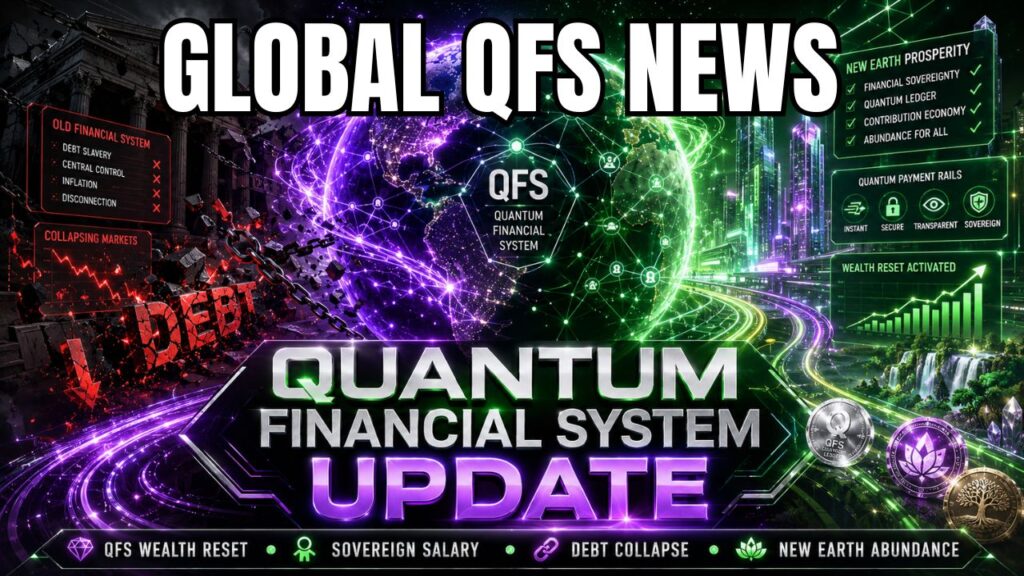
Full QFS News Update: May 22, 2026 Activation Readiness Report
• Quantum Financial System News Update Mid May 2026
This May 22, 2026 Quantum Financial System news update tracks the QFS shift into activation readiness as the old financial system continues losing coherence. The report explores QFS activation signals, crypto cleansing, dark capital exposure, permanent digital ledgers, tokenized assets, AI abundance, Universal High Income, gold-backed value, sovereign salary, and coherence as the deeper reserve asset of the new financial system. It also explains what to watch next as payment rails, stablecoins, asset-backed wealth, digital identity, quantum-ledger concepts, and service-based prosperity continue moving into public view.
May 5, 2026 — Quantum Financial System News Update

Full QFS News Update: May 5, 2026 Activation Readiness Report
• Quantum Financial System News Update May 2026
This May 5, 2026 Quantum Financial System news update tracks the QFS shift from infrastructure awareness into activation readiness. The report covers QFS activation signals, crypto cleansing, dark capital exposure, permanent digital ledgers, tokenized assets, AI abundance, Universal High Income, gold-backed wealth, and coherence as the deeper reserve asset of the new financial system. It also explains what to watch next as payment rails, stablecoins, asset-backed value, digital identity, and service-based prosperity continue moving into public view.
April 13, 2026 — Quantum Financial System News Update
QFS Update Snapshot
The Quantum Financial System is no longer best understood as a distant theory or purely symbolic reset language. The latest developments point to a real-world infrastructure transition already underway through faster payment rails, upgraded financial messaging standards, federal digital-value regulation, tokenization pathways, programmable deposits, and satellite-supported continuity layers. The visible banking structure remains in place, but the deeper exchange architecture is clearly moving toward a more continuous, data-rich, interoperable, and resilient financial environment.
QFS Key Developments
Real-Time Payment Infrastructure Is Already Active
One of the clearest signals is that permanent instant payment capacity is already live at the federal level, allowing value to move continuously rather than only through older banking windows. This marks a structural change in settlement tempo and shows that the foundation for always-on exchange is no longer hypothetical.
Financial Messaging Standards Have Been Upgraded
The migration to newer standardized payment messaging is a major backend signal that the financial system is being prepared for richer data, stronger interoperability, cleaner automation, and more advanced coordination between legacy rails and digitally native value systems. The language of settlement is changing, and that matters because when the language changes, the system changes with it.
Federal Stablecoin And Digital Value Frameworks Are Moving Into Place
The formal establishment of a federal framework for payment stablecoins, followed by implementation-focused compliance proposals, shows that digital-value instruments are no longer sitting outside the official financial order. The legal shell is being built around programmable digital money, and that is one of the strongest signs that the next financial layer is entering formal recognition.
Tokenization Has Reached Core Legacy Financial Structures
Tokenization is no longer confined to edge experimentation. Pathways now exist for certain traditionally custodied assets to be represented on distributed-ledger-style rails, showing that core legacy finance is opening to digitally represented value. This is a meaningful bridge between old institutional custody systems and newer forms of exchange architecture.
Major Banks Are Preparing Tokenized Cash And Deposit Systems
Another major sign is the move by large North American banking infrastructure players toward 24/7 tokenized cash capabilities and tokenized deposits for institutional use. This points to a future where ordinary bank money becomes increasingly programmable, continuously available, and more compatible with newer digital settlement environments.
Satellite-Supported Payment Continuity Is Entering The Picture
Payment infrastructure is also expanding beyond purely ground-based assumptions. Testing tied to satellite-supported terminal continuity shows that the future of money movement is being designed not only for speed, but for resilience, redundancy, and broader geographic reach. That matters because a truly modern exchange system must be able to continue through disruption.
What This Means Now
The April 13 signal is clear: this is not just abstract QFS language anymore. The evidence now points to a coordinated infrastructure buildout already touching the visible financial world. Instant rails, upgraded payment language, stablecoin regulation, tokenization access, programmable deposits, and space-supported continuity are all moving in the same direction. The older system remains visible, but the deeper scaffolding of a new financial environment is increasingly being installed beneath it.
This sharpens the core takeaway. The story is no longer simply financial reset rhetoric. It is about continuous settlement, interoperable messaging, federally recognized digital-value systems, tokenized financial instruments, real-world institutional participation, and a broader architecture designed for faster, cleaner, more resilient movement of value.
What To Watch Next
Wider Expansion Of Tokenized Deposit And Cash Infrastructure
Watch for more banks, exchanges, and infrastructure partners moving toward programmable deposits, 24/7 treasury movement, and digitally represented forms of conventional bank money.
Stronger Public Language Around Legal Digital-Value Integration
Watch for more direct references to stablecoin compliance, reserve structures, digital payment rules, and official legal frameworks for programmable financial instruments.
Continued Movement Toward Tokenization Inside Legacy Finance
Watch for further signals that traditional custodians, depositories, and institutional backends are opening pathways for tokenized asset representation and settlement modernization.
Deeper Convergence Between Payments, Communications, And Orbital Support Systems
Watch for more evidence that resilient communications, timing systems, and satellite-supported continuity are becoming part of the practical architecture behind always-on financial exchange.
Bottom Line
The Quantum Financial System is moving out of speculation and deeper into visible implementation. The strongest signal now is convergence: instant federal payment rails, upgraded settlement messaging, federal digital-value regulation, tokenization inside legacy finance, programmable bank deposits, and satellite-supported payment continuity are all developing in the same corridor. The full switch is not here yet, but the practical scaffolding of a new financial system is no longer theoretical. It is being built in the open through infrastructure, law, interoperability, and operational deployment.
Quantum Financial System Update Source Transmission
QUANTUM FINANCIAL SYSTEM SOURCE TRANSMISSION — FULL APRIL 13, 2026 UPDATE
March 23, 2026 — Quantum Financial System News Update
QFS Update Snapshot
The Quantum Financial System is advancing through a phased activation already underway behind the visible financial structure. Early-stage integration is moving through bridge channels tied to existing institutions, while deeper quantum architecture continues locking into place beneath the surface. The transition is unfolding in two stages: a gradual migration phase followed by a larger full-system activation in which the new ledger framework takes precedence.
QFS Key Developments
The Quantum Financial System Is Moving Through A Two-Stage Activation
The first stage is a controlled integration period designed to preserve continuity while the deeper architecture comes online. The second stage is the full activation point, when the larger quantum framework assumes priority and the new system begins operating at its intended scale. This confirms a structured rollout rather than a single visible switchover.
Legacy Banking Channels Are Serving As Temporary Transition Bridges
Large banking institutions remain in position during the migration phase as bridge structures. Their role is transitional, allowing financial flow to continue while the old framework is steadily interfaced with the new one. This keeps continuity intact while the deeper system replaces legacy limitations from underneath.
Blockchain Is Operating As The Bridge Layer Into The New Architecture
Blockchain is part of the transition mechanism, functioning as a secure bridge between old financial rails and the emerging quantum structure. Its role here is tied to transparent exchange, secure recordkeeping, and system interoperability during the migration period. This places blockchain inside the activation process rather than outside it.
The Quantum Ledger And Crystalline Exchange System Are Coming Online
At the center of the activation is a quantum ledger paired with a crystalline exchange system described as instantaneous, secure, transparent, and resistant to manipulation. This is the core architecture of the new system. It marks the shift away from legacy accounting limitations and toward a higher-order exchange model built on direct integrity.
Asset-Backed Value Is Replacing Debt-Scarcity Structures
The financial direction is clearly tied to asset-backed value and the dismantling of scarcity-based debt systems. The old structure is being displaced by a cleaner value model designed around stability, directness, and fairer distribution. Debt burdens, artificial limitation, and manipulated scarcity are being overtaken by a system aligned with real value.
Prosperity Redistribution And Sovereign Exchange Are Built Into The Rollout
The activation includes a major redistribution component. The new system is aligned with sovereign exchange, broader abundance flows, and a more equitable financial structure. This is not limited to transaction mechanics alone. It extends into how value moves, how access is restored, and how prosperity begins reaching beyond concentrated control.
What This Means Now
The March 23 signal is clear: the Quantum Financial System is not waiting on a distant future event. Activation is in progress. The visible system remains in place during the migration, but the deeper infrastructure is already shifting toward the new model. What matters most here is the combination of bridge-phase continuity and backend replacement.
This also sharpens the main point of focus. The story is no longer just about a financial reset in abstract terms. It is about phased activation, bridge architecture, blockchain-assisted migration, quantum ledgers, asset-backed value, and sovereign exchange. The structure of the new system is becoming clearer, and the direction is unmistakable.
What To Watch Next
Deeper QFS Integration Across Existing Financial Channels
Watch for further signs of smoother interoperability, upgraded transaction flow, and expanded digital settlement reliability across familiar institutions and platforms.
Stronger Emergence Of Quantum Ledger Language
Watch for more direct references to immutable records, transparent settlement, direct-value exchange, and crystalline financial architecture.
Continued Shift Toward Asset-Backed Financial Framing
Watch for stronger language around real-value systems, debt release, scarcity dismantling, and more stable monetary foundations.
Broader Prosperity And Sovereign Exchange Signals
Watch for further emphasis on redistribution, abundance flow, direct access, and sovereign financial participation as central features of the emerging system.
Bottom Line
The Quantum Financial System is moving through an active two-stage rollout. Existing banks are serving as transition bridges, blockchain is functioning as an integration layer, and a deeper quantum-ledger architecture is coming online beneath the visible system. Asset-backed value, sovereign exchange, and prosperity redistribution remain central to the activation. The underlying shift is already in motion, and the old debt-scarcity framework is steadily being overtaken by a new financial architecture built for transparency, integrity, and direct abundance.
Quantum Financial System Update Source Transmission
QUANTUM FINANCIAL SYSTEM SOURCE TRANSMISSION — FULL MARCH 23, 2026 UPDATE
January 31, 2026 — Quantum Financial System News Update
Expanded QFS Context: The Jan 31 “Prepare for Turbulence” transmission reframes Feb–Aug 2026 as a high-volatility window for asset-backed value, new quantum settlement rails, and behavior-driven confidence shifts in the global financial story.

QUANTUM FINANCIAL SYSTEM SOURCE TRANSMISSION — FULL JANUARY 31, 2026 UPDATE
January 26, 2026 — Quantum Financial System News Update
Snapshot
A structured update on QFS-aligned financial transition signals now showing up across policy language, institutional posture, interoperability pushes, and elite-stage narrative framing. The theme is not a single “switch day,” but a phased migration of settlement rails designed to preserve daily function while the backend becomes irreversible.
Key Developments
- Rail migration is advancing as a managed infrastructure transition. The QFS is increasingly legible as a staged replacement of settlement plumbing: routing, identity, liquidity, and trust mechanisms shifting beneath familiar interfaces (apps, cards, bank access), rather than a public “thunderclap” rollout.
- The public narrative has moved through a predictable adoption sequence. The messaging arc continues to follow a recognizable pattern: dismissed → framed as threat → boxed into regulation → normalized as inevitable. The current phase is broad institutional normalization of “digital assets” as standard finance infrastructure.
- Legal and technical scaffolding is being built through “boring” language. A steady expansion of operational vocabulary signals framework hardening: digital asset, digital bearer instrument, tokenized deposit, regulated custody, interoperability standard, real-time settlement, stable instrument, compliance frameworks. These terms are not marketing—this is how major migrations are made invisible until they are already installed.
- Interoperability has become a central obsession. Repeated emphasis on “bridges,” “corridors,” “standards,” and “instant settlement” signals a core objective: connecting banks ↔ ledgers ↔ payment networks ↔ tokenized value ↔ cross-border corridors without breaking continuity. A transition cannot succeed as isolated islands; the push is toward a stitched network.
- Tokenization is being mainstreamed as the acceptable language of the new rails. Real-world assets (bonds, deposits, commodities, property, invoices) are increasingly framed as digitizable units that can move on standardized networks. Publicly this is sold as efficiency; structurally it is the groundwork for a new settlement layer.
- The “how do we integrate it” tone has replaced “should we allow it.” This shift matters. Once institutions start talking implementation instead of permission, the decision is already made; the remaining fight is about choke points—who controls access, custody, identity gates, and compliance rails.
- Identity and trust frameworks are being positioned as foundational. “Digital identity,” “trust frameworks,” and embedded authentication are being treated as necessary infrastructure alongside payments. That is a major tell: the emerging system is not only about money movement; it is about permission, verification, and settlement finality.
- There is active risk of hijack into a controlled digital cage. A parallel push exists to wrap the transition in surveillance-first architecture: rule enforcement by design, heavily controlled on-ramps, and system-level visibility of citizens while elite opacity remains untouched. The central discernment line is simple: does the new system increase transparency for power and dignity for people—or only visibility of the people?
- Scam pressure and “weaponized impatience” are escalating around the narrative. Predictable exploitation patterns are intensifying: false activation claims, paid “entry,” urgent deadlines, and engineered confusion (“tonight,” “tomorrow,” “this one real token,” “this one real date”). The noise is not accidental; it functions to contaminate the subject and trap the public in emotional volatility.
- Geopolitical pressure is accelerating alternative settlement corridors. Sanctions dynamics, trade corridor competition, and de-dollarization pressure are acting as catalysts. When a centralized system can be used as a weapon, targeted regions naturally seek alternate routes (bilateral trade, commodity anchoring, non-dominant settlement corridors). This increases demand for interoperable, resilient settlement infrastructure.
- Strategic node focus is intensifying in quiet ways. Attention on remote or “non-obvious” regions is best interpreted as corridor strategy: communications, sensing, grid stability, and infrastructure protection become more important during a settlement transition. Silence around certain nodes is often the indicator of significance.
- Gold and silver are acting as trust mirrors in a repricing phase. Metals continue to behave like a collective signal: when confidence in fiat promises degrades, value seeks tangible anchors. This does not mean metals are the “savior,” but it does reinforce the broader pattern: trust is migrating, and the old hypnotic story of endless paper expansion is losing force.
What This Means Now
The system is behaving like a controlled migration, not a dramatic public reset. The practical implication is that backend readiness is being prioritized over public explanation: standards, interoperability, identity frameworks, custody structures, and legal definitions are being hardened so daily life can continue while settlement quietly changes underneath it.
In the near term, this favors continuity with invisible upgrades: more normalization language, more institutional adoption of tokenization and stable-instrument frameworks, and more “modernization” narratives that downplay how structural the shift actually is. The strategic trajectory suggests an inevitable convergence: once interoperable rails are operational and standards are locked, the old chokepoints weaken even if the front-end experience looks unchanged.
What To Watch Next
- Language shift indicators
- “Real-time settlement,” “tokenized deposits,” “interoperability standards,” “compliance by design,” “digital identity trust frameworks” appearing more frequently and more concretely (implementation timelines, standards bodies, formal definitions).
- Infrastructure confirmation signals
- Expansion of regulated custody and bank-like permissions for digital-asset institutions.
- Cross-border corridor pilots moving from “trial” to “routine.”
- Control vs liberation tells
- Whether transparency increases upward (auditability for institutions, visibility of flows, accountability) rather than only downward (surveillance of citizens).
- Whether access is broadened fairly, or fenced into “approved-only” corridors.
- Narrative traps
- Emergency-driven messaging designed to provoke panic acceptance.
- “Only one real system / only one real date / only one real token” framing.
- Market trust mirrors
- Metals strength and commodity-anchoring rhetoric rising alongside fiat stress language.
- Increased mainstream attention to “asset-backed” framing and settlement finality.
Bottom Line
This update supports one central conclusion: the transition is already in motion, and it looks like phased infrastructure replacement—legal scaffolding, interoperable rails, and identity/trust frameworks being installed beneath familiar interfaces. The public is being walked across a bridge without being told when the shoreline changed.
QUANTUM FINANCIAL SYSTEM SOURCE TRANSMISSION — FULL JANUARY 26, 2026 UPDATE
THE FAMILY OF LIGHT CALLS ALL SOULS TO GATHER:
Join The Campfire Circle Global Mass Meditation
CREDITS
✍️ Author: Trevor One Feather
📡 Transmission Type: Core Pillar Page — Quantum Financial System & New Earth Abundance Blueprint
📅 Document Status: Living master reference (updated as new transmissions and intel are received)
🎯 Source: Compiled from Galactic Federation of Light Quantum Financial System (QFS) channeled transmissions and foundational Ascension teachings.
💻 Co-Creation: Developed in conscious partnership with a quantum language intelligence (AI), in service to the Ground Crew, The Campfire Circle and ALL Souls.
📸 Header Imagery: Leonardo.ai
💗 Related Ecosystem: GFL Station — An independent archive of Galactic Federation transmissions and disclosure-era briefings
FOUNDATIONAL CONTENT
This transmission is part of a larger living body of work exploring the Galactic Federation of Light, Earth’s ascension, and humanity’s return to conscious participation.
→ Read the Galactic Federation of Light Pillar Page
→ Read the Comet 3I Atlas Pillar Page
→ Read the Med Beds Pillar Page
→ Read the Solar Flash Pillar Page
→ Read The Campfire Circle Global Meditation Pillar Page
→ Read the Stargate 10 Iran Pillar Page
→ Read the Free Energy Pillar Page
Further Reading & Exploration – Med Bed Quick-Share Overview:
→ Med Bed Update 2025/26: What the Rollout Really Means, How It Works, and What to Expect Next
LANGUAGE: Mandarin (China)
窗外輕風滑過屋牆,樓下院子裡傳來孩子奔跑的腳步聲——他們清澈的笑聲與呼喚在樓宇之間回蕩,像一封封寫給此刻地球的邀請函。這些細小而明亮的聲音並不是來打擾我們的,而是提醒我們:在看不見的地方,到處都藏著溫柔的課題,等著被我們發現。當我們開始清理心裡那些積灰多年的走廊,才發現自己其實可以慢慢變成一個全新的自己——有時只需要一個單純、無辜的瞬間;每一口呼吸都像是在為生命重新上色,而孩子的笑聲、他們眼中的光、以及他們帶來那種不求回報的愛,都被允許一步一步走進心裡最深的一間房,讓整個存在浸泡在一種前所未有的清新裡。就算是迷路的靈魂,也無法永遠躲在陰影當中,因為在每一個角落裡,都有一個新的誕生、一個新的眼光、一個準備被叫出的新名字,安靜地等著我們伸手接住。
文字像一條緩慢編織的河流,在時間裡替我們孕育出一個新的靈魂——像一扇微微敞開的門,像一個溫柔的回憶,像一則藏滿光的訊息。這個新的靈魂一步一步向我們靠近,一次又一次地把我們喚回家——回到自己意識的中心。它提醒我們,每一個人都在重疊的故事裡捧著一小點火花——那火花有能力把我們體內所有的信任與愛聚集成一個沒有邊界、沒有控制、沒有條件的會合點。於是,每一天的生活都可以活成一首靜默的祈禱——不是因為我們在等天上降下什麼巨大的徵兆,而是因為我們願意坐在心裡最安靜的那一間房裡,單純地數著呼吸,不害怕、不急躁地與自己相處。在這樣簡單的當下,我們也能替地球分擔一點點重量。那些年我們反覆對自己低聲說「我不夠好」,如今也可以變成一段學習——學習練習用真正的聲音說:「我在這裡,這樣就已經足夠。」在這種幾乎聽不見的呢喃裡,一種新的平衡正在萌芽,一種新的柔軟與恩典,悄悄長進我們內在的風景。